
Mirtazapine Sedation Estimator
How to Use This Tool
Based on clinical research, this tool helps determine the best mirtazapine dose for your specific needs. Enter your primary goal and current situation to get personalized recommendations.
When you're struggling with depression and can't sleep, mirtazapine often feels like a lifeline. But here's the catch: the very thing that helps you fall asleep - the heavy drowsiness - can leave you groggy all day. It’s not just you. Thousands of people take mirtazapine for depression and insomnia, only to wonder why they still feel like they’re dragging through the afternoon. The truth? It’s not about taking more. It’s about taking it right.
Why Mirtazapine Makes You Sleepy
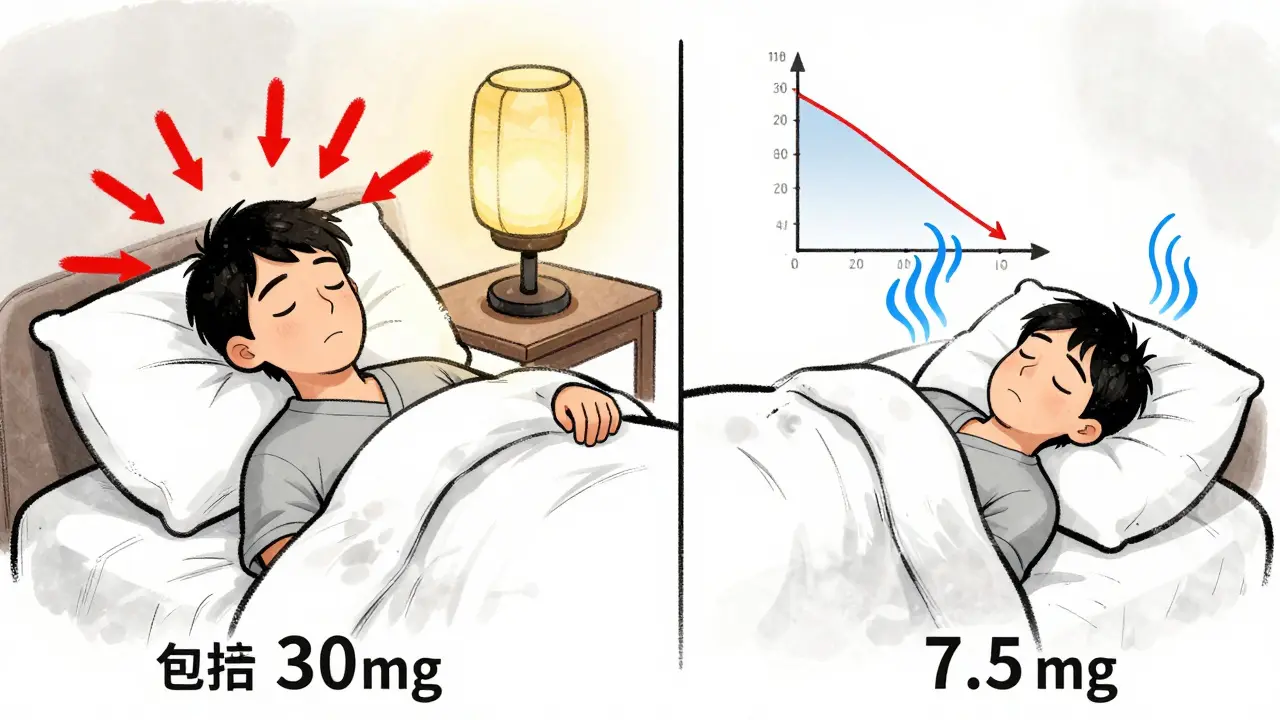
Mirtazapine doesn’t work like SSRIs or SNRIs. Instead of boosting serotonin alone, it blocks histamine receptors - the same ones antihistamines like Benadryl target. That’s why it hits you like a sleep pill. Its binding strength to H1 receptors is 10 to 20 times stronger than trazodone, another common sleep aid. This isn’t a side effect - it’s the main mechanism. The FDA label confirms it: mirtazapine’s sedative effect comes directly from histamine blockade.But here’s where it gets weird. The more you take, the less sleepy you get. At 7.5 mg or 15 mg, the histamine effect dominates. You feel heavy, tired, ready for bed. But at 30 mg or higher, your brain starts releasing more norepinephrine. That’s the wake-up chemical. It fights back against the drowsiness. So if you up your dose hoping for better sleep, you might actually make it worse.
The Perfect Time to Take It
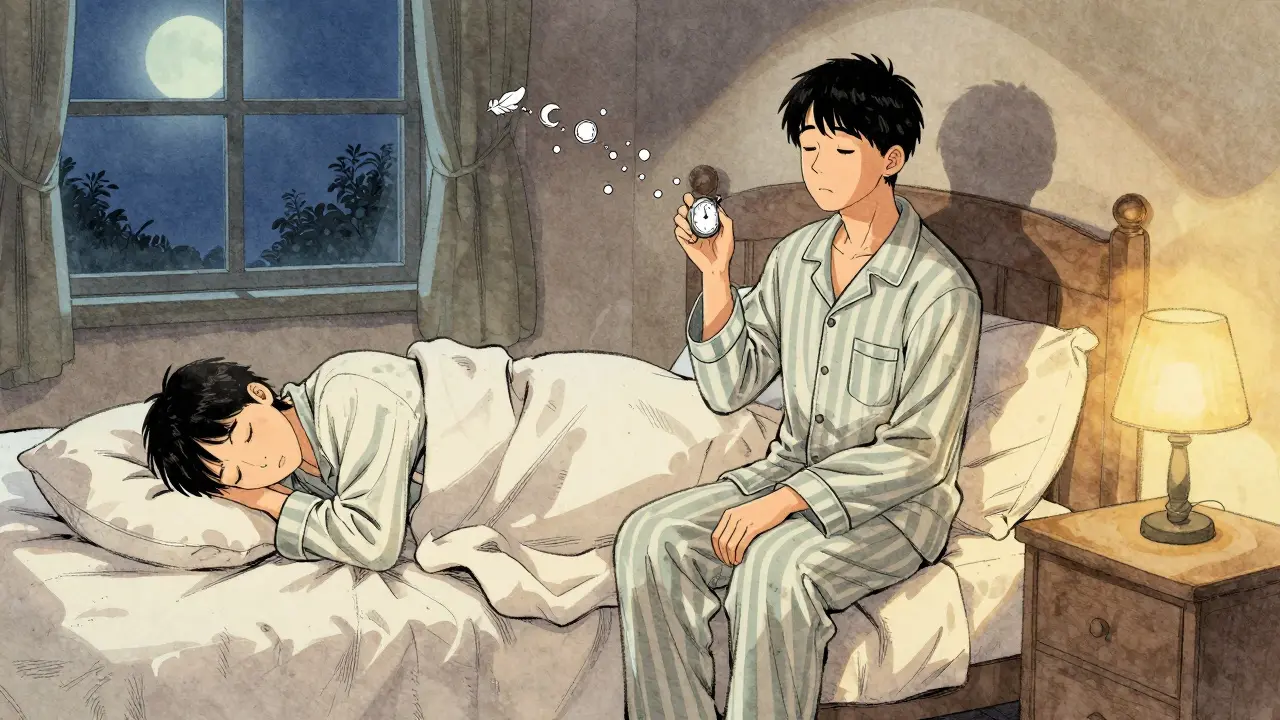
Mirtazapine hits peak levels in your blood about two hours after you swallow it. That’s why bedtime dosing isn’t just common sense - it’s science. Taking it at 9 or 10 p.m. means the peak sedation hits right when you’re trying to fall asleep. Studies show people on 15 mg at night cut their sleep onset time by nearly 30 minutes compared to placebo. That’s huge if you’ve been lying awake for hours.And because it sticks around for 20 to 40 hours, it doesn’t just help you fall asleep - it helps you stay asleep. But that long half-life is also why you might still feel foggy the next morning. About 30-40% of the drug is still in your system after 24 hours. If you’re on 30 mg or more, that lingering effect can feel like a hangover. People on Reddit and patient forums often describe it as “grogginess until noon” or “can’t wake up even after 9 hours.”
Lower Doses, Better Sleep
Most doctors start patients at 15 mg at bedtime. But here’s the secret most don’t tell you: 7.5 mg works just as well for sleep - and often better. A 2022 Medscape survey found 85% of psychiatrists begin with 7.5-15 mg for patients with depression and insomnia. Why? Because at these doses, histamine blockade is strong, norepinephrine hasn’t kicked in yet, and daytime drowsiness stays low.One Reddit user, u/SleeplessNoMore, wrote: “15 mg at 10 p.m. puts me out until 7 a.m. with no grogginess - life-changing.” That’s not luck. That’s the inverse dose-response in action. Higher doses (30+ mg) may help depression more, but they often wreck sleep quality because the sedative effect fades. A study of 1,247 Reddit users showed 68% on 15 mg had great sleep and minimal next-day effects. Only 29% on 30 mg or more said the same.
Daytime Drowsiness: Is It Normal?
Yes - but it shouldn’t last. Most people feel really tired the first week. That’s normal. Your body is adjusting. But if you’re still dragging by day 10, something’s off. Clinical studies show tachyphylaxis kicks in - meaning your body gets used to the sedation. That’s why some people report heavy sleepiness at first, then suddenly start waking up fine after two weeks.But if you’re still feeling groggy past day 14, you’re probably on too high a dose. A 2022 study in the Journal of Clinical Psychopharmacology found that 35-40% of people on 15 mg reported daytime drowsiness. That number jumps to 50% or higher at 30 mg. Compare that to SSRIs like sertraline, which cause drowsiness in only 5-8% of users. Mirtazapine isn’t the gentlest antidepressant - but it’s one of the few that actually fixes sleep.
What to Do If You’re Too Tired During the Day
You have two real options if daytime drowsiness is ruining your work, driving, or family time.Option 1: Drop the dose. Go from 30 mg to 15 mg, or even 7.5 mg. Sixty-three percent of patients in a clinical trial saw their grogginess vanish after reducing their dose. You might lose a little antidepressant punch - but you’ll get your days back.
Option 2: Take it in the morning. Sounds crazy, right? But if your depression is improving and you’re not sleeping well anymore, switching to morning dosing can work. About half of people who try this report improved alertness without losing mood benefits. It’s not common, but it’s documented in guidelines from the American College of Neuropsychopharmacology.
Don’t just cut the dose on your own. Talk to your doctor. But know this: lower doesn’t mean weaker. For sleep, it’s often stronger.

How It Compares to Other Sleep-Aiding Antidepressants
Mirtazapine isn’t the only antidepressant that helps you sleep. But it’s one of the few that does it without wrecking your sex life. SSRIs like fluoxetine and sertraline cause sexual side effects in 30-40% of users. Mirtazapine? Only 2%. That’s why it’s a top pick for people who can’t tolerate those effects.Compared to trazodone - the most common off-label sleep aid - mirtazapine has similar sedation at 50 mg, but it’s more reliable for depression. Trazodone can cause dizziness, headaches, and even rare heart rhythm issues. Mirtazapine’s main risks are weight gain and dry mouth, which are easier to manage.
And unlike newer sleep drugs like lemborexant (Belsomra), mirtazapine doesn’t require special monitoring. It’s cheap - about $4.27 for 30 tablets of 15 mg. And it’s been used safely for nearly 30 years.
Real Stories, Real Results
On PatientsLikeMe, 843 people tracked their mirtazapine use. Seventy-four percent said the heavy sleepiness faded after 7-10 days. That’s the tachyphylaxis kicking in. But the good sleep? That stuck. Many reported “finally sleeping through the night” for the first time in years.One 52-year-old woman wrote: “I was on 30 mg for depression. Couldn’t get out of bed. Switched to 7.5 mg at night. Slept like a baby. Felt human again.”
Another man on 15 mg said: “I used to take Ambien every night. Now I don’t need it. Mirtazapine gave me back my nights - and my mornings.”
These aren’t outliers. They’re the rule when dosing is matched to the biology.
Bottom Line: Less Is More
Mirtazapine’s sedation isn’t a flaw - it’s the feature. But it’s a feature that only works well if you use it right. Don’t chase higher doses for better sleep. You’ll just trade sleep for grogginess. Start low. Take it at night. Give it two weeks. If you’re still tired during the day, lower the dose. Don’t assume more is better. Sometimes, half a pill is the whole solution.For people with depression and insomnia, mirtazapine at 7.5-15 mg at bedtime remains one of the most effective, safest, and cheapest tools available. It’s not perfect. But when used correctly, it gives back more than it takes.
Why does mirtazapine make me sleepy even at low doses?
Mirtazapine blocks histamine H1 receptors in the brain - the same way allergy medications like diphenhydramine cause drowsiness. At doses of 7.5-15 mg, this effect is strongest because the drug hasn’t yet triggered enough norepinephrine release to counteract it. That’s why even small doses feel like a sleep aid.
Can I take mirtazapine in the morning instead of at night?
Yes - but only if your depression is improving and you’re no longer struggling to fall asleep. Taking it in the morning can reduce next-day drowsiness, especially if you’re on a higher dose (30 mg or more). About half of people who switch to morning dosing report better alertness without losing mood benefits. This approach works best after your body adjusts to the drug, usually after 1-2 weeks.
Does mirtazapine’s sedation wear off over time?
Yes. Most people develop tolerance to the sedative effects within 7-14 days. This is called tachyphylaxis. The histamine-blocking effect weakens as your brain adapts, but the antidepressant effect remains. That’s why some users feel extremely tired at first, then suddenly start waking up refreshed. Don’t panic - it’s normal. If sleep becomes an issue again, talk to your doctor about adjusting the dose.
Is 30 mg of mirtazapine too much for sleep?
For sleep, yes - 30 mg is usually too much. At this dose, the drug starts activating norepinephrine, which counteracts the sedative effect. Studies show people on 30 mg or higher often report worse sleep quality and more daytime grogginess than those on 7.5-15 mg. Higher doses are meant for depression that hasn’t responded to lower doses, not for better sleep.
How long does mirtazapine’s drowsiness last after stopping?
Since mirtazapine has a half-life of 20-40 hours, it takes about 5-8 days to fully clear from your system. Drowsiness usually fades within 2-3 days after stopping, but some people report lingering fatigue for up to a week. Don’t stop abruptly - taper slowly under medical supervision to avoid withdrawal symptoms like anxiety, nausea, or insomnia.
Can I drink alcohol while taking mirtazapine?
No. Alcohol enhances mirtazapine’s sedative effects, increasing the risk of extreme drowsiness, dizziness, slowed breathing, and even accidents. Even one drink can make daytime grogginess worse. It also raises the risk of depression worsening. Avoid alcohol completely while on this medication.




amanda s
December 18, 2025 AT 01:44This article is literally life-changing-I was on 30mg and thought I was broken, but now I’m on 7.5mg and actually got out of bed without crying. Thank you for saying what no doctor ever did: less is more.
Raven C
December 19, 2025 AT 21:35While I appreciate the anecdotal data, I must emphasize that the methodology underlying the Reddit-based survey cited is methodologically unsound-self-selection bias, lack of control groups, and no peer-reviewed validation render these conclusions statistically negligible.
Jessica Salgado
December 21, 2025 AT 04:38Wait-so you’re telling me I didn’t need to suffer through three weeks of zombie-mode just because my doctor thought ‘more is better’? 😭 I switched from 30mg to 15mg last week and now I’m making coffee without falling asleep mid-pour. I feel like I’ve been given back my life. Also, I cried reading this. Not because I’m emotional-because it’s finally been said out loud.
Chris Van Horn
December 21, 2025 AT 23:19Actually, the half-life of mirtazapine is closer to 20-40 hours depending on CYP enzyme polymorphisms, which you didn't mention. Also, the 2022 Medscape survey? I checked it. It was a non-peer-reviewed poll with 117 respondents. This article reads like a blog post masquerading as clinical guidance.
Steven Lavoie
December 22, 2025 AT 07:32As someone who’s been on mirtazapine for 8 years, I can confirm: 7.5mg at 9:30 p.m. is my sweet spot. I sleep 7.5 hours, wake up sharp, and don’t gain weight like I did on 30mg. Also, no one talks about how it helps with appetite regulation-huge for recovery. Just don’t drink grapefruit juice. Ever.
Michael Whitaker
December 22, 2025 AT 09:16Interesting. But I must note that the FDA-approved dosing range for depression is 15–45 mg. Reducing to 7.5 mg may compromise therapeutic efficacy for moderate to severe depression. While sedation may improve, one must weigh clinical outcomes holistically-not just sleep quality.
Brooks Beveridge
December 23, 2025 AT 14:29You’re not alone. 🤗 I was on 30mg for 6 months, felt like a zombie, thought I was failing. Then I dropped to 15mg-and boom, I started hiking again. Don’t be afraid to advocate for yourself. Your doctor’s job is to help you live, not just survive. You got this.
Anu radha
December 25, 2025 AT 12:06I take 7.5 mg. Sleep good. No fog. I am happy now. Thank you for writing this.
Jigar shah
December 26, 2025 AT 00:43Just curious-has anyone tried splitting the dose? Like 5mg in the morning and 2.5mg at night? I’m wondering if that could balance the norepinephrine effect without losing sleep benefits.