
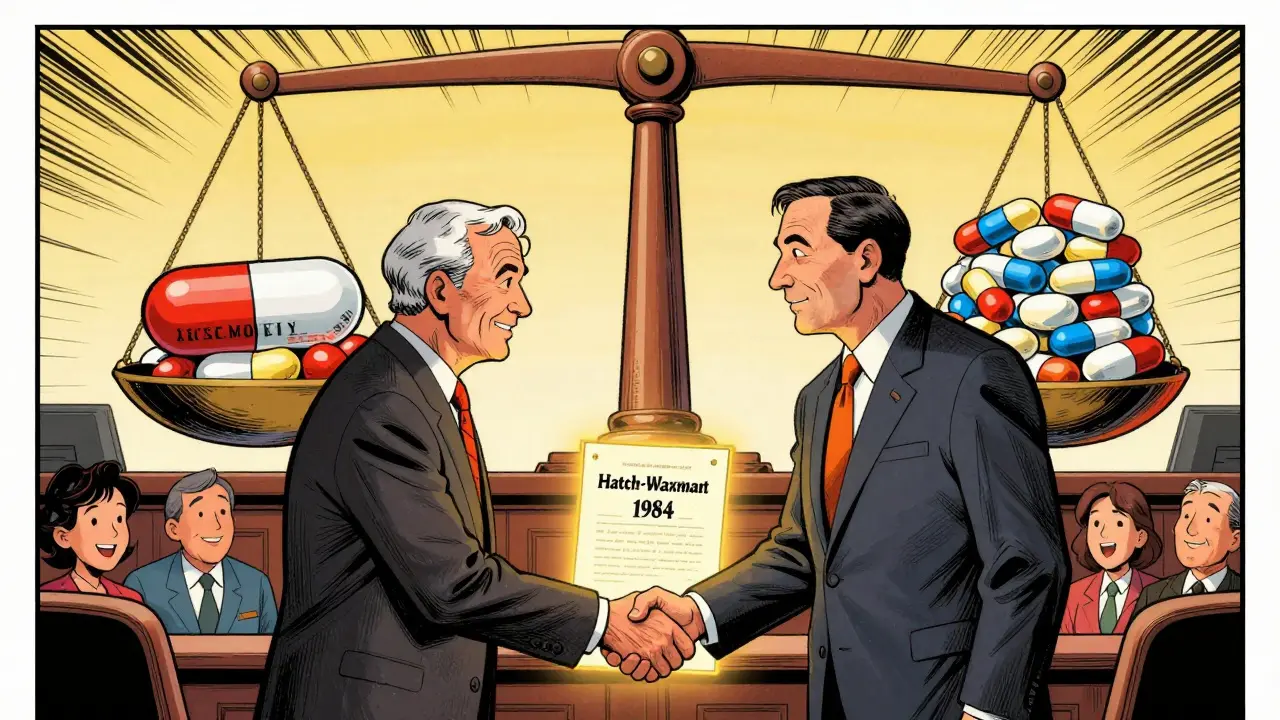
The U.S. generic drug market didn’t just happen. Before 1984, if you needed a cheaper version of a brand-name medicine, you were out of luck. The system was stacked against copycats. Generic manufacturers had to run full clinical trials - just like the original drug maker - even though the chemical was identical. That meant years of delays and millions in costs. Most never tried. By 1983, only about 19% of prescriptions filled in the U.S. were for generics. The rest? Brand-name drugs, often at full price.
What the Hatch-Waxman Act Actually Did
The Drug Price Competition and Patent Term Restoration Act of 1984 - better known as the Hatch-Waxman Amendments - changed all that. It didn’t just tweak the system. It rebuilt it. The law was named after its two sponsors: Senator Orrin Hatch and Representative Henry Waxman. One was a Republican from Utah, the other a Democrat from California. They didn’t agree on much. But they both saw the problem: patients were paying too much, and innovation was being stifled by legal loopholes.
The law had two big goals. First, make it faster and cheaper to bring generic drugs to market. Second, give brand-name companies extra patent time to make up for the years they lost waiting for FDA approval. It was a trade. A compromise. And it worked.
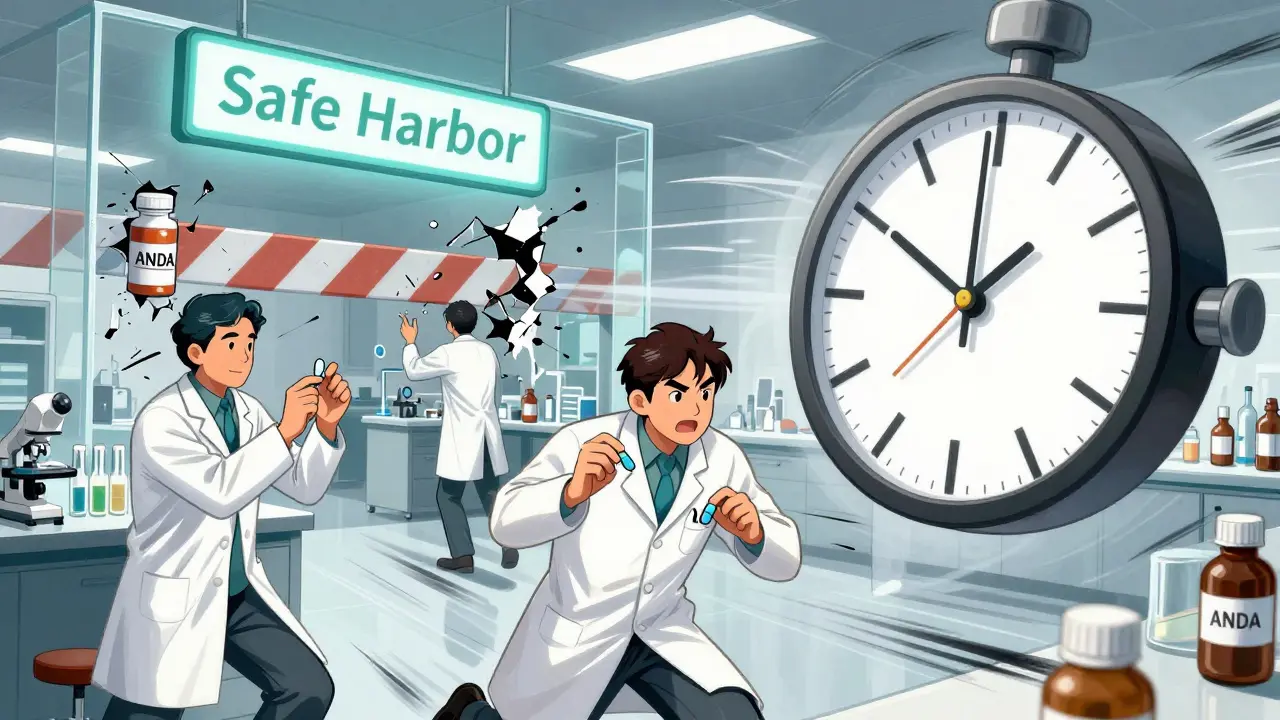
Before Hatch-Waxman, generic companies couldn’t even start testing their version of a drug until the patent expired. A 1984 court case, Roche v. Bolar, made it clear: any testing before patent expiration was illegal. That meant patients waited years longer than necessary. Hatch-Waxman fixed that with something called the safe harbor provision. It said: if you’re testing a drug to get FDA approval, you’re not breaking the patent. Just as long as it’s for regulatory purposes. That single change let generic makers start preparing years in advance.
The ANDA: The Secret Weapon Behind Generic Drugs
The real game-changer was the Abbreviated New Drug Application, or ANDA. Before 1984, generics had to prove safety and effectiveness from scratch. Now, they just had to prove they were bioequivalent - meaning they worked the same way in the body as the brand-name drug. No need for new clinical trials. No need to re-prove what the FDA already knew.
This cut development costs by 80 to 90%. It turned generic drug development from a risky, expensive gamble into a predictable business. Suddenly, companies could invest in generics without betting millions on unproven science. The result? More options. Lower prices. Faster access.
Today, more than 90% of all prescriptions in the U.S. are filled with generic drugs. And they cost 80 to 85% less than the brand-name versions. That’s not luck. That’s Hatch-Waxman.
Patent Games: The Orange Book and Paragraph IV
But the law didn’t just help generics. It gave brand-name companies tools to protect their investments too. One of those tools is the Orange Book. Officially called the Approved Drug Products with Therapeutic Equivalence Evaluations, it’s a public list of all approved drugs and their patents. If you’re making a generic, you have to check this book. And then you have to say how you’re dealing with those patents.
There are four ways to respond. The most important is called a Paragraph IV certification. That’s when a generic company says: “Your patent is invalid, or we’re not breaking it.” This is a direct challenge. And it’s risky. If the brand-name company sues, the FDA can’t approve the generic for up to 30 months.
But here’s the twist: the first generic company to file a Paragraph IV gets a 180-day exclusivity period. No other generic can enter the market during that time. That’s a huge reward. It means the first filer can charge lower prices than the brand - but still higher than everyone else. That’s why companies race to be first. Some even file on the same day, hoping to share the prize. The FDA now says if multiple companies file on the same day, they split the exclusivity.
The Trade-Off: Innovation vs. Access
Hatch-Waxman was supposed to balance two things: encouraging new drugs and making old ones affordable. And for a long time, it did. Brand-name companies got extra patent time - up to five years - to make up for delays in FDA review. That gave them more time to recoup R&D costs. Meanwhile, generics flooded the market.
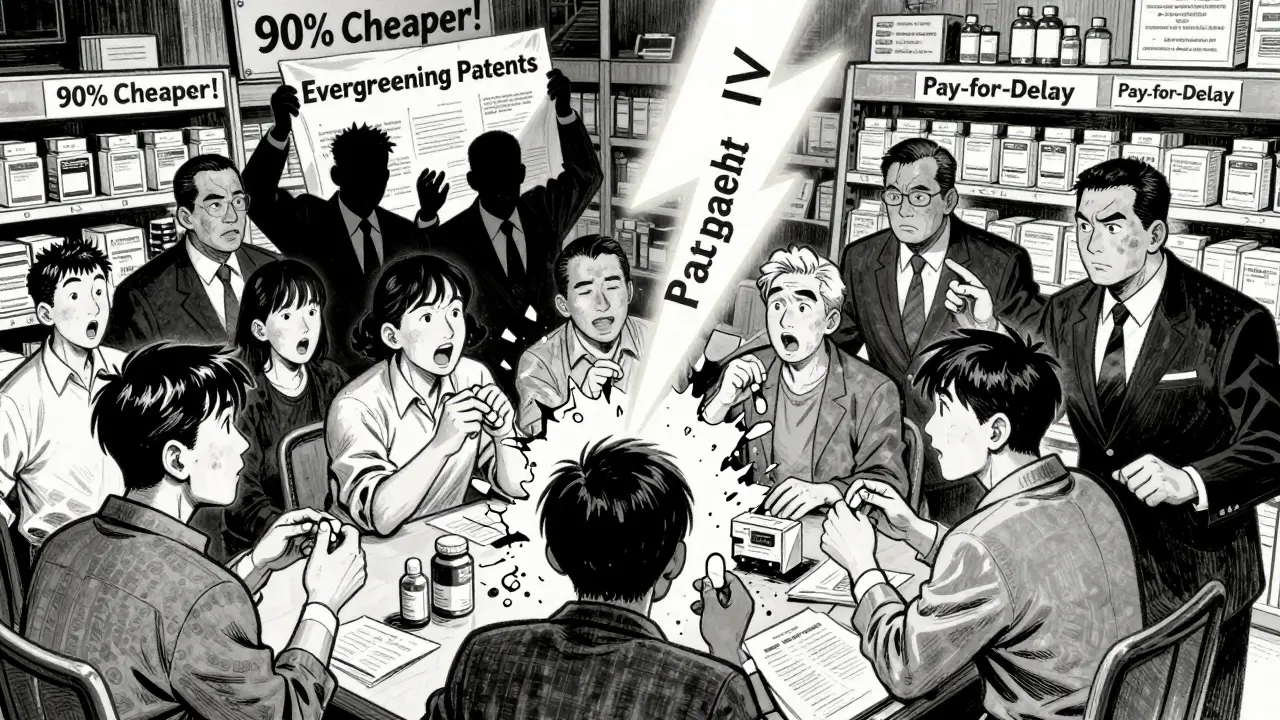
But over time, the balance started to tilt. Brand-name companies learned to game the system. They started filing dozens of patents on minor changes - new coatings, new dosages, new delivery methods - just to keep generics out. This is called “evergreening.” It’s legal. But it’s not what Hatch and Waxman intended.
Then there’s “pay-for-delay.” That’s when a brand-name company pays a generic maker to stay off the market. The FTC found 668 of these deals between 1999 and 2012. They estimate those deals cost consumers $35 billion a year. It’s not competition. It’s collusion. And it’s still happening, even though courts have started cracking down.
The law also created regulatory exclusivity periods - five years for new chemical entities, three for new uses. That’s fine. But sometimes, companies use these to block generics even after patents expire. The FDA has tried to close loopholes, but the system is still full of gray areas.
What’s Changed Since 1984
The law hasn’t stayed the same. In 2012, Congress passed the Generic Drug User Fee Amendments (GDUFA). It gave the FDA money to hire more reviewers. Before GDUFA, it took an average of 30 months to approve a generic. By 2022, that dropped to under 12 months. The backlog cleared. More generics hit the shelves faster.
In 2003, the Medicare Prescription Drug Act added new rules for how generics are priced under Medicare Part D. In 1997, the Better Pharmaceuticals for Children Act gave extra exclusivity to companies that tested drugs in kids. These weren’t changes to the core of Hatch-Waxman. They were refinements.
Today, over 10,000 generic drugs are available in the U.S. That’s up from just a few hundred in 1984. The generic industry is worth billions. It employs tens of thousands. And it saves patients and the healthcare system tens of billions every year.
Is the Law Still Working?
Ask a patient who pays $5 for a generic blood pressure pill instead of $300 for the brand - and they’ll say yes. Ask a researcher who’s trying to develop a new cancer drug and sees patents stacked like bricks - and they might say no.
Some experts argue that Hatch-Waxman’s original promise is broken. That the system now protects monopolies more than it promotes competition. Others say it’s still the best thing we’ve got. Without it, we wouldn’t have the generic drug industry at all.
The truth? It’s a living law. It works - but it’s being stretched. The 180-day exclusivity period? Still powerful. The Paragraph IV challenge? Still risky. The safe harbor? Still essential. The Orange Book? Still confusing.
Legislators are trying to fix it. In 2023, the Preserve Access to Affordable Generics and Biosimilars Act was introduced to crack down on pay-for-delay deals. The FTC keeps pushing for more transparency. The FDA keeps updating its guidance.
But the foundation remains. Hatch-Waxman didn’t just change how drugs are approved. It changed how we think about medicine. It said: access matters. Innovation matters. And if you can’t balance both, you’re not serving patients.
Today, when you pick up a bottle of generic ibuprofen, you’re holding the result of a political compromise made 40 years ago. It wasn’t perfect. It still isn’t. But it saved lives. And it’s still doing it - every day.



Todd Scott
December 28, 2025 AT 05:09The Hatch-Waxman Act was one of those rare legislative miracles - a true win-win that actually worked. Before 1984, if you wanted a generic, you were basically begging for mercy from Big Pharma. Now? You walk into any pharmacy and grab a $4 bottle of lisinopril like it’s candy. That’s not magic. That’s policy done right. The ANDA process? Genius. It didn’t weaken innovation - it redirected it. Companies stopped wasting years re-proving what was already known and started innovating on delivery systems, combination therapies, and pediatric formulations. The Orange Book? Annoying, yes - but necessary. Without it, we’d have chaos. The 180-day exclusivity? A little too juicy sometimes, but it’s the carrot that keeps the race going. And yes, pay-for-delay is disgusting - but it’s also proof that the system works so well that some will cheat to kill it. Hatch and Waxman didn’t just write a law. They built a bridge between profit and public health. And we’re still walking on it.
Nicola George
December 28, 2025 AT 10:40So let me get this straight - we invented a system that cut drug prices by 85%, and now we’re mad because the rich found loopholes to game it? 🤦♀️
That’s like blaming the chef because someone figured out how to steal the recipe and sell it at a yard sale. The law did its job. The players just got greedy. If you want to fix pay-for-delay, ban the damn payments. Don’t blame the architecture because the tenants started throwing money out the window.
Paula Alencar
December 28, 2025 AT 22:30It is imperative to acknowledge, with the utmost gravity, that the Hatch-Waxman Amendments represent not merely a regulatory adjustment, but a profound moral realignment in pharmaceutical policy. Prior to its enactment, the American healthcare system operated under a paradigm of exclusivity that prioritized corporate profit over patient survival. The introduction of the Abbreviated New Drug Application, while ostensibly procedural, functioned as a democratizing force - dismantling the monopoly of intellectual property when applied to life-sustaining compounds. The safe harbor provision, though technocratic in nature, embodied a humanitarian ethos: that the pursuit of therapeutic equivalence should not be criminalized. One cannot help but note the irony that the same entities who once lobbied fiercely against generic competition now rely on the very framework they opposed to extend monopolies through evergreening. This is not innovation - it is exploitation cloaked in legal semantics. The FDA’s subsequent reforms under GDUFA, while commendable, remain reactive rather than prophylactic. We must demand structural reform - not merely cosmetic corrections - lest we allow the spirit of Hatch-Waxman to be buried beneath layers of patent thickets and corporate indemnity.
Babe Addict
December 30, 2025 AT 09:30Look, if you’re gonna talk about Hatch-Waxman, you gotta understand the difference between a Paragraph IV certification and a 505(b)(2). Most people think it’s just ‘generic vs brand,’ but no - it’s a chess match with 37 pieces, half of which are hidden under the table. The 180-day exclusivity? That’s not a reward - it’s a market distortion engine. And don’t even get me started on the Orange Book’s ‘listing requirements’ - the FDA lets pharma dump every patent they can think of, even ones that cover the color of the pill. That’s not protection. That’s patent trolling with a stethoscope. And don’t tell me ‘it’s legal’ - legal doesn’t mean ethical. The system was designed to balance innovation and access. Now? It’s a casino where the house always wins - and the players are dying of hypertension because they can’t afford the $300 brand when the generic’s been stuck in regulatory purgatory for 18 months.
Elizabeth Ganak
December 31, 2025 AT 05:51i just took my generic metformin this morning and thought about how wild it is that we almost didn’t have this. like, imagine if you had to pay $200 for a pill that’s been around since the 60s. we’re so used to it now, we forget it wasn’t always this way. thanks to hatch-waxman, my grandma’s blood sugar is stable and she doesn’t have to choose between meds and groceries. that’s not policy - that’s dignity.
Kishor Raibole
January 1, 2026 AT 11:22It is a matter of profound regret that the American legislative apparatus, in its wisdom, chose to institutionalize the commodification of pharmaceuticals under the guise of public welfare. The Hatch-Waxman Amendments, while ostensibly promoting accessibility, have in fact entrenched a dual-tiered medical hierarchy - one in which the indigent are granted the remnants of innovation, while the affluent retain privileged access to branded formulations under the pretext of ‘therapeutic superiority.’ The so-called bioequivalence standard is a fallacy, a statistical mirage that ignores inter-individual pharmacokinetic variance. Moreover, the Paragraph IV certification regime incentivizes litigation over collaboration, transforming the FDA into an arbiter of corporate warfare. The 180-day exclusivity period, far from being a boon, is a cynical manipulation of market dynamics, effectively creating a legal cartel for the first filer. One must question: Is this not a betrayal of the Hippocratic Oath, codified into statute? The law did not serve the patient - it served the shareholder.
Monika Naumann
January 1, 2026 AT 17:45India has been producing generic medicines for decades - long before Hatch-Waxman. We made them for Africa, for Latin America, for the poor of the world - without patents, without corporate handouts. Why did America need a law to do what a developing nation does out of moral necessity? This isn’t innovation. This is catching up. And now you’ve turned it into a legal battlefield. We gave the world medicine. You turned it into a lawsuit.
Andrew Gurung
January 2, 2026 AT 15:20Let’s be real - Hatch-Waxman was the moment Big Pharma said ‘okay fine, we’ll let you have the crumbs’ 😒
And now we’re all acting like it’s some noble compromise? Nah. It’s the corporate version of ‘I’ll give you the last slice of pizza if you promise not to ask for dessert.’
And don’t even get me started on the Orange Book - it’s basically a patent bingo card for lawyers. 🎲
Meanwhile, real patients are still choosing between insulin and rent. 🥲
So yeah, ‘it worked’ - for the stockholders. Not for the sick.
Raushan Richardson
January 4, 2026 AT 10:10My dad’s on a generic heart med that costs $3. He used to pay $400. He’s 72. He doesn’t care about patents or Paragraph IVs. He just wants to wake up. That’s what this law did - it turned ‘hope’ into ‘routine.’ And yeah, there are shady deals. But if you took Hatch-Waxman away tomorrow, he’d be back to choosing between pills and heat. So let’s fix the loopholes - not throw the whole system out. The foundation’s solid. We just need better maintenance.
Robyn Hays
January 5, 2026 AT 22:58There’s something quietly revolutionary about how this law turned pharmacology into a puzzle - not a prison. You’ve got this beautiful, clunky machine: patents as walls, ANDAs as keys, Paragraph IV as a lockpick, and the Orange Book as the map. And somehow, it works - mostly. The fact that we can now have 10,000 generics in circulation isn’t just data - it’s a quiet rebellion against the idea that medicine should be a luxury. I love that the law didn’t say ‘kill patents’ - it said ‘here’s a better way.’ Even the 180-day exclusivity? It’s like a time-limited gift to the brave. The problem isn’t the system - it’s the people who treat it like a monopoly playground. Maybe we need a new word for ‘generic’ - not ‘cheap,’ but ‘democratized.’ Because that’s what it is: medicine made for everyone, not just the ones who can afford the brand name.
Liz Tanner
January 6, 2026 AT 05:06I’ve worked in pharmacy for 18 years. I’ve seen patients cry because they couldn’t afford their meds. Then Hatch-Waxman happened - slowly, then all at once. I remember the first time a patient said, ‘Wait, this is the same as the blue pill? But it’s $5?’ That moment changed everything. It wasn’t about science. It was about dignity. And yes, the system’s flawed. But the fact that a single mother in rural Ohio can now fill her child’s asthma inhaler for $10 instead of $200? That’s not a loophole. That’s a legacy. We don’t need to tear it down. We need to sharpen it.
Satyakki Bhattacharjee
January 7, 2026 AT 00:58Life is simple. You make medicine. You sell it. If you want to copy, you pay. But now everyone is playing games with papers and patents. This is not medicine. This is business. And business is not for healing. The rich get richer. The poor get pills that cost less but still hurt. This law is not a miracle. It is a trick. A trick to make people think they are free when they are still chained.
John Barron
January 7, 2026 AT 19:07Let’s not romanticize this. Hatch-Waxman didn’t create a fair system - it created a more efficient one for capital. The 180-day exclusivity? That’s a monopoly license with a stopwatch. The Orange Book? A legal weapon disguised as a directory. The ‘safe harbor’? A loophole that lets generics test while pretending they’re not infringing. And don’t get me started on the ‘new chemical entity’ exclusivity - pharma now files patents on functional groups, not molecules. It’s not innovation. It’s intellectual property engineering. The FDA’s approval timelines improved because they got paid to do it - not because the system got smarter. We’ve optimized for speed, not justice. The real tragedy? We call this progress. It’s just capitalism with a stethoscope.
Liz MENDOZA
January 7, 2026 AT 20:32Thank you for writing this. I’ve been trying to explain this to my cousin who thinks generics are ‘inferior.’ This is exactly what I needed to show her - not just the numbers, but the humanity behind them. I work with uninsured patients every day. They don’t care about patents. They care about breathing. Eating. Living. And Hatch-Waxman gave them that. I’m not blind to the abuses - but I’m not ready to throw out the baby with the bathwater. Let’s fix the loopholes. Let’s ban pay-for-delay. But let’s never forget what this law gave millions of people: the right to be healthy without going broke.