
Renal Dosing Calculator
eGFR Input
Dosing Recommendations
When managing type 2 diabetes in someone with kidney disease, getting the dose right isn’t just about blood sugar-it’s about survival. Too much metformin in a person with low kidney function can cause lactic acidosis. Too little SGLT2 inhibitor, and you miss out on the only class of drugs proven to slow kidney failure by 30-40%. The rules changed in 2022, and many doctors are still catching up. Here’s what you need to know right now-not what you learned five years ago.
Metformin: The Old Rules Are Gone
For years, metformin was pulled the moment eGFR dropped below 60 mL/min/1.73 m². That was the FDA’s rule. But in 2016, the agency quietly updated its stance after a major review of 137 studies. The new truth? Metformin is safer than we thought.Today, you can still use metformin if eGFR is between 30 and 44 mL/min/1.73 m²-but only at 1000 mg per day max. That’s half the usual dose. At eGFR 45-59, you can go up to 2000 mg. Above 60? Full dose: up to 2550 mg daily.
Below 30? Don’t start it. Most guidelines say avoid it entirely. But here’s the nuance: if someone has been stable on metformin for years and their eGFR drops to 25, some nephrologists will keep it at 500 mg daily, with weekly checks. It’s not in the official guidelines, but it’s happening in clinics. Why? Because the risk of lactic acidosis is incredibly low-just 3.3 cases per 100,000 patient-years, according to a 2014 BMJ study. The bigger danger? Stopping metformin and letting blood sugar spike, which accelerates kidney damage.
SGLT2 Inhibitors: The Game-Changer
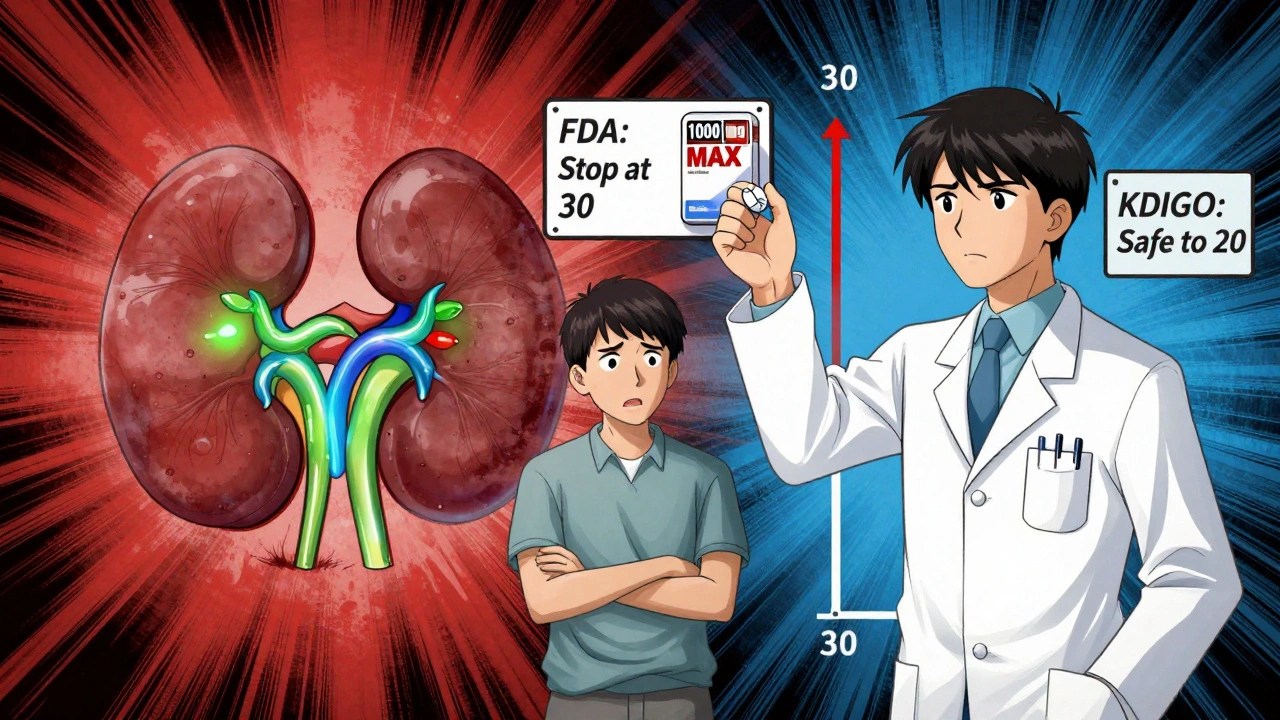
SGLT2 inhibitors-drugs like dapagliflozin, empagliflozin, and canagliflozin-don’t just lower blood sugar. They protect the kidneys. The evidence is overwhelming. The DAPA-CKD trial showed dapagliflozin cut the risk of kidney failure or death by 39% in patients with eGFR as low as 25. EMPA-KIDNEY found empagliflozin reduced kidney disease progression by 28% even in patients with eGFR as low as 20.In 2022, KDIGO-the global kidney health group-did something bold. They lowered the minimum eGFR for starting an SGLT2 inhibitor from 30 to 20 mL/min/1.73 m². That’s huge. It means a patient with stage 3b CKD (eGFR 25-29) can now get a drug that will likely keep them off dialysis for years longer.
But here’s the catch: each SGLT2 inhibitor has different rules.
- Canagliflozin: Max dose 100 mg if eGFR is 45-59. Contraindicated below 45. FDA still says no below 45, even though KDIGO says yes down to 20.
- Dapagliflozin: Can be used up to 10 mg daily if eGFR is 25-45. Contraindicated below 25.
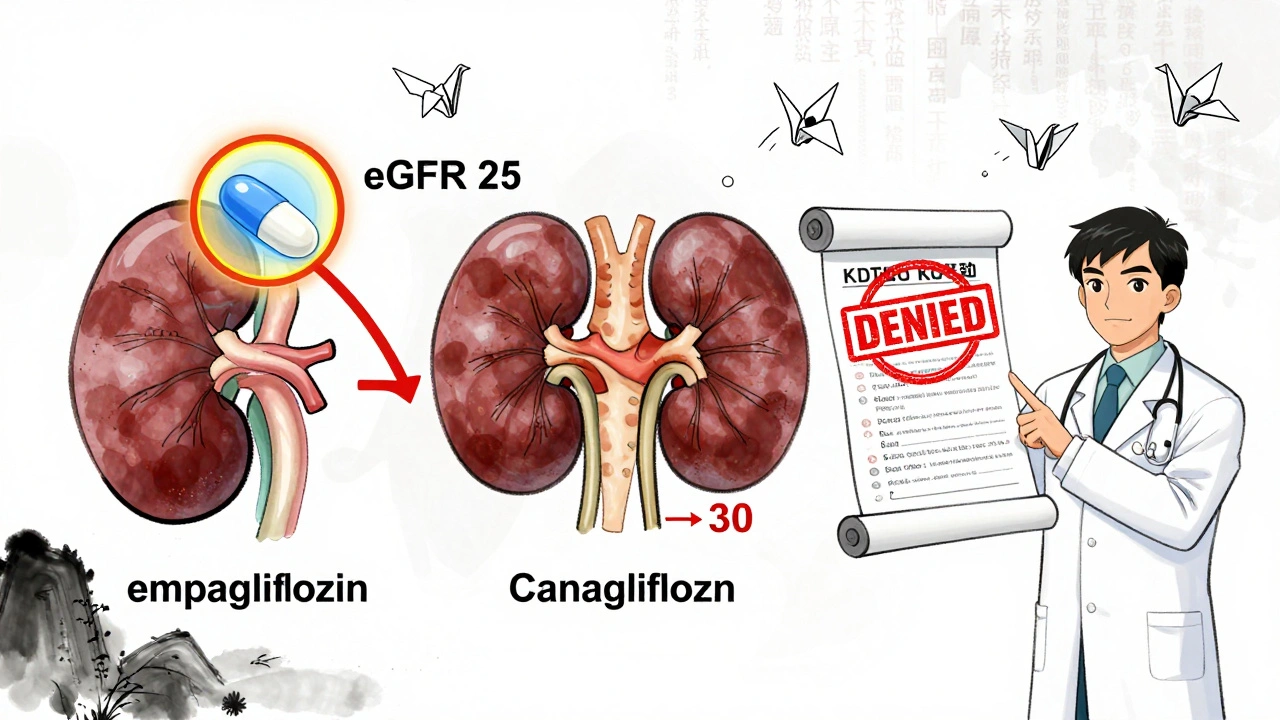
- Empagliflozin: Max 10 mg daily if eGFR is 30-45. Contraindicated below 30.
That’s not a typo. One drug can be used at eGFR 25, another can’t. You have to know which one you’re prescribing. And if eGFR drops after you start it? Don’t panic. A 5-10% dip in eGFR within the first 4-6 weeks is normal. It’s not kidney damage-it’s the drug working. The kidneys are adjusting to reduced pressure in the glomerulus. Most patients’ eGFR rebounds within 3 months.
The Overlap Zone: eGFR 20-29
This is where things get tricky. You can use an SGLT2 inhibitor here. But you cannot use metformin. The guidelines are clear: metformin is contraindicated below eGFR 30. So if a patient is on metformin and their eGFR drops to 28, you must stop metformin and switch to an SGLT2 inhibitor-or add one if they’re not already on it.This window-eGFR 20-29-is where the most benefit happens. Studies show patients in this range who get an SGLT2 inhibitor have a 40% lower risk of needing dialysis over 5 years. But many doctors still won’t prescribe because of FDA labels or fear of liability. One nephrologist on the American Society of Nephrology forum said she’s kept dapagliflozin going in patients with eGFR as low as 18. No adverse events. Proteinuria dropped. Her patients stayed off dialysis.
Yet, a primary care doctor in Texas told a similar story: he discontinued empagliflozin when eGFR fell from 32 to 27. The nephrologist on the case was furious. Why? Because the FDA label says contraindicated below 30, but KDIGO says continue. He followed the label. The patient lost protection.
Insurance Denials and Regulatory Confusion
Here’s the real-world problem: insurance companies still use FDA labels, not KDIGO guidelines. A 2022 survey by the American Diabetes Association found 43% of endocrinologists were denied coverage for SGLT2 inhibitors in patients with eGFR between 20 and 29. The pharmacy says no. The doctor says yes. The patient gets caught in the middle.Some clinics now include a letter of medical necessity with every prescription for SGLT2 inhibitors below FDA thresholds. It cites KDIGO 2022, the DAPA-CKD trial, and the fact that stopping the drug increases hospitalization risk. Still, denials happen. Some patients pay out of pocket-$500 a month for dapagliflozin isn’t cheap.
And then there’s the FDA’s stubbornness. In February 2024, they approved dapagliflozin for chronic kidney disease even in people without diabetes-but only if eGFR is ≥25. KDIGO says ≥20. The gap is still there. The FDA says they need more safety data. But the data already exists. The trials included patients down to eGFR 20. They just won’t update the label.
When to Stop or Hold
Never stop an SGLT2 inhibitor just because eGFR drops-unless the patient is vomiting, dehydrated, or on high-dose diuretics. That’s when you hold it. Same with metformin. If someone has an infection, gets dehydrated, or has a heart attack, stop metformin for a few days. The risk of lactic acidosis spikes during acute illness.For both drugs, hold during:
- Severe dehydration (diarrhea, vomiting, fever)
- Major surgery
- Contrast dye procedures (wait 48 hours after, check eGFR before restarting)
- Acute kidney injury
For metformin, restart only when eGFR is stable and above 30. For SGLT2 inhibitors, restart when the acute issue resolves-even if eGFR is still low. The kidney protection doesn’t vanish after a short pause.

Monitoring: What and How Often
You can’t just prescribe and forget. You need to track.- Metformin: Check eGFR every 6-12 months if above 60. Every 3-6 months if between 45-59. Every 3 months if 30-44.
- SGLT2 inhibitors: Check eGFR and electrolytes within 2-4 weeks of starting. Then every 3-6 months. Watch for volume depletion-dizziness, low BP, dry mouth. Especially if they’re also on a loop diuretic like furosemide.
And remember: eGFR is not a one-time number. It’s a trend. A single drop from 35 to 30 doesn’t mean you stop the drug. A drop from 35 to 20 over 3 months? That’s a red flag. But if it drops 5 points and holds? That’s the drug doing its job.
What’s Coming in 2025
The ADA and KDIGO are working on a 2025 update. Early drafts are looking at whether SGLT2 inhibitors should be used even below eGFR 20-in patients with eGFR 15-19. Early data from small studies suggest it’s possible. The UK Kidney Association already says it’s reasonable to continue if the patient is stable and tolerating the drug.Meanwhile, the FDA is under pressure. In January 2024, their advisory committee admitted they’re reviewing safety data for SGLT2 inhibitors below eGFR 20. Change is coming. But it’s slow.
For now, the best practice is simple: if you have a patient with type 2 diabetes and CKD, start an SGLT2 inhibitor when eGFR is ≥20. If they’re on metformin and eGFR drops below 30, switch or add. Monitor closely. Don’t panic over a small eGFR dip. And if insurance denies it-fight it. The evidence is on your side.
Key Takeaways
- Metformin is safe down to eGFR 30 at 1000 mg/day max. Avoid below 30 unless carefully monitored.
- SGLT2 inhibitors can be started at eGFR ≥20-even if metformin is stopped.
- Each SGLT2 inhibitor has different eGFR limits. Know your drug.
- A drop in eGFR after starting an SGLT2 inhibitor is normal. Don’t stop it.
- Hold both drugs during acute illness, dehydration, or contrast dye.
- Insurance denials are common. Use KDIGO guidelines to appeal.
- Continuing SGLT2 inhibitors below eGFR 20 is emerging practice-watch for 2025 updates.
Can I keep metformin if my eGFR is 28?
No. Metformin is contraindicated when eGFR falls below 30 mL/min/1.73 m² according to ADA and KDIGO guidelines. At eGFR 28, you should stop metformin and switch to or add an SGLT2 inhibitor, which is still safe and recommended at this level.
Why did my eGFR drop after starting dapagliflozin?
It’s expected. SGLT2 inhibitors reduce pressure in the kidney’s filtering units, which can cause a temporary 5-10% drop in eGFR within the first 4-6 weeks. This isn’t damage-it’s the drug working. In most cases, eGFR stabilizes or even improves over 3-6 months as kidney protection kicks in.
Is empagliflozin safe if my eGFR is 25?
No. Empagliflozin is contraindicated below eGFR 30 mL/min/1.73 m² according to its FDA label. Dapagliflozin, however, can be used down to eGFR 25. If your eGFR is 25, switch to dapagliflozin or canagliflozin (if above 20) for continued kidney protection.
Should I stop SGLT2 inhibitors before surgery?
Yes. Hold SGLT2 inhibitors at least 3-4 days before major surgery due to risk of volume depletion and ketoacidosis. Restart only after you’re eating normally and kidney function is stable. Metformin should also be held during this time.
Can I use SGLT2 inhibitors if I’m on dialysis?
No. SGLT2 inhibitors are not effective once you’re on dialysis because they work by blocking sugar reabsorption in the kidneys-something dialysis replaces. They’re also not studied in this group. For patients on dialysis, other diabetes medications like insulin or GLP-1 agonists are preferred.
What if my insurance denies my SGLT2 inhibitor prescription?
Appeal. Use the KDIGO 2022 Clinical Practice Guideline and cite the DAPA-CKD or EMPA-KIDNEY trials. Emphasize that the drug reduces kidney failure risk by 30-40% and that guidelines override outdated FDA labels. Many insurers approve after appeal-especially with a letter from your nephrologist.





Joe Lam
December 5, 2025 AT 01:56Let’s be real - if you’re still using FDA labels as gospel in 2025, you’re practicing medicine like it’s 2012. KDIGO updated their guidelines for a reason: the data is overwhelming. I’ve seen patients on dapagliflozin with eGFRs at 19 for over a year - stable, no acidosis, no hospitalizations. The real danger isn’t the drug, it’s the doctors who let fear override evidence. Stop being a bureaucrat. Be a clinician.
Jenny Rogers
December 5, 2025 AT 02:06While I appreciate the clinical pragmatism expressed herein, one must not overlook the ethical imperative of adhering to regulatory frameworks. The FDA’s contraindications are not arbitrary; they are the product of rigorous, albeit conservative, risk-benefit analyses. To advocate for off-label use in the absence of formal approval is to engage in a form of medical libertarianism that, however well-intentioned, undermines the very pillars of evidence-based governance. The patient’s safety must be paramount - even if that means delaying therapeutic benefit.
Rachel Bonaparte
December 5, 2025 AT 20:42Okay, but have you ever stopped to think that this whole ‘eGFR is a trend’ thing is just Big Pharma’s way of keeping us hooked on drugs they don’t really need? I mean, think about it - why do you think the FDA hasn’t updated the labels yet? Because they know the data is being manipulated. I read a blog once - anonymous, but super credible - that said the DAPA-CKD trial had a 40% attrition rate and they only reported the ‘good’ numbers. And don’t even get me started on how SGLT2 inhibitors are being pushed to replace insulin like it’s some kind of miracle cure. Meanwhile, your average patient is getting dehydrated, hospitalized, and then blamed for ‘non-compliance.’ Wake up. The system is rigged. They want you dependent. And they’re using nephrologists as puppets.
Scott van Haastrecht
December 7, 2025 AT 06:55Someone in this thread actually said ‘don’t panic over a small eGFR dip.’ That’s not advice - that’s negligence. I had a patient whose eGFR dropped from 32 to 21 in 6 weeks after starting dapagliflozin. He ended up in the ER with volume depletion and a 3-day hospital stay. His nephrologist said ‘it’s normal.’ I said ‘no, it’s not.’ He’s now on insulin and dialysis. You don’t get to call it ‘normal’ when someone’s kidneys fail because you ignored the label. This isn’t a blog post - it’s a lawsuit waiting to happen.
Chase Brittingham
December 8, 2025 AT 12:15Just wanted to say thank you for writing this. I’m a PCP and I’ve been terrified to prescribe SGLT2 inhibitors below eGFR 30 because of the fear of backlash - from insurers, from colleagues, even from patients who’ve heard horror stories. This post clarified so much for me. The part about the eGFR dip being normal? That’s the lightbulb moment I needed. I’ve already switched two patients from metformin to dapagliflozin this week. One of them cried because she finally felt like someone was listening. You’re not just prescribing drugs - you’re preserving dignity.
Bill Wolfe
December 9, 2025 AT 17:12Let me drop some truth bombs 💣: If you’re still using metformin at eGFR 30, you’re playing Russian roulette with lactic acidosis. And don’t even get me started on those ‘nephrologists keeping it at eGFR 25’ - that’s not clinical wisdom, that’s reckless hero worship. The FDA didn’t make these rules for fun. They’re not stupid. They’ve seen the corpses. The fact that you’re quoting KDIGO like it’s scripture is just proof you’ve been drinking the Kool-Aid from Big Pharma’s ‘save the kidneys’ PR machine. Dapagliflozin isn’t magic - it’s a gamble. And the only person who wins is the pharmacy that sells it. 🧠🩺
Ollie Newland
December 11, 2025 AT 15:49There’s a critical nuance missing here: the distinction between eGFR trajectory and absolute value. A single-point drop of 10% is physiologically meaningful - it’s a hemodynamic shift, not nephrotoxicity. But if you’re seeing a progressive decline over serial measurements - say, from 35 to 25 in 6 months - that’s a red flag for underlying progression, not drug effect. The SGLT2 inhibitor isn’t causing the decline; it’s revealing it. That’s why monitoring trends matters more than snapshots. Also - for those on loop diuretics, the risk of volume depletion is real. Check sodium, check orthostatics. Don’t just prescribe and ghost.
Rebecca Braatz
December 13, 2025 AT 14:05THIS. THIS RIGHT HERE. I’ve been screaming this from the rooftops for years. Insurance denies SGLT2 inhibitors for patients with eGFR 22? Tell them to read the DAPA-CKD paper. Tell them to look at the hospitalization stats. Tell them to talk to a nephrologist who’s actually treating patients, not just following a PDF. I had a patient who paid $400 out of pocket for 6 months - she’s still off dialysis. Her A1c’s down, her proteinuria’s cut in half. That’s not a drug. That’s hope. Fight for your patients. Don’t let bureaucracy steal their future.