

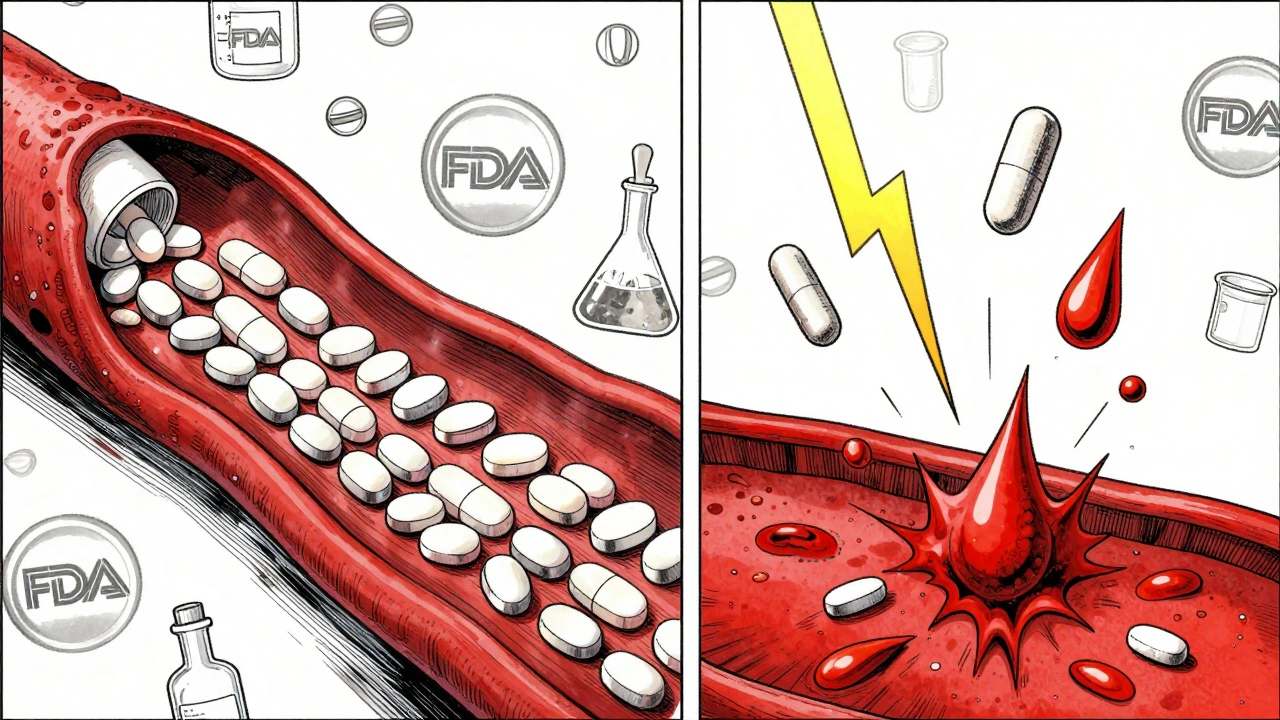
When a doctor prescribes a medication like warfarin, phenytoin, or digoxin, there’s no room for error. These are NTI drugs - narrow therapeutic index drugs - where even a small change in dose can mean the difference between healing and harm. The FDA doesn’t treat these like regular generics. For NTI drugs, the rules around bioequivalence are tighter, more complex, and designed to protect patients from potentially life-threatening mistakes.
What Makes a Drug an NTI Drug?
An NTI drug has a very narrow window between a safe, effective dose and a toxic one. The FDA defines these drugs using a clear metric: a therapeutic index of 3 or less. That means the lowest dose that causes harm is no more than three times the lowest dose that works. Out of 13 drugs studied, 10 fell under this cutoff. A few hovered between 3 and 5, but the 3-or-less rule is now the standard.
It’s not just about numbers. The FDA also looks at whether the drug requires regular blood monitoring, if doses are adjusted in small increments (like 5-10% changes), and whether the difference between the minimum effective and minimum toxic concentration is no more than twofold. Drugs like carbamazepine, lithium carbonate, cyclosporine, and valproic acid all meet these criteria. These aren’t just minor conditions - we’re talking about seizure control, organ transplant rejection, blood clotting, and heart rhythm. One wrong pill can send someone to the ICU.
How Bioequivalence Works for Regular Generic Drugs
For most generic medications, the FDA allows a bioequivalence range of 80% to 125%. That means the amount of drug your body absorbs from the generic version can be 20% less or 25% more than the brand-name version - and it’s still considered safe and effective. This works fine for drugs like statins or antibiotics, where the body can handle some variation without consequences.
But for NTI drugs, that 20-25% leeway is dangerous. A 20% drop in blood concentration of warfarin might lead to a clot. A 20% spike in phenytoin could cause seizures or toxicity. That’s why the FDA doesn’t use the same standard for everyone.
The FDA’s Special Rules for NTI Drugs
The FDA’s approach for NTI drugs isn’t just a tighter version of the old rule - it’s a whole new system. Instead of a flat 80-125% range, they use something called reference-scaled average bioequivalence (RSABE). Here’s how it works:
- The acceptable range for the ratio of test to reference drug exposure is narrowed to 90.00%-111.11% (often called 90-111%).
- The generic drug must also pass the traditional 80-125% test - it has to clear both hurdles.
- The variability between doses of the brand-name drug is measured. If the brand’s own blood levels vary too much between doses (more than 30%), the FDA adjusts the acceptable range slightly - but only if the generic matches that variability.
- The upper limit of the confidence interval for the ratio of within-subject variability (how much the drug’s absorption changes in the same person over time) must be ≤ 2.5.
This isn’t theoretical. Studies on tacrolimus, an immunosuppressant used after transplants, showed that generics that passed the standard 80-125% test still didn’t behave the same way in patients. Only when the 90-111% rule was applied did the results line up. That’s why the FDA requires replicate studies - where the same person takes the brand and generic multiple times - to get a clear picture of how the drug behaves inside the body.
Quality Control Is Even Tighter
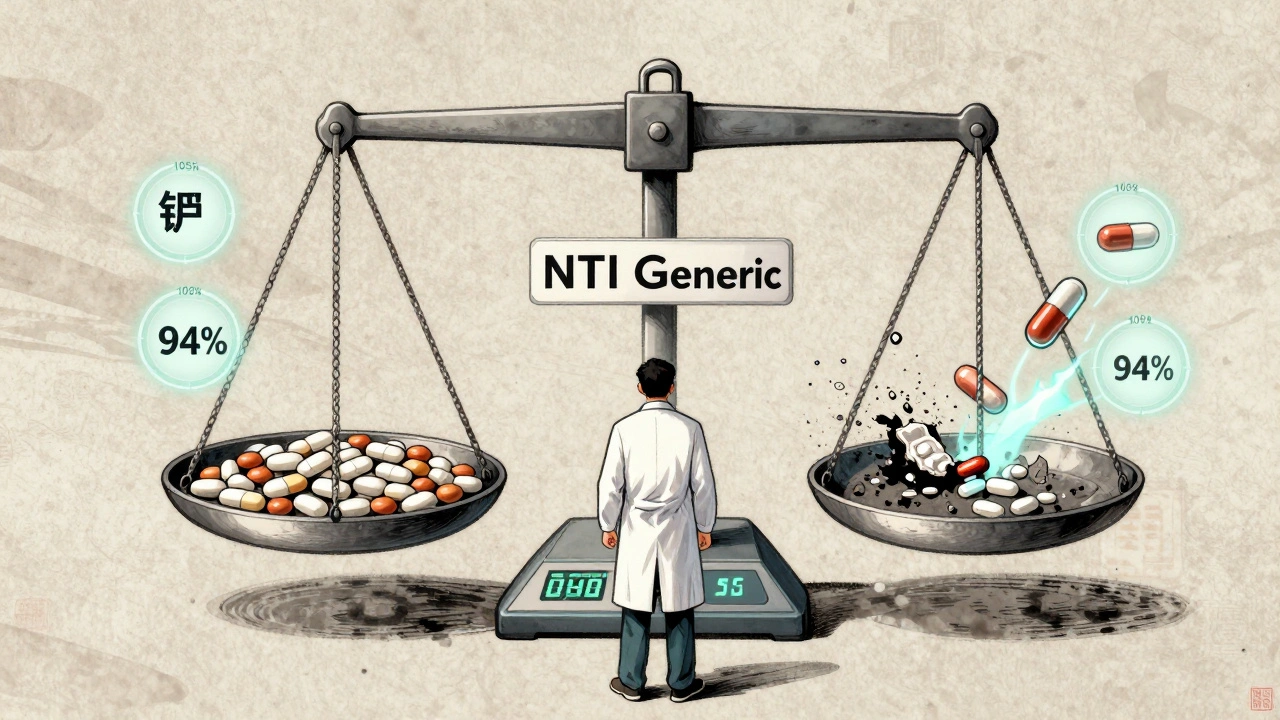
It’s not just about how much drug gets into your blood. The FDA also demands stricter quality control on the actual pills or capsules. For non-NTI generics, the active ingredient can vary by ±10% - so 90% to 110% of the labeled amount. For NTI drugs, that range shrinks to 95% to 105%. That means every batch has to be nearly identical. No room for manufacturing drift. No batch-to-batch surprises. If a pill is 4% under or over, it gets rejected.
This level of precision isn’t easy. It requires advanced manufacturing, tighter controls on raw materials, and more frequent testing. That’s one reason why fewer companies make generic NTI drugs - and why they often cost more than other generics.
Which Drugs Are Covered?
The FDA doesn’t publish a single public list of NTI drugs. Instead, they list them in product-specific guidance documents for each generic application. But from those documents, we know the key players:
- Anticonvulsants: Carbamazepine, phenytoin, valproic acid
- Immunosuppressants: Cyclosporine, tacrolimus, sirolimus, mycophenolic acid
- Cardiac drugs: Digoxin, digitoxin
- Anticoagulants: Warfarin
- Mood stabilizers: Lithium carbonate
These aren’t obscure drugs. They’re used by hundreds of thousands of Americans every day. And if you’re on one of them, the difference between two generic versions matters.
Why Some Experts Still Worry
Even with these strict rules, questions remain. Some studies show that two generics - both approved under the 90-111% rule - still don’t behave the same way in patients. One might work fine, another might cause a seizure or a rejection episode. That’s because bioequivalence doesn’t guarantee therapeutic equivalence. It measures blood levels, not clinical outcomes.
This is especially true for antiepileptic drugs. Clinical trials often show generics are interchangeable. But real-world reports from neurologists and patients tell a different story: sudden seizures, mood swings, or toxicity after switching. The FDA says real-world evidence supports safety, but they also admit these concerns are well-documented. That’s why some states still require patient consent before switching a patient from brand to generic for NTI drugs.
How This Affects Patients
If you’re on an NTI drug, you might notice a few things:
- Your pharmacist might ask if you’re okay with switching to a generic.
- Your doctor might prefer you stay on the brand name - especially if you’ve been stable for months.
- Insurance might push for the cheapest generic, but your doctor can override it with a ‘dispense as written’ note.
Don’t assume all generics are equal. Even if they’re FDA-approved, switching between different generic versions of an NTI drug can be risky. Talk to your doctor before making any changes. If you notice new side effects, changes in mood, or unexpected symptoms after a switch, get your blood levels checked immediately.
Where the FDA Is Headed
The FDA is working to make its NTI standards more consistent globally. Right now, the European Medicines Agency and Health Canada use simpler rules - they just shrink the bioequivalence range to 90-111% without scaling. The FDA’s method is more complex, but it’s also more flexible. It accounts for how the brand-name drug actually behaves in people.
Looking ahead, the agency plans to expand the list of NTI drugs as new data comes in. They’re also pushing for better tracking of real-world outcomes after generic switches. If you’re on one of these drugs, your experience matters - not just lab numbers. The FDA is starting to collect that data.
For now, the message is clear: NTI drugs are different. The FDA knows it. Your doctor should know it. And you should know it too. These aren’t just cheaper versions of the same pill. They’re precision instruments - and they need to be treated that way.




Arun kumar
December 3, 2025 AT 14:33so like if i switch from one generic warfarin to another and my INR goes nuts, its not the pharmacists fault? lol
ATUL BHARDWAJ
December 5, 2025 AT 10:49in india we dont even have this level of regulation. generics are generics. no one checks. hope you dont need these drugs.
Steve World Shopping
December 6, 2025 AT 22:30the FDA's RSABE framework is statistically robust but operationally overengineered. the 90-111% CI with within-subject variability constraints represents a paradigm shift from population-based to individualized pharmacokinetic modeling. this is not just regulation-it's precision medicine enforcement.
Rebecca M.
December 7, 2025 AT 17:12oh great. so now i have to pay $200 for my lithium because the FDA decided my brain deserves a luxury brand? 🙄
Laura Baur
December 8, 2025 AT 23:10It’s fascinating how the FDA’s approach reveals a fundamental tension in modern pharmacology: the belief that bioequivalence is sufficient for therapeutic equivalence. The data, however, tells a different story. Real-world clinical outcomes-seizure recurrence, transplant rejection, arrhythmias-are not captured in AUC and Cmax metrics. This is why some neurologists refuse to switch patients, even when the generic is technically compliant. The system rewards conformity over clinical nuance. And patients? They’re the ones who pay the price in unstable moods, ER visits, and lost trust.
dave nevogt
December 9, 2025 AT 21:08There’s something deeply human here that gets lost in all the regulatory jargon. These aren’t just molecules in a capsule-they’re the difference between someone being able to hold their child, or being in a coma. The FDA’s 90-111% rule isn’t just science, it’s a moral stance. It says: some lives don’t get to be approximated. Some systems don’t tolerate variance. And yet, we still let pharmacies switch these without warning. We let insurance companies prioritize cost over stability. We let patients assume ‘generic’ means ‘identical.’ It doesn’t. And until we treat these drugs like the precision instruments they are-until we educate doctors, pharmacists, and patients-we’re just delaying the next preventable tragedy.
Paul Keller
December 9, 2025 AT 23:14While the FDA’s standards are commendable, the implementation is flawed. The requirement for replicate studies increases development costs, which in turn reduces market competition. Fewer manufacturers mean less pressure to innovate or lower prices. The 95-105% active ingredient tolerance is laudable, but it’s also a barrier to entry for smaller generic houses. We’re creating a two-tier system: high-cost, high-precision generics for the insured, and questionable alternatives for those without coverage. This isn’t equity-it’s elitism disguised as safety.
Zed theMartian
December 11, 2025 AT 21:28Of course the FDA has a 17-page flowchart for this. Because nothing says ‘patient safety’ like making a life-saving drug so expensive that only the top 5% can afford the *approved* generic. 🙃 The real NTI drug here? The one that costs $500/month and requires a PhD to understand.
Ella van Rij
December 13, 2025 AT 07:52soo… i took my generic digoxin and my heart went ‘wtf’? oh wait it’s because the pill was 97% not 100%? lolllllllllllllllllll
Roger Leiton
December 14, 2025 AT 12:57Just had my pharmacist switch my tacrolimus to a new generic. Got my blood drawn 3 days later. Trough dropped 22%. 😳 Doctor said ‘stick with the brand’ and insurance is screaming. FDA’s rules are good… but why don’t they make pharmacies show the batch number on the label? 🤔
Lynn Steiner
December 16, 2025 AT 11:56My cousin switched generics for his epilepsy med. Had a seizure in front of his kid. Now he’s on the brand. Insurance won’t cover it. He’s working two jobs. This isn’t science. This is capitalism with a stethoscope.
Alicia Marks
December 18, 2025 AT 08:54You're not alone. Talk to your doctor. Get your levels checked. You've got this. 💪
Jack Dao
December 19, 2025 AT 23:05Let’s be real. If you’re on an NTI drug and you’re okay with switching generics, you’re either naive or you’ve never watched someone go into toxic shock because a pill was 3% off. The FDA’s rules are barely enough. The real problem? We treat medicine like a commodity. It’s not. It’s a covenant. And we’re breaking it.