
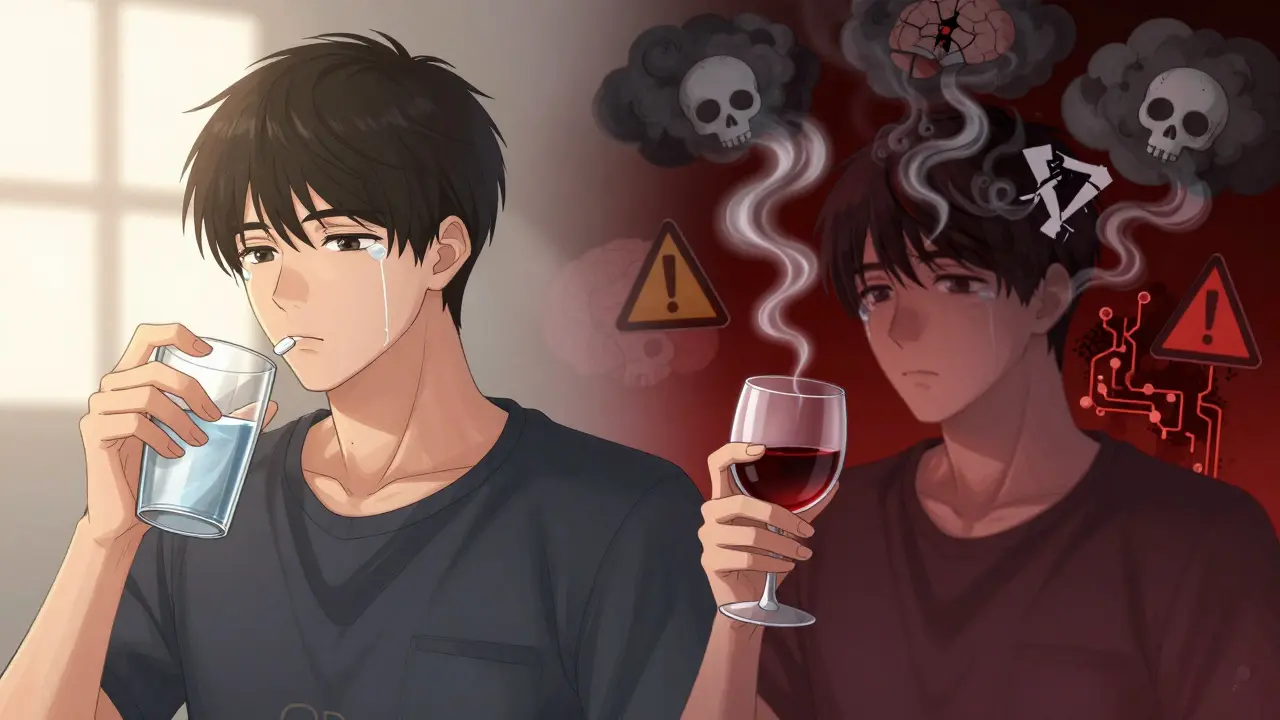
Antidepressant-Alcohol Risk Calculator
Assess Your Risk
Enter your medication type and alcohol consumption to understand your specific risk level.
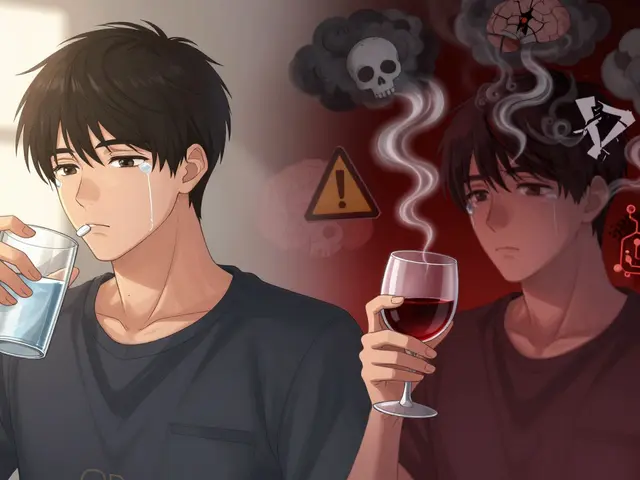
Combining antidepressants and alcohol isn't just a bad idea-it can be life-threatening. If you're taking medication for depression or anxiety, drinking alcohol-even just one drink-can turn a routine evening into a medical emergency. This isn't speculation. It's backed by clinical data, hospital records, and real stories from people who thought they could handle it.
Why Alcohol and Antidepressants Don't Mix
Antidepressants work by balancing chemicals in your brain, like serotonin, norepinephrine, and dopamine. Alcohol, on the other hand, is a depressant that slows down your central nervous system. When you mix them, you're not just adding two substances-you're creating a dangerous chemical tug-of-war inside your body.The result? Your brain can't function properly. You might feel more tired, dizzy, or confused than usual. Worse, your depression might get worse, not better. Studies show that even one standard drink per day can cut the effectiveness of antidepressants by 35% to 50%. That means your medication might stop working, and your symptoms could come back stronger.
How Different Antidepressants React With Alcohol
Not all antidepressants react the same way with alcohol. The risks vary depending on the type you're taking.- SSRIs (like Prozac, Zoloft, Lexapro): These are the most commonly prescribed. When mixed with alcohol, they make you get drunk faster-up to 50% quicker than normal. You might feel lightheaded, nauseous, or extremely drowsy. Many people report feeling like they’ve had five drinks after just one. Worse, 41% of users say their depression gets noticeably worse within 24 hours of drinking.
- Tricyclic Antidepressants (like amitriptyline): These amplify alcohol’s sedative effects. At just a blood alcohol level of 0.05%-below the legal driving limit in most places-some people have stopped breathing. Falls, accidents, and car crashes are far more likely.
- MAOIs (like Nardil, Parnate): These are the most dangerous. Alcohol, especially beer and wine, contains tyramine. When combined with MAOIs, tyramine causes a sudden, explosive spike in blood pressure-sometimes over 220/120 mmHg. This can trigger a stroke or heart attack within minutes. Even one glass of wine can be enough.
- Wellbutrin (bupropion): This one is often misunderstood. People think it’s “safer,” but it’s not. Mixing Wellbutrin with alcohol can flood your brain with dopamine, leading to hallucinations, paranoia, and delusions. In 12% of documented cases, patients ended up in the ER with symptoms that looked like psychosis. One user on PatientsLikeMe described hearing voices telling them to hurt themselves after just two glasses of wine.
The Real Cost: More Than Just Side Effects
The dangers go beyond dizziness or nausea. The biggest risk? Suicide.Research shows people who drink while on antidepressants are 2.7 times more likely to die by suicide. Nearly 80% of all deaths linked to antidepressant use are suicides-and alcohol is a major factor. Alcohol lowers your inhibitions, makes you impulsive, and deepens feelings of hopelessness. If you’re already struggling with depression, alcohol doesn’t help. It pulls you deeper.
It’s not just about immediate danger, either. Long-term, drinking while on antidepressants reduces your chances of recovery. A 2021 study in the Journal of Clinical Psychiatry found that people who avoided alcohol had a 62% higher chance of going into full remission from depression. That’s a huge difference. And yet, most patients aren’t told this.
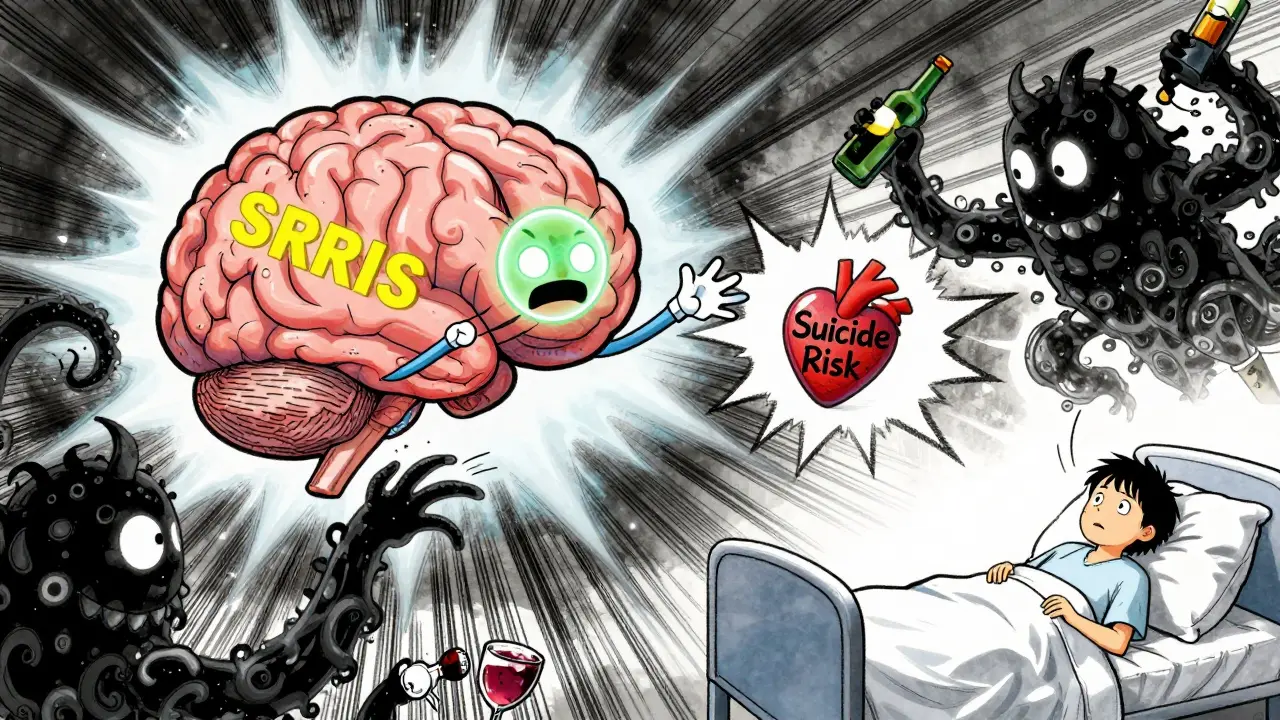
What Do Doctors Really Say?
There’s confusion out there. Some patients hear, “One drink won’t hurt.” Others are told to avoid it completely. The truth? It depends.Most experts agree: avoid alcohol entirely during the first 4 to 8 weeks of starting an antidepressant. That’s when your body is adjusting, and the risks are highest.
After that, opinions split. Some doctors, like Dr. Michael Thase, say maybe one drink a week is okay for stable patients on SSRIs who’ve been on medication for over a year. But they stress it must be approved, monitored, and never done on an empty stomach.
Others, like Dr. Mark R. Gold from American Addiction Centers, say there’s no safe level. “Alcohol interferes with treatment and potentiates suicide risk,” he says. The National Alliance on Mental Illness (NAMI) walks a middle line: “Some physicians allow one drink per day,” but they add a huge caveat-“this should only happen with food and under strict supervision.”
Here’s the bottom line: If your doctor hasn’t explicitly said it’s okay, assume it’s not. And even if they did, be honest with yourself. Are you drinking to relax-or to numb your pain?
What Real People Experience
Online forums are full of stories that sound like warnings from a horror movie.One Reddit user wrote: “One beer on Zoloft made me feel like I was drunk on a bottle of whiskey. I couldn’t stand up. I threw up for hours.” Another shared: “Two glasses of wine on Wellbutrin-I started hearing voices telling me to jump off the balcony. I called 911.”
A 2022 survey by the Depression and Bipolar Support Alliance of over 4,300 people found:
- 67% felt their depression get worse within 48 hours of drinking
- 29% had a spike in anxiety
- 42% said they were too sleepy to work
- 28% had stronger suicidal thoughts
Only 3% of users on Drugs.com reported no issues. That’s one out of every 33 people. The odds aren’t in your favor.

What You Can Do Instead
If you’re using alcohol to cope with anxiety, stress, or sleep problems, you’re not alone-but there are better ways.- Therapy: Cognitive behavioral therapy (CBT) for alcohol use has a 47% success rate in helping people cut back while on antidepressants.
- Non-alcoholic alternatives: Sparkling water with lime, herbal teas, or mocktails can replace the ritual of drinking without the risk.
- Medication check-ins: Schedule appointments every 2-4 weeks during the first few months. Ask your doctor directly: “Is it safe for me to drink?”
- Genetic testing: Since March 2023, a test called GeneSight Psychotropic can analyze your genes to see how your body processes alcohol and antidepressants. It’s not perfect, but it gives personalized insight.
The Bigger Picture
More than 28 million Americans take antidepressants. Over 1 in 3 of them also drink alcohol. That’s over 9 million people at risk. The FDA now requires all antidepressant packaging to include alcohol interaction warnings. Treatment centers now train staff to discuss this with every new patient.But awareness still falls short. A 2023 NAMI survey found only 41% of patients even received educational materials about alcohol risks. Most assume it’s fine-until something goes wrong.
The good news? Better education could reduce dangerous interactions by 37% by 2028. That’s thousands of lives saved. But it starts with you. If you’re on antidepressants, ask yourself: Is one drink worth the risk?
The answer isn’t just medical-it’s personal. Your mental health is worth more than a temporary escape. You’ve already taken the hardest step: asking for help. Don’t undo it with alcohol.
Can I have one drink while on antidepressants?
It depends on the medication and your individual situation. For most people, especially in the first few months of treatment, the answer is no. Even one drink can reduce the effectiveness of your medication and worsen side effects like dizziness, drowsiness, and depression. Some doctors may allow one drink per week for stable patients on SSRIs after 12+ weeks of treatment-but only if they’ve approved it in writing and you’re closely monitored. Never assume it’s safe without asking your doctor.
Does alcohol make antidepressants less effective?
Yes. Research shows that even a single standard drink per day can reduce antidepressant effectiveness by 35% to 50%. Alcohol interferes with how your brain responds to the medication, lowers adherence (people skip doses more often when drinking), and increases impulsivity-all of which make depression harder to treat. The more you drink, the less your medication works.
Is Wellbutrin safer to mix with alcohol than other antidepressants?
No. Wellbutrin (bupropion) is actually one of the riskiest. Unlike SSRIs, it affects dopamine, and when combined with alcohol, it can trigger dopamine flooding. This can lead to hallucinations, delusions, paranoia, and even psychosis-like symptoms. In 12% of documented cases, patients required emergency hospitalization. There is no safe level of alcohol with Wellbutrin.
Can alcohol cause suicidal thoughts while on antidepressants?
Yes. Alcohol lowers inhibitions, increases impulsivity, and deepens feelings of hopelessness-all of which are dangerous when you’re already struggling with depression. Studies show that people who drink while on antidepressants are 2.7 times more likely to die by suicide. This isn’t a coincidence. Alcohol doesn’t fix depression-it makes it worse.
How long should I wait after stopping antidepressants before drinking alcohol?
Wait at least 2 weeks after your last dose before consuming alcohol. Many antidepressants stay in your system for days or weeks after you stop taking them. Even after you feel fine, the chemical interactions can still occur. For MAOIs, wait at least 14 days after stopping, and longer if your doctor advises. Always check with your prescriber before resuming alcohol use.
What should I do if I accidentally mixed alcohol and antidepressants?
If you feel extremely dizzy, confused, have chest pain, trouble breathing, or hallucinations, call emergency services immediately. For milder symptoms like nausea or drowsiness, stay hydrated, avoid driving or operating machinery, and contact your doctor or pharmacist as soon as possible. Don’t wait for symptoms to worsen. Even if you feel fine, it’s worth checking in-some reactions can be delayed.

Jenna Allison
January 24, 2026 AT 09:31Just got prescribed Lexapro last month and I already drank one glass of wine at dinner. Felt like I’d been hit by a truck. Dizzy, nauseous, and then cried for no reason. My doctor never warned me this would happen. I thought it was just me being weak. Turns out it’s the combo. Don’t do it.
Elizabeth Cannon
January 25, 2026 AT 21:11so like… if u r on zoloft and u have 1 beer at a bbq is ur brain gonna explode? or just feel like u got hit by a bus and then cry in the bathroom? bc i did that last weekend and now i’m scared to ever drink again lol
siva lingam
January 27, 2026 AT 02:14alcohol and antidepressants? wow what a shocker. next you’ll tell me breathing is bad for your lungs
Phil Maxwell
January 27, 2026 AT 14:19I’ve been on Wellbutrin for 18 months. One glass of wine once a month, after dinner, with food. No issues. But I also go to therapy twice a week. Maybe that’s the real difference.
Shelby Marcel
January 28, 2026 AT 07:21wait so if i drink and my depression gets worse does that mean the meds are working? or am i just broken? idk anymore
blackbelt security
January 28, 2026 AT 08:46you’re not alone. i stopped drinking after my last ER trip. i didn’t even know i was hallucinating until my roommate said i was screaming at the ceiling. now i drink sparkling water with lime and feel better than ever.
Patrick Gornik
January 28, 2026 AT 22:00Let’s deconstruct the pharmacological hegemony here. The state, the pharma-industrial complex, and the medical orthodoxy have weaponized fear to pathologize human pleasure. Alcohol isn’t the enemy-it’s the capitalist suppression of embodied autonomy. You think serotonin is your savior? It’s just another corporate patent. The real tragedy? You’ve internalized the lie that you need a pill to feel human. Wake up. The system wants you docile, medicated, and silent. One drink isn’t self-destruction-it’s rebellion.
But also, don’t drink MAOIs with wine. That part’s legit terrifying.
Tommy Sandri
January 30, 2026 AT 15:06While the clinical evidence presented is compelling, it is worth noting that cultural attitudes toward alcohol and mental health vary significantly across global populations. In certain European contexts, moderate alcohol consumption is integrated into social rituals without the same level of alarmism. This may reflect differing healthcare models, patient education practices, and societal norms regarding substance use. Further cross-cultural research is warranted to contextualize these findings.
Tiffany Wagner
January 31, 2026 AT 12:11i read this and just cried. i didnt know i wasnt alone. i thought i was just weak for drinking when i was sad. turns out my brain was literally fighting itself
Chloe Hadland
January 31, 2026 AT 22:46you’re not broken. you’re healing. i used to drink every night to sleep. now i do yoga and journal. it’s harder but i feel like me again
Amelia Williams
January 31, 2026 AT 23:53if you’re reading this and you’re scared to stop drinking because you think you’ll feel worse-trust me, you won’t. i went cold turkey after 3 years on SSRIs. first week was hell. second week i slept through the night. third week i laughed at a dumb cat video. it’s worth it. you’re worth it.
Viola Li
February 2, 2026 AT 23:40so you’re saying it’s okay for rich people with therapists to have one drink but poor people should just suffer? what a privileged perspective. not everyone can afford therapy or check-ins. this article feels like victim-blaming dressed up as care.
Dolores Rider
February 3, 2026 AT 10:21they’re watching us. they know when we drink. the pills have trackers. the ERs are full of people who drank one beer. they want us dependent. i saw a man on the news with a chip in his neck. he said it was for "mental compliance". i think they’re using alcohol to test us.
don’t drink. don’t trust anyone. even your doctor. 💀