
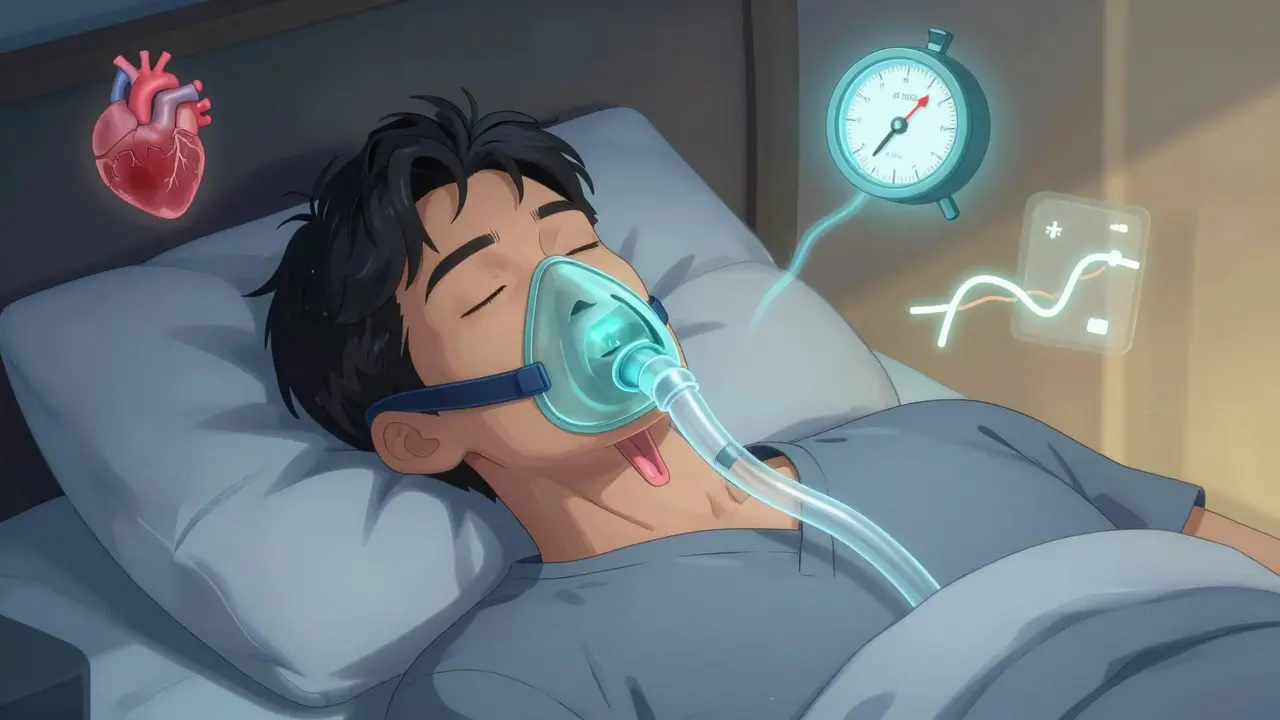
When your breathing stops repeatedly during sleep, your body doesn’t just wake you up-it starts a slow, silent damage process. Sleep apnea isn’t just snoring. It’s a condition where your airway collapses, cutting off oxygen, and your brain forces you awake just enough to breathe again. Over time, this pattern strains your heart, spikes your blood pressure, and can lead to respiratory failure if left untreated. Two of the most common tools to fight this are CPAP therapy and oxygen therapy. But they work in very different ways, and mixing them up can cost you more than sleep-it can cost you health.
What CPAP Actually Does (And What It Doesn’t)
CPAP stands for Continuous Positive Airway Pressure. It’s not a magic mask. It’s a machine that blows gently pressurized air through a tube and into your nose or mouth. That air acts like a splint, holding your throat open so it doesn’t collapse. Think of it like holding a straw open with your fingers so air can keep flowing. Without CPAP, your throat closes. With it, your breathing stays smooth.
Studies show that when people use CPAP correctly, it reduces breathing pauses by 90%. That’s not a small win-it’s life-changing. People report feeling alert within days. Their blood pressure drops. Their risk of heart attack and stroke goes down. But here’s the catch: CPAP doesn’t fix low oxygen levels directly. It fixes the cause of low oxygen-the blocked airway. If you’re using CPAP and still feel tired, it’s not because the machine isn’t working. It’s probably because you’re not using it enough-or you’re using the wrong type.
Oxygen Therapy: Why It’s Not the Answer for Obstructive Sleep Apnea
Many people assume that if they’re low on oxygen at night, they need extra oxygen. That logic makes sense-until you test it. Oxygen therapy delivers supplemental oxygen through a nasal cannula. It helps in conditions like COPD or severe lung disease where your lungs can’t pull in enough air. But in obstructive sleep apnea (OSA), your lungs are fine. Your airway is blocked. Adding oxygen doesn’t unblock it. It just masks the problem.
Research from the American Thoracic Society shows that patients with OSA who use oxygen alone don’t see improvements in sleep quality or daytime fatigue. Their apnea events? Still happening. Their blood pressure? Still high. Their risk of heart failure? Still unchanged. Oxygen therapy might make you feel a little less dizzy, but it doesn’t stop the cycle. That’s why it’s not recommended as a standalone treatment for OSA. In fact, the American Academy of Sleep Medicine says it should only be used in rare cases-like when someone has both OSA and severe lung disease.
CPAP Types: Which One Fits Your Life?
Not all CPAP machines are the same. There are three main types, and choosing the wrong one can make adherence nearly impossible.
- Fixed CPAP: Delivers one steady pressure all night. Best for people with stable breathing patterns. Most common, least expensive.
- Auto-CPAP (APAP): Adjusts pressure automatically based on your breathing. If you snore, it increases pressure. If you’re breathing smoothly, it drops. Great for people whose needs change-like if you gain weight, sleep on your back, or travel to high altitudes.
- Bilevel PAP (BiPAP): Gives you higher pressure when you inhale, lower when you exhale. Easier to breathe out against. Often used when people need high pressure (over 15 cm H2O) or have trouble with standard CPAP.
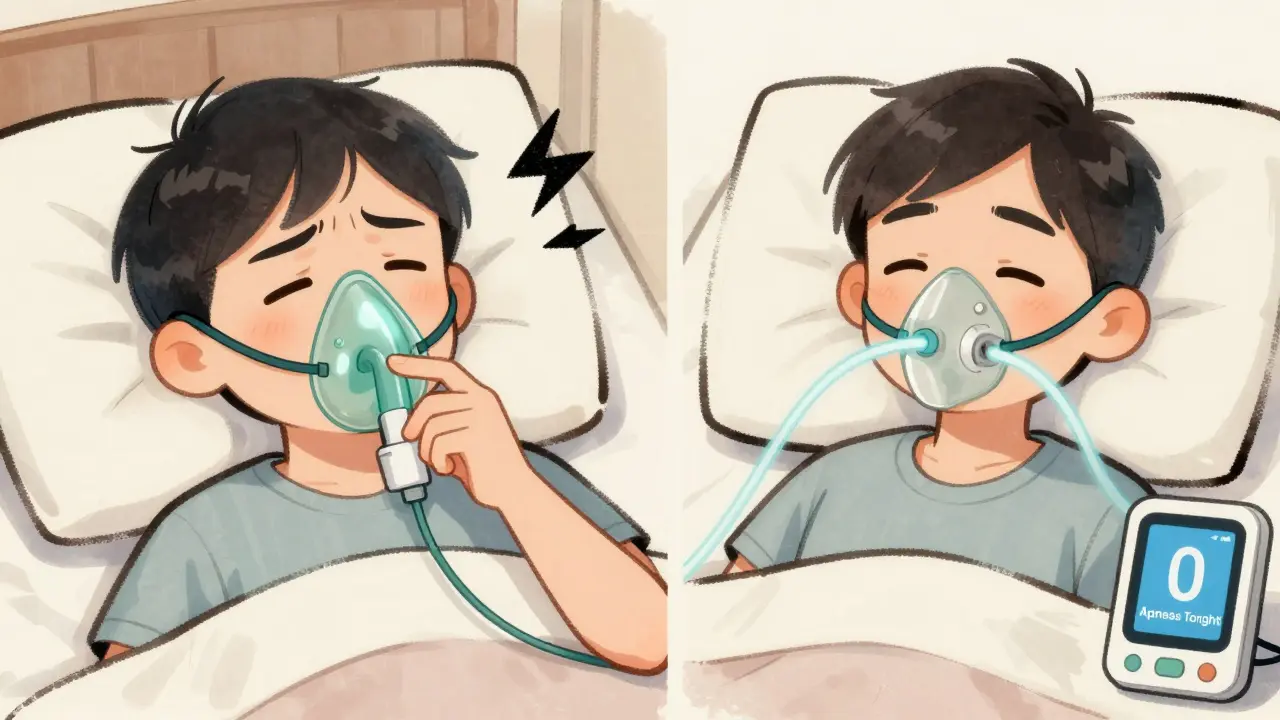
Mask choice matters just as much. Nasal pillows (small prongs that fit in your nostrils) are used by 73% of patients who stick with treatment. Full-face masks are better if you breathe through your mouth. But if your mask leaks, your therapy fails. A 2022 Sleep Review study found that 42% of people quit CPAP because of discomfort or leaks. The fix? Try different masks. Use a chin strap if your mouth opens. Add heated humidification-73% of users who kept CPAP said it made a huge difference.
Adherence Is the Real Battle
Here’s the uncomfortable truth: CPAP only works if you use it. And most people don’t. Studies show adherence rates between 17% and 85%. The average? Around 50%. Why?
It’s not laziness. It’s fit, feel, and fear. A tight mask feels like a strangulation. The noise is annoying. Traveling with a machine is a hassle. But the biggest reason? No one explains what success looks like.
Good adherence isn’t just “use it 4 hours a night.” That’s the old rule. New guidelines say: Use it long enough to feel awake during the day. If you’re still sleepy after two weeks, your pressure might be too low. If you wake up with a dry mouth, your mask leaks. If you feel claustrophobic, try nasal pillows. A 2023 study found that patients who got in-person setup help had 32% higher adherence than those who got everything online. Don’t just get the machine. Get the support.
What About Central Sleep Apnea?
Not all sleep apnea is the same. Obstructive sleep apnea (OSA) is caused by a blocked airway. But there’s another type: central sleep apnea (CSA). In CSA, your brain forgets to tell your body to breathe. It’s not a physical blockage-it’s a signal failure. CPAP doesn’t work well here. That’s why doctors use something called adaptive servo-ventilation (ASV). ASV learns your breathing pattern and gives you a little boost when it detects you’re about to stop breathing.
ASV reduces central apneas by 68%, compared to 32% with CPAP. But here’s the danger: ASV is risky for people with severe heart failure. The SERVE-HF trial found it increased death risk in those patients. So if you have heart disease and sleep apnea, your doctor needs to know which type you have before choosing treatment.
CPAP vs. New Alternatives
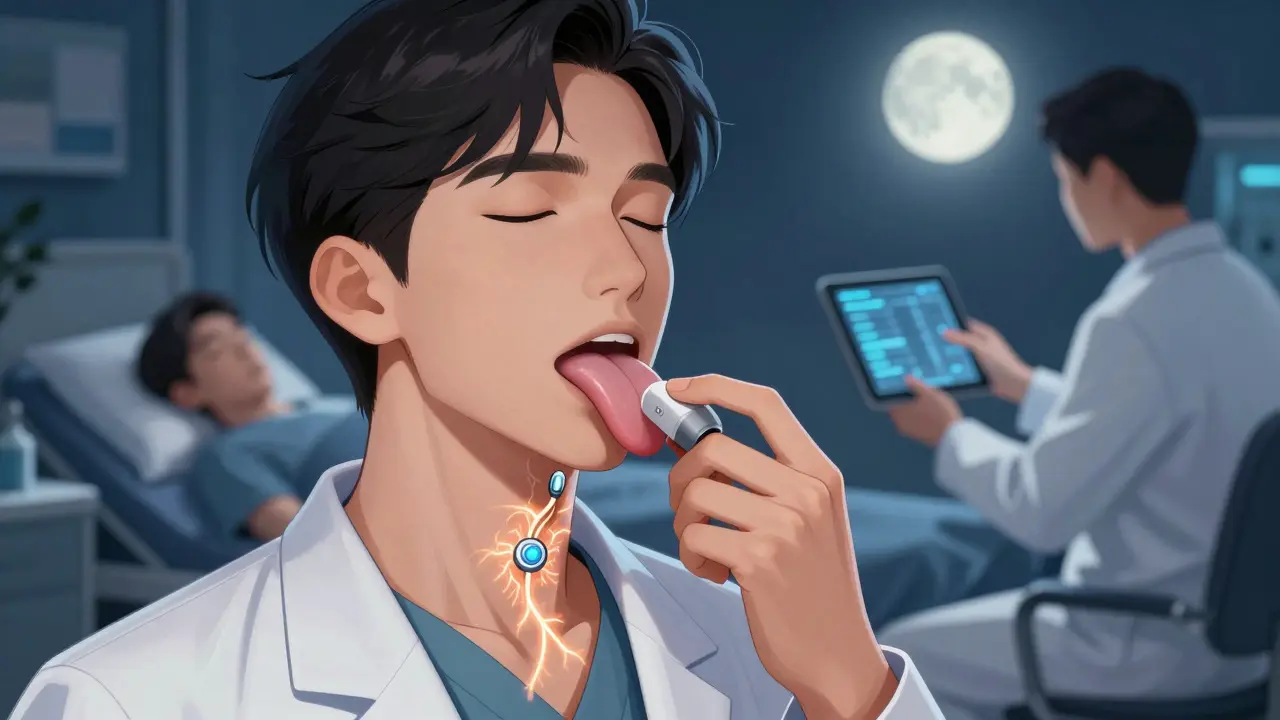
CPAP has been the gold standard since 1981. But it’s not the only option anymore. In 2023, the FDA approved the first implantable device: a nerve stimulator called Inspire. It works like a pacemaker for your tongue. It gently pushes your tongue forward during sleep to keep your airway open. In a clinical trial, 79% of people stuck with it after 12 months-compared to 46% for CPAP. It’s expensive. It’s surgery. But for people who can’t tolerate CPAP, it’s a game-changer.
Another shift? Remote monitoring. Today’s CPAP machines send data to your doctor. If you’re not using it, they know. If your pressure needs adjusting, they can change it without you ever stepping into a clinic. ResMed’s AirView platform cut follow-up visits by 27%. This isn’t science fiction-it’s happening now. And it’s making adherence easier.
When CPAP Isn’t Enough: Respiratory Failure
Sleep apnea can lead to respiratory failure when your body can’t get rid of carbon dioxide. This happens mostly in people with COPD or neuromuscular disease. In these cases, CPAP alone might not be enough. That’s where non-invasive ventilation (NIV) comes in. NIV gives you two levels of pressure-like BiPAP-but with timed breaths. It helps you breathe out carbon dioxide, not just keep your airway open.
Studies show NIV reduces the need for intubation by 20-30% in COPD flare-ups. If your blood pH drops or your CO2 rises during a sleep study, your doctor may switch you from CPAP to NIV. This isn’t a failure. It’s an upgrade.
What You Need to Know Right Now
- CPAP treats the cause of sleep apnea. Oxygen therapy treats a symptom. Don’t confuse them.
- Mask fit and comfort matter more than brand. Try 3 different masks before giving up.
- Use CPAP for at least 4 hours a night, 5 nights a week. But more importantly, use it until you feel awake during the day.
- If you have heart disease, ask if you have central sleep apnea. ASV might help-but only if it’s safe for you.
- Remote monitoring and new devices like Inspire are changing the game. Talk to your sleep specialist about options.
Sleep apnea doesn’t just steal your rest. It steals your future. But CPAP, when used right, gives it back. You don’t need to love the machine. You just need to use it. And if you can’t? There are other paths. You just need to ask the right questions.
Can oxygen therapy replace CPAP for sleep apnea?
No. Oxygen therapy adds oxygen to your bloodstream but does not prevent your airway from collapsing. In obstructive sleep apnea, the problem is physical blockage-not low oxygen. CPAP keeps your airway open, stopping the events that cause low oxygen. Using oxygen alone leaves the root cause untreated, so you’ll still wake up repeatedly, your blood pressure will stay high, and your risk of heart problems won’t drop. Oxygen may be used alongside CPAP in rare cases, like severe lung disease, but never as a replacement.
Why do I still feel tired after using CPAP for weeks?
If you’re still tired, your CPAP isn’t working as well as it should. It could be a leaky mask, pressure that’s too low, or an undiagnosed central sleep apnea component. Check your machine’s data-most modern devices track leaks and residual events. If your apnea-hypopnea index (AHI) is still above 5, talk to your sleep specialist. You may need a pressure adjustment, a different mask, or a switch to auto-CPAP or BiPAP. Also, make sure you’re using it for at least 4 hours every night. Short nights don’t give your body time to recover.
Is CPAP covered by Medicare or insurance?
Yes, in the U.S., Medicare covers CPAP machines and supplies with a doctor’s prescription. As of 2023, the monthly reimbursement rate is $209.74, covering 80% of costs after your deductible. Most insurers require you to use the device for at least 4 hours per night on 70% of nights to keep coverage. Some also require follow-up sleep studies to prove effectiveness. If you’re not meeting adherence targets, your insurer may stop paying-so keep your data logs and attend check-ups.
Can I travel with my CPAP machine?
Yes, and you should. Most modern CPAP devices are compact, lightweight, and FAA-approved for air travel. Many have built-in batteries for use on planes or in places without power. Travel adapters are included with most models. If you’re flying to high altitudes, use an auto-CPAP (APAP) machine-it automatically adjusts for pressure changes. Pack extra filters and tubing. Some users report better sleep on trips with CPAP than without. Don’t skip it, even for a weekend.
What are the alternatives to CPAP if I can’t tolerate it?
If CPAP doesn’t work for you, there are other options. Mandibular advancement devices (MADs)-custom mouthpieces that move your jaw forward-work well for mild to moderate OSA and have higher adherence rates. For severe cases, the Inspire hypoglossal nerve stimulator is an implantable device that keeps your airway open by stimulating your tongue. It’s been shown to have 79% adherence after one year. Weight loss, positional therapy (sleeping on your side), and avoiding alcohol before bed also help. But none of these are as universally effective as CPAP. Talk to a sleep specialist to find the best fit for your body.


Tom Bolt
March 11, 2026 AT 15:35Let me get this straight: you’re telling me that adding oxygen to a blocked airway is like pouring water into a clogged drain and calling it a solution? That’s not therapy-that’s delusion. CPAP isn’t just a machine; it’s a lifeline. If you’re still tired after using it, maybe your mask is leaking like a sieve or your pressure is set by someone who’s never slept a night in their life. Stop blaming the device. Start blaming your laziness.
Gene Forte
March 12, 2026 AT 23:40Every breath we take is a gift-not a guarantee. Sleep apnea doesn’t just steal rest; it steals moments with loved ones, years from our lives, peace from our minds. CPAP is not a punishment. It’s a tool to reclaim what was taken. One night of use, one hour longer of deep sleep, one clearer morning-it all adds up. You don’t have to love the mask. You just have to let it help you. The future you will thank the present you.
Kenneth Zieden-Weber
March 14, 2026 AT 13:32So let me ask you this-why do people quit CPAP? Is it really the noise? The mask? Or is it because no one ever sat them down and said, ‘Hey, this isn’t about compliance. This is about dignity.’ You’re not a patient. You’re a human who deserves to wake up without feeling like you’ve been dragged through a mud pit all night. If your doctor just handed you a machine and said ‘use it,’ they failed you. The real treatment isn’t the machine-it’s the support behind it.
Chris Bird
March 14, 2026 AT 15:44CPAP is a scam. Oxygen is cheaper. Why spend $1000 on a machine when you can buy a concentrator for $300? People just don't wanna think. They wanna be told what to do. But if your airway is blocked, why not just pump air in? It's basic logic. You think the brain is smart? Nah. It's lazy. And so are you.
David L. Thomas
March 15, 2026 AT 07:14From a clinical standpoint, the distinction between OSA and CSA is critical-but underappreciated. The pathophysiology diverges at the level of the medullary respiratory centers. CPAP is a mechanical solution to a mechanical problem. But when you’re dealing with a neurogenic dysrhythmia, you need ventilatory modulation-not just positive pressure. That’s where ASV and NIV enter the equation. And yes, the SERVE-HF data is terrifying-but it’s also why phenotyping matters more than ever.
Bridgette Pulliam
March 17, 2026 AT 05:15I’ve been on CPAP for five years. I used to hate it. Now? I feel like a different person. I used to nap in meetings. Now I lead them. I used to wake up with a headache. Now I wake up to coffee and sunshine. The mask? Still weird. The noise? Still annoying. But the difference? Unmistakable. If you’re struggling, try a different mask. Try heated humidification. Try a chin strap. Don’t quit. Just adapt.
Donnie DeMarco
March 18, 2026 AT 11:38bro i got my cpap from walmart for 200 bucks and it’s a beast. no joke. i was snoring like a chainsaw in a tornado. now? i sleep like a baby. well, a baby that’s hooked to a rocket. but still. the mask? i went from full face to nasal pillows. life changed. also, humidifier? non-negotiable. dry mouth? gone. my wife says i’m not a zombie anymore. i think she’s right. also-i got a travel case. it fits in my backpack. no excuses.
Shourya Tanay
March 18, 2026 AT 14:38As someone from a country where sleep clinics are rare and CPAP machines are luxury items, I’ve seen firsthand how access shapes outcomes. The real issue isn’t adherence-it’s equity. In rural India, many patients stop because they can’t afford filters, or because their power cuts out for 8 hours a day. The technology exists. The compassion? Not always. We need decentralized care, solar-powered units, community health worker training-not just better masks.
LiV Beau
March 19, 2026 AT 18:03Okay but like… have y’all tried the new mask with the built-in Bluetooth? 😍 I got mine last month and now my doc gets my data automatically. Like… I don’t even have to think about it. And the humidifier? HOT. Like, steamy. I feel like I’m in a spa. Also, I use it while watching Netflix. No more midnight mask adjustments. I’m sleeping 7 hours. I’m alive again. 💪😴
Adam Kleinberg
March 19, 2026 AT 21:10CPAP is just the beginning. The real conspiracy? They don’t want you to know about the nasal implants. Or the magnetic tongue devices. Or how the FDA was pressured to approve these machines because Big Sleep wants you dependent on $2000 machines instead of letting you fix it with posture and a pillow. I’ve been using a wedge pillow since 2018. No machine. No mask. No oxygen. Just sleep. And I’m healthier than every doctor in this thread.
Denise Jordan
March 20, 2026 AT 09:46Wow. So much jargon. So many studies. So little actual proof that CPAP saves lives. I’ve been using oxygen for years. I feel fine. My doctor says I’m ‘not a good candidate’ for CPAP. Maybe the whole thing’s overhyped? Maybe we’re just scared of breathing? Maybe the real problem is that we’re too lazy to sleep on our sides?
Mike Winter
March 20, 2026 AT 16:57There’s a quiet tragedy in how we treat chronic conditions: we focus on the device, not the person. CPAP isn’t a cure. It’s a bridge. And bridges need maintenance, understanding, and patience. I’ve seen patients who’ve been on it for 15 years-still using the same mask, same machine, same frustration. We need to shift from compliance metrics to connection metrics. How does the patient feel? Not how many hours they used it.
Randall Walker
March 22, 2026 AT 16:27I used to think CPAP was a joke. Then I tried it. Then I cried. Not because it hurt. Because I realized I hadn’t slept in 10 years. I didn’t know what deep sleep felt like. I thought snoring was normal. I thought fatigue was aging. I was wrong. I’m 42. I feel 28. I still hate the noise. I still hate the mask. But I don’t hate the life it gave me. So… yeah. Use it. Even if you hate it.
Miranda Varn-Harper
March 23, 2026 AT 02:31It is imperative to underscore that the prevailing clinical paradigm regarding obstructive sleep apnea is predicated upon a foundational assumption-that airway patency is the sole determinant of nocturnal oxygenation. This is, frankly, a reductionist fallacy. One must consider the role of systemic inflammation, autonomic dysregulation, and circadian misalignment. To prescribe CPAP as a panacea is not medical science-it is medical theater.
Alexander Erb
March 23, 2026 AT 05:15Just wanna say-this thread is everything. I got my Inspire implant last year. Wasn’t sure at first. Now? I sleep like I’m 20 again. No mask. No hose. No leaks. Just… peace. My wife says I snore less than before. That’s wild. If you’ve tried CPAP and it’s a nightmare? Talk to your sleep doc. There’s hope. And yeah, it’s pricey. But so is a heart attack. Worth it.