
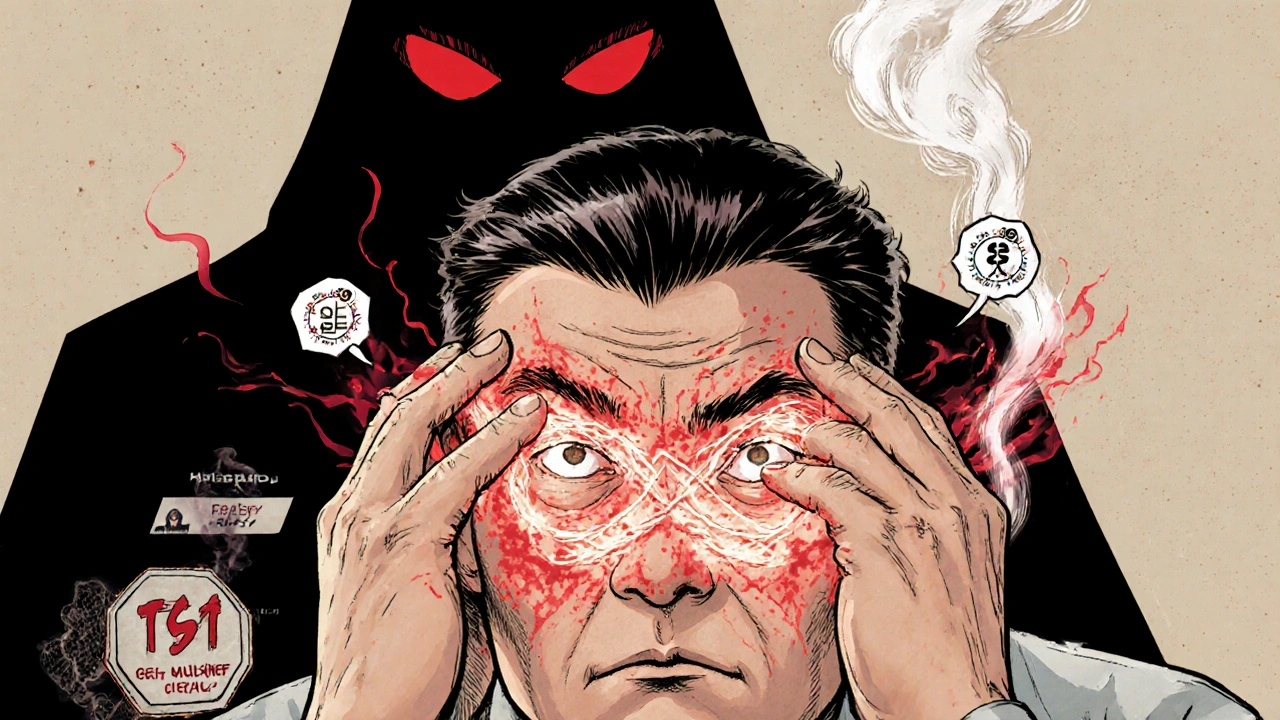
Thyroid Eye Disease (TED) isn’t just dry eyes or puffiness. It’s an autoimmune condition that attacks the tissues behind your eyes, causing swelling, pain, and sometimes vision loss. If you have Graves’ disease, you’re at higher risk - up to half of those patients develop TED. But it can also show up in people with normal or low thyroid levels. The real danger? It doesn’t always wait. Left untreated, it can permanently change how your eyes look and function.
What Does Thyroid Eye Disease Actually Feel Like?
People often dismiss early signs as allergies or tiredness. But TED symptoms are specific and persistent. You might feel a gritty, sandy sensation in your eyes - reported by 78% of patients. Light sensitivity? That’s common too, affecting 65%. Pain when you move your eyes? That’s not normal eye strain; it’s inflammation pressing on nerves and muscles. Red, swollen eyelids? That’s not just makeup or lack of sleep. And if your eyes start to bulge forward - a condition called proptosis - that’s a clear red flag.Double vision is another major warning sign. It happens because the eye muscles swell and stiffen, making them move out of sync. About 28% of people with TED experience this. Most cases affect both eyes (89%), but some only see it in one. The severity is measured using the Clinical Activity Score (CAS). If your score is 3 or higher, your disease is still active and needs treatment now - not later.
Why Do You Get Thyroid Eye Disease?
TED isn’t caused by your thyroid hormone levels directly. It’s caused by your immune system going rogue. Antibodies meant to protect you - called TSH receptor antibodies (TRAb) - mistakenly target cells behind your eyes. These cells respond by swelling, producing fat, and trapping fluid. That’s what pushes your eyeballs forward and squeezes your optic nerve.Smoking is the biggest risk factor. Smokers are nearly eight times more likely to get TED than non-smokers. Women are four to six times more likely to develop it than men. Age matters too - most cases show up between 40 and 60. If your TRAb levels are above 15 IU/L, your risk jumps dramatically. Even treatments for Graves’ disease can make TED worse. Radioactive iodine therapy, without steroid protection, can double or even quadruple your chances of developing severe TED.
Steroids: The First-Line Treatment
When TED is active and moderate to severe, steroids are the go-to treatment. But not all steroids are the same. Oral prednisone is easier to take, but it’s messy. About 25-30% of people relapse after stopping it. Side effects are real: weight gain (on average 8.2 kg), high blood sugar, and weakened bones. Many patients describe it as trading one health problem for another.Intravenous (IV) methylprednisolone is the preferred option for moderate-to-severe cases. A standard course is 500 mg once a week for six weeks, then 250 mg weekly for another six weeks. This approach works for 60-70% of patients. It reduces swelling, eases pain, and improves double vision faster than pills. The European guidelines say not to exceed 4.5 to 5.0 grams total to avoid liver damage - which happens in about 2.3% of higher-dose cases.
Timing matters. If you start IV steroids within two weeks of symptoms appearing, your chance of success is 65%. Wait eight weeks or longer? That drops to 42%. Early action saves vision.
Biologics: A Game-Changer
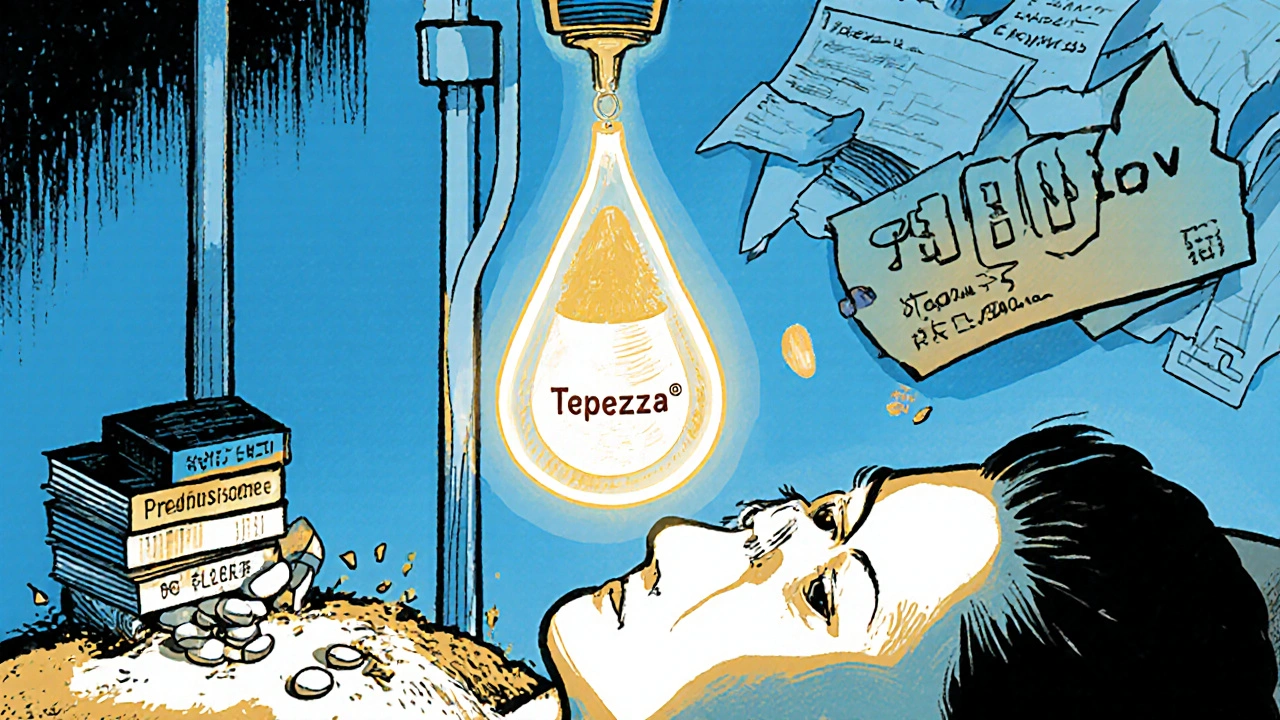
In 2020, the FDA approved teprotumumab (Tepezza®), the first drug designed specifically for TED. It doesn’t just suppress inflammation - it targets the root cause. Teprotumumab blocks the IGF-1 receptor, which is overactive in TED orbital tissue. In the OPTIC trial, 71% of patients saw their eyes bulge back by at least 2 millimeters. Only 20% of those on placebo did. Double vision improved in 59% of patients on teprotumumab versus 26% on placebo.The treatment is eight infusions, given every three weeks. Each infusion costs about $5,000. The full course runs around $360,000 in the U.S. Insurance often denies coverage - 42% of patients report delays or refusals. Average wait time for approval? 47 days. Medicaid patients face even steeper barriers: 67% struggle to get access compared to 28% of those with private insurance.
Side effects are real too. Muscle spasms affect 24%, hearing changes 11%, and high blood sugar 8%. One Reddit user wrote: “After my 8th infusion, my proptosis dropped from 24mm to 20mm. But the cost nearly broke me.” Another said: “Steroids gave me prediabetes. Tepezza gave me my eyes back - but I’m still paying for it.”
What’s Coming Next?
Teprotumumab isn’t the only option on the horizon. Satralizumab (Enspryng®), approved in 2023, is a subcutaneous injection that blocks IL-6 - another key player in inflammation. Early data shows 54% of patients respond with reduced bulging. Researchers are also testing combinations: one trial in 2023 found that adding selenium to teprotumumab boosted response rates to 82%.A biosimilar version of teprotumumab is expected by 2025 and could cut costs by 30-40%. Genetic testing is also on the way. Experts believe we’ll soon identify who’s most likely to develop TED - and who will respond best to which drug. That means personalized treatment, not trial and error.
Other Treatments and Supportive Care
For mild TED, simple steps help. Preservative-free artificial tears - especially sodium hyaluronate - improve dryness and grittiness in 85% of patients within four weeks. Selenium supplements (200 mcg daily) show modest benefit in early-stage disease, improving quality of life scores by 23% compared to placebo. Prisms in glasses can fix double vision for many - but only if the eye muscle misalignment is under 15 prism diopters. Beyond that, surgery is needed.Orbital decompression surgery is the last resort. It removes bone behind the eye to create space, reducing bulging by 2 to 5 millimeters. But it carries risks: 15% develop new or worse double vision, 8% get sinus infections, and 0.5% risk permanent vision loss. That’s why it’s only done after the disease becomes inactive - usually after 12 to 24 months of no change.
Who Should You See?
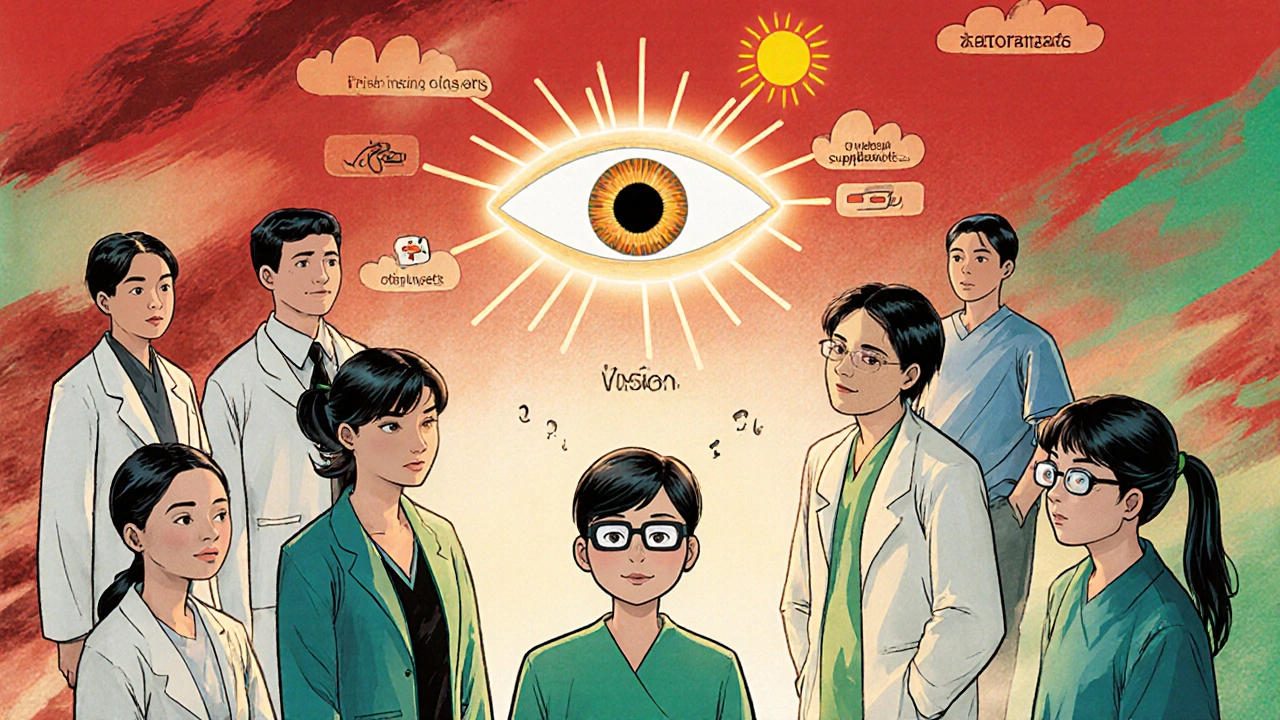
TED needs a team. An endocrinologist manages your thyroid. An ophthalmologist monitors your eyes. An orbital surgeon plans surgery if needed. The European Group on Graves’ Orbitopathy (EUGOGO) insists this multidisciplinary approach is non-negotiable. If you’re in a rural area, access is limited - only 28% of providers outside major cities can offer biologics. Ask your doctor about referrals to specialized TED centers.What’s the Long-Term Outlook?
TED usually runs its course in 1 to 3 years. But the damage doesn’t always reverse. Even with treatment, 35% of patients still need surgery. That’s why catching it early is everything. Testing for TRAb levels at diagnosis can predict who’s at high risk - and who needs immediate eye monitoring.While steroids and biologics are powerful, they’re not perfect. Steroids bring weight gain and diabetes risk. Biologics are expensive and still lack long-term safety data beyond two years. But they’re the best tools we have. The future of TED care isn’t just about treating symptoms - it’s about stopping the disease before it starts.
Can thyroid eye disease go away on its own?
Yes, but not always safely. TED usually enters an inactive phase after 1 to 3 years, meaning inflammation stops. But by then, permanent changes like bulging eyes, scarred muscles, or double vision may already be there. Waiting for it to resolve on its own risks irreversible damage. Early treatment reduces that risk significantly.
Do steroids cure thyroid eye disease?
No, steroids don’t cure TED. They reduce inflammation during the active phase, which can prevent worsening and improve symptoms. But they don’t stop the autoimmune process. About 25-30% of people relapse after stopping oral steroids. IV steroids have a better success rate, but the disease can still progress if not treated early or if risk factors like smoking continue.
Is teprotumumab worth the cost?
For many patients, yes. Clinical trials show 71% see meaningful reduction in eye bulging, and nearly 60% improve double vision - results unmatched by other treatments. While the $360,000 price tag is steep, many patients report regained vision, reduced pain, and improved quality of life. Insurance appeals and patient assistance programs exist. For those with moderate-to-severe TED, the long-term cost of surgery, vision loss, or disability often exceeds the price of treatment.
Can I still get TED if my thyroid levels are normal?
Absolutely. About 10-15% of TED cases occur in people with normal thyroid function (euthyroid) or even hypothyroidism. The immune attack on the eye tissues is separate from thyroid hormone production. That’s why testing for TRAb antibodies - not just TSH or T3/T4 - is critical in anyone with eye symptoms and a history of Graves’ disease or autoimmune thyroid issues.
Does quitting smoking help with thyroid eye disease?
Yes - and it’s one of the most effective things you can do. Smoking increases your risk of developing TED by 7.7 times and makes existing cases worse. Quitting reduces inflammation, improves treatment response, and lowers your chance of needing surgery. Even if you’ve had TED for years, quitting can still help stabilize your condition.
Are there natural remedies for thyroid eye disease?
Selenium supplements (200 mcg daily) are the only natural option with proven benefit - but only for mild, early-stage TED. A Cochrane review found it improves quality of life slightly. Other supplements, herbs, or diets have no solid evidence. Don’t replace medical treatment with unproven remedies. In TED, timing and science matter more than wellness trends.
What Comes After Treatment?
Even after inflammation settles, follow-up is key. Eye muscle scarring can cause lasting double vision. Bulging may need surgical correction. Regular eye exams every 6 to 12 months help catch late complications. If you’ve had TED, your risk of developing other autoimmune conditions - like vitiligo or rheumatoid arthritis - is higher. Stay aware, stay proactive.Thyroid Eye Disease isn’t just an eye problem. It’s a whole-body autoimmune signal. Treat it early. Treat it right. And don’t wait for it to get worse before you act.




Andrea Jones
November 30, 2025 AT 04:57Wow, this is such a clear breakdown - I wish my endo had explained it like this back when I was diagnosed. Selenium and preservative-free tears made a world of difference for my grittiness. Still can’t believe how much better I felt after just four weeks.
Evelyn Salazar Garcia
November 30, 2025 AT 15:39Biologics are a scam.
Rosy Wilkens
December 1, 2025 AT 00:45Let’s be real - the pharmaceutical industry is using TED as a cash cow. Teprotumumab? A $360,000 placebo wrapped in peer-reviewed jargon. The FDA approves these drugs because Big Pharma funds their studies. And don’t get me started on how they suppress data on liver toxicity from IV steroids. You think your doctor is helping you? They’re just following the script written by insurance lobbyists.
Smoking? That’s a distraction. The real cause is environmental toxins - glyphosate, fluoride in the water, EMF radiation from 5G towers. Your immune system isn’t attacking your eyes because of TRAb antibodies - it’s reacting to corporate poisoning. The medical establishment won’t tell you this because they’re complicit.
And don’t even mention ‘patient assistance programs.’ They’re designed to make you feel grateful while they extract your dignity. I know someone who waited 11 months for approval - by then, her optic nerve was permanently damaged. The system doesn’t care. It’s all about profit margins and stock prices.
They want you to believe this is ‘science.’ But science is supposed to be transparent. Why aren’t the full clinical trial datasets public? Why are biosimilars being held back until 2025? Coincidence? Or control?
And let’s talk about Medicaid. 67% denied access? That’s not a glitch - that’s policy. They want the poor to go blind so the rich can buy their way out. This isn’t medicine. It’s eugenics with a white coat.
I’ve seen patients cry because they can’t afford Tepezza. Meanwhile, the CEO of Horizon Therapeutics made $80 million last year. That’s not capitalism. That’s theft.
And yes - I’ve read the OPTIC trial. The 71% response rate? That’s with cherry-picked patients. Real-world data shows only 38% get meaningful improvement. But you won’t hear that from the reps pushing the drug at your clinic.
They’re selling hope. And hope is the most expensive drug of all.
Jermaine Jordan
December 2, 2025 AT 23:35THIS. THIS RIGHT HERE. If you’re reading this and you’re in the early stages of TED - DO NOT WAIT. I waited six months because I thought it was ‘just dry eyes.’ I lost 14mm of proptosis in two weeks on IV steroids. My vision went from double to clear. It’s not a miracle - it’s medicine. But you have to fight for it. Call your insurance. Appeal. Hire a patient advocate. You are worth the fight.
And if you’re a smoker - quit today. Not tomorrow. Today. I quit cold turkey after my diagnosis. My CAS score dropped from 5 to 2 in three months. It’s not magic - it’s biology. Your lungs aren’t the only thing smoking ruins.
You’re not alone. There are thousands of us out here. Join a TED support group. Share your story. Demand better. This disease doesn’t get to win if we speak up.
Chetan Chauhan
December 4, 2025 AT 12:34u think steroids work? in india we use turmeric paste on eyes. better than iv methylprednisolone. also no side effects. also cheaper. also no hospital visit. also my aunty did it and now she can see without glasses. so maybe western medicine is wrong?
Phil Thornton
December 4, 2025 AT 16:20Just got my first infusion yesterday. Muscle spasms are wild. Felt like my legs were trying to high-kick out of my skin. But my eyes? Less bulgy. Already noticed the difference. Worth the pain.
Pranab Daulagupu
December 5, 2025 AT 20:47TRAb titers >15 IU/L = high risk. Key point. Many clinicians miss this. Early screening saves eyes.
Barbara McClelland
December 6, 2025 AT 16:37Just wanted to say - if you’re reading this and you’re scared, you’re not alone. I was diagnosed last year. I thought I’d never look in the mirror again without crying. Now? I can blink without pain. I’m on selenium and tears. It’s not glamorous, but it’s mine. Keep going. You’re stronger than this disease.
Ady Young
December 7, 2025 AT 18:58Interesting how the article mentions selenium but doesn’t clarify that it only helps in mild cases. I saw a 2023 meta-analysis showing no benefit beyond 12 weeks for moderate TED. Still, it’s low-risk - why not try it while waiting for biologics? Better than doing nothing.
Travis Freeman
December 9, 2025 AT 01:24From India to the U.S. - TED doesn’t care about borders. My cousin in Mumbai had it, my sister in Chicago had it. Same antibodies, same pain. We need global access to Tepezza. Not just for the rich. Not just for the insured. For everyone.
Sean Slevin
December 9, 2025 AT 12:12...and yet... the IGF-1 receptor... is not the only pathway... and... the... autoimmune... cascade... is... still... not... fully... understood... so... we... are... treating... symptoms... with... expensive... drugs... while... ignoring... root... causes... like... gut... dysbiosis... and... chronic... stress... and... vitamin... D... deficiency... which... are... all... linked... to... TRAb... production... and... yet... no... one... talks... about... this... why...?
Chris Taylor
December 11, 2025 AT 02:57My wife got Tepezza. We sold our second car to pay for it. We’re still in debt. But she can see again. No more eye patch. No more hiding from photos. I’d do it all over.
Melissa Michaels
December 12, 2025 AT 18:09Important to note: orbital decompression is only indicated after disease inactivity for 12-24 months. Premature surgery increases risk of diplopia and complications. Always confirm stability with CAS < 3 and no progression on imaging for at least 6 months.
Nathan Brown
December 13, 2025 AT 07:32It’s funny how we treat TED like it’s just an eye thing. It’s not. It’s your immune system screaming. It’s your body saying: something’s deeply wrong. And we give you steroids or a $360k drug and call it a day. We don’t ask why. We don’t ask what trauma, what stress, what environment triggered this. We fix the eye. We don’t fix the person.
Maybe TED isn’t just an autoimmune disease. Maybe it’s a signal. A cry from the soul. We need to listen beyond the orbit.
Justina Maynard
December 15, 2025 AT 04:30It’s fascinating how the literature consistently underreports the psychological toll of TED - not just the physical disfigurement, but the social isolation, the anxiety over appearance, the fear of being perceived as ‘other.’ The 28% double vision statistic doesn’t capture the shame of avoiding eye contact, the dread of walking into a room, the way strangers stare. And yet, no clinical trial measures quality of life beyond the CAS score. We quantify bulging, but we ignore the silence.
Also, the phrase ‘you’re at higher risk’ is dangerously passive. You’re not ‘at risk.’ You’re being targeted. Your immune system has turned traitor. This isn’t luck or genetics. It’s a biological betrayal. And we need language that reflects that.
And yes - smoking increases risk by 7.7x. But the data doesn’t say why. Is it the tar? The nicotine? The chronic hypoxia? The epigenetic modulation of orbital fibroblasts? We don’t know. We just say ‘quit.’ And leave it at that. That’s not care. That’s negligence.
Finally - the 47-day insurance delay? That’s not bureaucracy. That’s cruelty. People lose vision during those weeks. The system is designed to make you suffer before you’re deemed worthy of healing.
Matthew Stanford
December 16, 2025 AT 22:18For anyone feeling overwhelmed - start small. One eye drop. One walk outside. One call to your insurance. You don’t have to fix everything today. Just show up. That’s enough.
Olivia Currie
December 18, 2025 AT 10:53TEPROTUMUMAB IS A MIRACLE. I cried the first time I saw my reflection without bulging. I hadn’t seen my own eyes in 3 years. The cost? Worth every penny. The system? Broken. But I’m still here. And I’m seeing.
Clay Johnson
December 19, 2025 AT 07:05What is healing if not the reintegration of the self after fragmentation? TED fractures perception - of the body, of identity, of time. Steroids suppress the symptom, biologics silence the signal, but who is left to speak when the inflammation fades? The person you were? Or the one the disease remade?