
PML Risk Calculator
PML Risk Assessment Tool
This tool estimates your PML risk based on key factors from the latest clinical guidelines. Results are for informational purposes only and should not replace medical advice.
Your estimated risk
Important: This calculator uses clinical guidelines from the article. For accurate assessment, consult your neurologist and follow your treatment monitoring schedule.
What Is Progressive Multifocal Leukoencephalopathy (PML)?
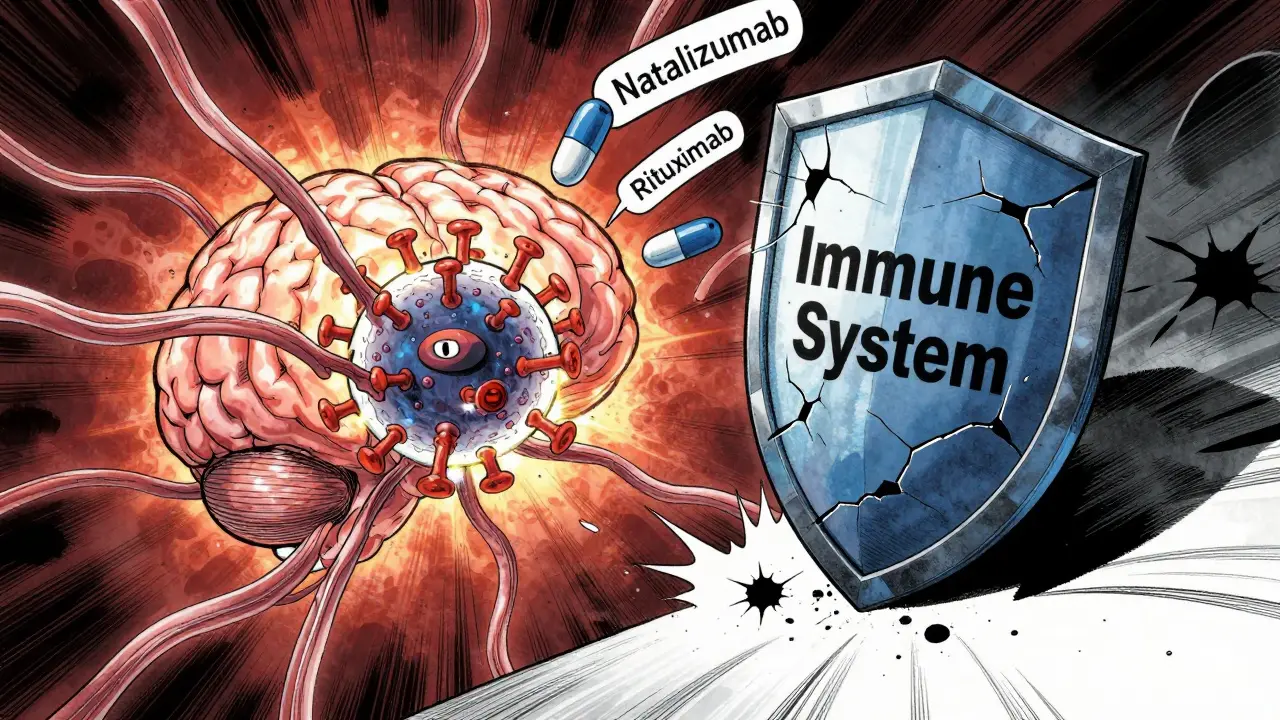
PML is a rare but deadly brain disease caused by the reactivation of the John Cunningham (JC) virus. Most people carry this virus without knowing-between 50% and 70% of adults have been exposed. It stays quiet in the kidneys and bone marrow, harmless as long as your immune system is strong. But when you take strong immunosuppressants, your body’s defenses drop. That’s when the virus wakes up, attacks the protective coating around nerve cells in your brain, and starts destroying them. The result? Progressive damage that can lead to paralysis, vision loss, speech problems, and even death.
Why Immunosuppressants Are the Main Culprit
Not all immunosuppressants carry the same risk. Some are far more dangerous than others. The biggest red flag is natalizumab (Tysabri), used for multiple sclerosis and Crohn’s disease. Through February 2011, over 82,000 people took Tysabri worldwide. Of those, 102 developed PML. That’s about 0.12%-low overall, but deadly when it happens. The risk jumps dramatically if you’ve taken other immunosuppressants before, like azathioprine or methotrexate. In those cases, your chance of getting PML increases 2.5 times.
Other high-risk drugs include fingolimod (Gilenya), dimethyl fumarate (Tecfidera), and rituximab (Rituxan). Their PML rates are lower than Tysabri’s, but still serious: 0.4, 0.2, and 0.8 cases per 1,000 patient-years respectively. For context, drugs like interferon beta and glatiramer acetate have never been linked to a single confirmed PML case. That’s why doctors now avoid using high-risk drugs unless absolutely necessary.
The Three Big Risk Factors for PML
If you’re on an immunosuppressant, your risk isn’t random. It’s tied to three specific factors:
- JC virus antibody status - If you’ve been exposed to the virus (which most people have), your blood will test positive for JC antibodies. A positive test means you’re at risk. A negative test doesn’t guarantee safety-2-3% of people get false negatives.
- Prior immunosuppressant use - Taking drugs like azathioprine, mitoxantrone, or cyclophosphamide before starting Tysabri or other high-risk meds multiplies your risk. The FDA requires doctors to ask this question before prescribing.
- Treatment duration - The longer you’re on natalizumab, the higher your risk. After 24 months, the risk begins climbing sharply. By 48 months, patients with a JC antibody index above 1.5 have a nearly 11% chance of developing PML.

How Doctors Detect PML Early
Early detection saves lives. PML symptoms-like sudden weakness, blurry vision, slurred speech, or memory issues-are often mistaken for a multiple sclerosis flare-up. That’s why regular monitoring is non-negotiable.
Neurologists use two key tools:
- Brain MRIs every 3-6 months - Advanced imaging, especially diffusion-weighted sequences, can spot PML lesions before symptoms appear. But reading these scans isn’t easy. Neurologists need 15-20 hours of special training to tell the difference between PML and MS plaques.
- JC virus antibody testing every 6 months - This isn’t a one-time test. Your antibody index (a number that measures how much virus your body has seen) tells doctors how your risk changes over time. An index above 1.5 means you’re in the danger zone.
One patient on Reddit shared their story: after 18 months on Tysabri, their neurologist found early PML lesions on an MRI-even though their JC test was negative. That’s the 2-3% false-negative rate in action. That’s why doctors now rely on MRI more than blood tests alone.
What Happens When PML Strikes
PML doesn’t just damage your brain-it can trigger something even more dangerous: immune reconstitution inflammatory syndrome, or IRIS. When doctors stop the immunosuppressant, your immune system tries to fight back. But in 50-60% of PML cases, it overreacts. The immune attack on the virus causes massive brain swelling, which can be fatal.
Without treatment, 30-50% of PML patients die. Survivors often face permanent disability: trouble walking, speaking, or seeing clearly. But early intervention changes the game. One patient, u/NatalizumabSurvivor, stopped Tysabri at the first sign of symptoms, started high-dose steroids for IRIS, and regained 90% of their motor function after six months. That’s why catching it early is everything.
How Patients Are Managing the Fear
Living with this risk isn’t just medical-it’s emotional. On the National Multiple Sclerosis Society’s forums, 78% of patients on natalizumab say they feel extreme anxiety about PML. More than half say they’d quit the drug after two years, even if it’s working well for their MS.
Some switch therapies. Since 2015, prescriptions for natalizumab have dropped 22% in patients with prior immunosuppressant use. Ocrelizumab and other alternatives have filled the gap. But switching isn’t easy. Many patients feel stuck: their MS is controlled, but they’re terrified of PML.
Doctors are responding. Academic medical centers now have standardized PML protocols. But only 67% of community neurology practices do. That means your care depends heavily on where you go. If you’re on a high-risk drug, ask: “Do you follow the Cleveland Clinic’s PML monitoring guidelines?” If they don’t know what you’re talking about, it’s time to seek a second opinion.

New Hope: What’s Changing in 2026
There’s real progress on the horizon. A new experimental therapy called DIAVIS T-cell therapy showed 68% lower death rates and better recovery in a small 2024 study. Immune checkpoint drugs like pembrolizumab are also being tested-early results show some patients respond well.
The Cleveland Clinic is now running a Phase II trial (NCT05678901) testing maraviroc, an HIV drug, to prevent PML in high-risk natalizumab patients. Early lab results suggest it may block the JC virus from entering brain cells. If this works, it could make Tysabri safer for thousands.
By 2030, experts predict PML risk from natalizumab could drop to just 0.5 cases per 1,000 patient-years-close to the level of safer drugs. That might bring it back as a first-line option for select patients who need strong control of their MS.
What You Should Do Right Now
If you’re on any immunosuppressant, especially natalizumab, fingolimod, or rituximab:
- Ask for your JC virus antibody test results-don’t just take the doctor’s word.
- Confirm your antibody index value. If it’s above 1.5, talk about switching or stopping.
- Request a baseline brain MRI before starting, and schedule follow-ups every 3-6 months.
- Know the early warning signs: sudden clumsiness, blurred vision, confusion, or trouble speaking.
- If you’ve ever taken another immunosuppressant, tell your neurologist-every time.
Don’t wait for symptoms. PML moves fast. The goal isn’t to scare you-it’s to empower you. You have the right to know your risk, demand testing, and make informed choices about your treatment.
Why This Matters More Than Ever
The global PML diagnostic market is growing fast-projected to hit $412 million by 2028. That’s because more people are on powerful immunosuppressants, and doctors are getting better at catching PML early. But the real win isn’t the money-it’s the lives saved.
PML used to be a death sentence. Now, with better screening, faster detection, and new treatments, survival is possible. But only if you’re vigilant. You’re not just a patient. You’re the most important part of your own safety net. Stay informed. Ask questions. Push for the tests. Your brain is worth it.





Nick Cole
January 16, 2026 AT 11:51Nicholas Gabriel
January 18, 2026 AT 06:55Allen Davidson
January 20, 2026 AT 00:04Samyak Shertok
January 21, 2026 AT 10:22vivek kumar
January 21, 2026 AT 13:07Jody Fahrenkrug
January 23, 2026 AT 03:51Kasey Summerer
January 23, 2026 AT 21:17john Mccoskey
January 24, 2026 AT 04:46