
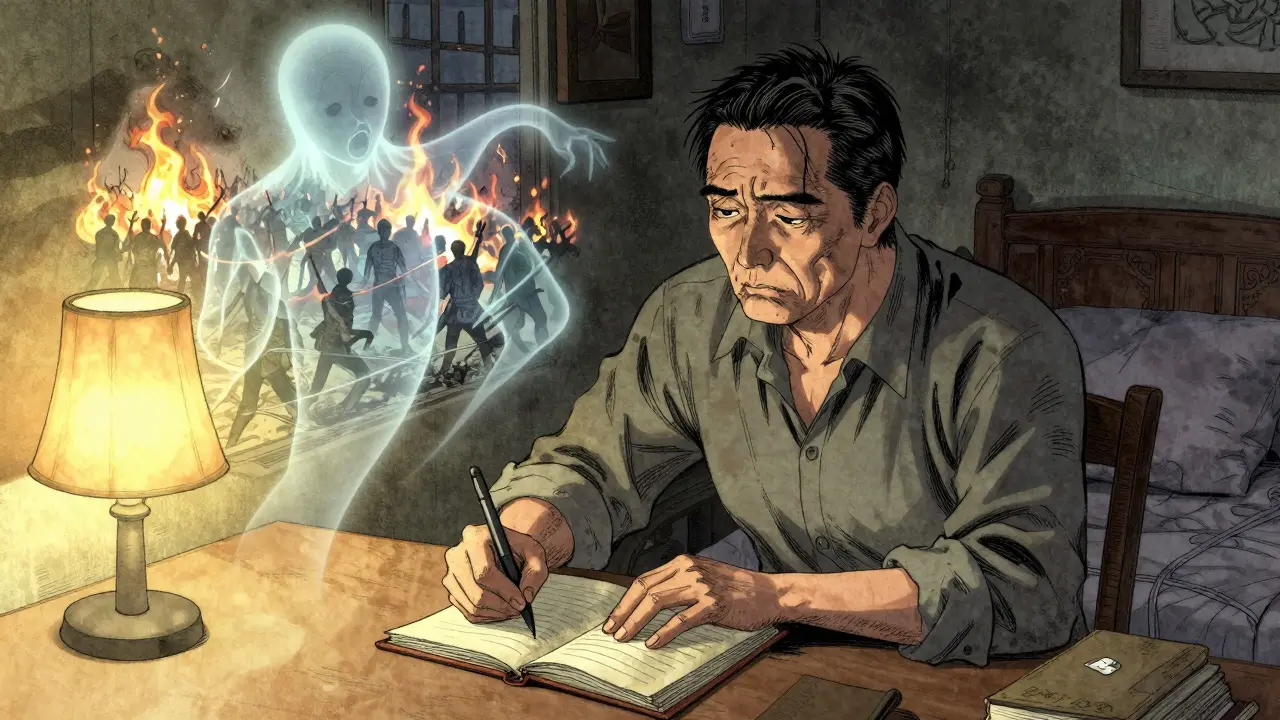
If you’ve been stuck in the same terrifying dream over and over - the same falling, the same chasing, the same voice yelling - and it’s been ruining your sleep for months or even years, you’re not broken. You’re not weak. You’re dealing with a very real, very treatable symptom of PTSD: trauma-related nightmares.
Up to 72% of people with PTSD experience these nightmares. They’re not just bad dreams. They’re flashbacks that replay in your sleep, often so vivid you wake up sweating, heart pounding, convinced it’s still happening. And here’s the thing: standard PTSD therapy doesn’t always touch them. Talk therapy, exposure work, even meds like SSRIs? They might help your anxiety or flashbacks during the day, but the nightmares? They keep coming. That’s where Imagery Rehearsal Therapy, or IRT, steps in.
What Is Imagery Rehearsal Therapy (IRT)?
IRT isn’t about digging deeper into the trauma. It’s not about reliving it. It’s about rewriting it - in your mind, while you’re awake - so your brain stops replaying the horror at night.
Developed in the early 2000s and backed by solid research since, IRT is now the first-line psychological treatment for PTSD nightmares, according to the American Academy of Sleep Medicine. It’s not a cure for PTSD itself, but it’s one of the most effective ways to stop the nightmares that keep PTSD alive. Studies show it reduces nightmare frequency by more than half for most people, and about 6 in 10 stop having them entirely after just 4 to 6 sessions.
Unlike medications like prazosin - which used to be the go-to for veterans but failed in large trials - IRT works without pills. It’s safe, non-invasive, and its effects last. Follow-up studies show people still sleeping better six months to a year later.
The Four Steps of IRT (Simple, But Not Easy)
IRT has a clear structure. It’s not magic. It’s work. But it’s work you can do. Here’s how it works:
- Write it down. Right after a nightmare, grab a pen and paper (no phone screen - the blue light messes with your sleep cycle). Write the dream exactly as it happened. Don’t judge it. Don’t edit it. Just record it. Include the emotions, the sounds, the details. This isn’t about memory - it’s about capturing the dream version.
- Change the ending. Now, rewrite the dream. Not as a denial of what happened. Not as a fantasy. But as a version that gives you power, safety, or peace. Maybe you turn around and face the attacker. Maybe you call for help and someone shows up. Maybe the scene shifts to a quiet room with sunlight. The goal isn’t realism - it’s relief. You’re not erasing the trauma. You’re changing how your brain replays it.
- Rehearse it daily. Every night before sleep, spend 10 to 15 minutes imagining the new version. Close your eyes. Picture it like a movie. Feel the calm. Hear the different sounds. Let your body relax into the new scene. This is the key. Your brain learns from repetition. You’re teaching it a new script.
- Do it consistently. This isn’t a one-time fix. You need to do this every night, even if you didn’t have a nightmare. The goal is to overwrite the old pattern. Some people combine this with progressive muscle relaxation - slowly tensing and releasing each muscle group - to help their body settle into sleep.
That’s it. Four steps. No complex tools. No expensive equipment. Just your mind, a notebook, and discipline.
Why It Works (And Why It’s Better Than Meds)
For years, doctors pushed prazosin - a blood pressure drug - for PTSD nightmares. It made sense: it calms the nervous system. But in a major 2018 study of 304 U.S. veterans, prazosin performed no better than a sugar pill. Zero improvement in nightmare frequency. Zero improvement in sleep quality.
Meanwhile, IRT? A 2014 meta-analysis of 13 clinical trials found it had a large effect on reducing nightmares (d = 1.24), improving sleep (d = 0.98), and even easing PTSD symptoms (d = 0.87). That’s not minor. That’s life-changing.
Why does IRT beat meds? Because it targets the root of the problem: the brain’s learned pattern of replaying trauma at night. Medications try to numb the system. IRT rewires the script.
And here’s the kicker: IRT works even when other treatments fail. People who’ve been in years of therapy and still can’t sleep? IRT helps them. The Department of Veterans Affairs now offers IRT in 92% of its PTSD programs. That’s not a fluke. That’s evidence.

Who Can Benefit? (And Who Might Struggle)
IRT is most effective for people whose nightmares are directly tied to a specific traumatic event - combat, assault, accidents, abuse. If your nightmares are recurring, vivid, and follow a similar pattern, you’re a great candidate.
But it’s not for everyone. If you have severe insomnia, sleep apnea, or other sleep disorders, IRT alone won’t fix them. You’ll need to treat those first. And if your trauma is extremely complex - multiple events over years, childhood abuse, ongoing abuse - IRT might need to be part of a bigger plan. It’s not a one-size-fits-all fix.
Some people resist changing the dream. They feel like they’re “betraying” the memory. But here’s what clinicians say: your nightmare is not the event. It’s your brain’s distorted replay of it. The original memory? That stays. The nightmare? That’s the one you can change.
What to Expect - Real Results, Real Timeline
Don’t expect miracles on day one. Most people don’t. But within 2 to 3 weeks of nightly rehearsal, many notice a shift. The nightmares become less intense. The fear fades a little. By session 3 to 5, that’s when the real change kicks in.
One veteran I spoke with - who’d been having nightmares every night for 12 years - said after four weeks of IRT, he slept through the night for the first time since returning from deployment. He didn’t stop having nightmares. He just stopped being terrified of them. That’s the goal.
And it’s not just about sleep. When nightmares stop, people start sleeping longer. They wake up less tired. They’re less irritable. They can focus at work. They reconnect with family. It’s not just a sleep fix - it’s a life reset.

How to Get Started
IRT isn’t something you just read about and do alone. It’s best done with a trained clinician - someone who understands both trauma and sleep disorders. A therapist trained in IRT will guide you through each step, help you reframe the dream safely, and keep you on track.
If you’re in Australia, look for providers through Phoenix Australia or your local mental health service. In the U.S., the VA offers IRT nationwide. Private therapists trained in trauma-focused CBT often include IRT in their toolkit.
Some clinics now offer group IRT sessions or telehealth versions - especially useful if you’re in a rural area or can’t leave the house. A 2023 pilot study in Brazil even showed that a single, condensed session combining IRT with narrative therapy reduced nightmares by over 70% - suggesting future shortcuts are on the horizon.
But don’t wait for the perfect program. Start now. Grab a notebook. Write down your last nightmare. Then, tonight, imagine a different ending. Just once. See what happens.
Can I do IRT on my own without a therapist?
Yes, many people start IRT on their own using manuals or guided audio. But it’s safer and more effective with a trained clinician - especially if you have complex trauma. A therapist helps you avoid retraumatization, guides your script changes, and keeps you from getting stuck in perfectionism. If you’re unsure, start with a consultation.
How long does IRT take to work?
Most people notice a difference in 2 to 3 weeks. Significant improvement usually happens between sessions 3 and 5. The full course typically lasts 4 to 6 weekly sessions. Some newer versions, like N-IRT, show results in a single session - but these are still being studied and aren’t standard yet.
Does IRT work for non-PTSD nightmares?
Yes. While IRT was developed for trauma-related nightmares, it’s also effective for idiopathic nightmares - recurring bad dreams without a clear trauma trigger. The process is the same: rewrite the dream, rehearse it. The cause doesn’t matter as much as the pattern.
What if I can’t change the dream? It feels wrong to rewrite it.
That’s common. Many people feel guilty or like they’re “denying” their trauma. But IRT isn’t about forgetting. It’s about changing the nightmare’s script - not the memory. Your trauma history stays. The nightmare is just your brain’s glitchy replay. A therapist can help you separate the two, so you feel safe making the change.
Are there side effects to IRT?
IRT has no physical side effects. Some people feel emotionally drained after sessions, especially early on. A few report temporary increases in dream intensity as the brain adjusts. These usually pass within days. If you feel overwhelmed, pause and talk to your clinician. That’s normal. It doesn’t mean you’re failing.
Can I combine IRT with medication?
Yes. Many people use IRT alongside other treatments. But if you’re on prazosin or similar meds, know this: research shows IRT is just as effective - and often more lasting. If your meds aren’t helping, IRT is a strong alternative. Always talk to your doctor before stopping any medication.
Next Steps
If you’re reading this and your nightmares are still haunting you - don’t wait. Start tonight. Grab a pen. Write down your last nightmare. Don’t analyze it. Just write it. Then, before you sleep, imagine a version where you’re safe. Where someone helps you. Where the scene changes. Just once. That’s your first step.
And if you’re ready to go further - find a clinician trained in IRT. It’s not a luxury. It’s a lifeline. Thousands have done it. You can too.





Milad Jawabra
March 4, 2026 AT 06:20tatiana verdesoto
March 4, 2026 AT 19:24Ethan Zeeb
March 6, 2026 AT 10:27Darren Torpey
March 7, 2026 AT 05:52Lebogang kekana
March 7, 2026 AT 15:39Jessica Chaloux
March 8, 2026 AT 14:22Mariah Carle
March 9, 2026 AT 02:45Alex Brad
March 9, 2026 AT 23:34Renee Jackson
March 10, 2026 AT 16:15Levi Viloria
March 12, 2026 AT 06:52