

When the temperature rises, most people sweat to cool down. But if you're taking certain medications, your body might not be able to sweat at all - or at least not enough. This isn't just uncomfortable. It's dangerous. Heat intolerance from medications is a real, underrecognized risk that can lead to heat exhaustion or even heat stroke, especially during summer heat waves. And it’s not rare. Around 1 in 7 adults in the U.S. who take prescription drugs are affected. If you or someone you know is on meds and feels unusually hot, dizzy, or dry in warm weather, this is something you need to understand.
How Medications Kill Your Body’s Cooling System
Your body cools itself in two main ways: sweating and blood flow to the skin. When you get hot, your brain tells sweat glands to release fluid, and your blood vessels widen to carry heat to the surface. Medications can block either or both of these processes. Take diuretics, for example. These are often prescribed for high blood pressure or heart failure. Common ones like hydrochlorothiazide and chlorthalidone make you pee more - a lot more. Some people lose 1.5 to 2.5 liters of fluid a day just from these pills. Less fluid means less sweat. Studies show this can cut your sweating capacity by 30% to 50%. You might not even feel thirsty, but your body is running on empty. Then there are beta blockers like metoprolol and propranolol. These slow your heart rate and lower blood pressure, but they also prevent blood vessels in your skin from opening up. Without that extra blood flow, heat gets trapped inside. One study found people on these drugs had a 0.15°C higher core temperature during heat exposure than those not on them. That might not sound like much, but in extreme heat, it’s enough to push you into danger. Anticholinergic drugs - used for overactive bladder, allergies, or even Parkinson’s - are even more risky. They block acetylcholine, the chemical your body uses to trigger sweat glands. Medications like oxybutynin and diphenhydramine (Benadryl) can reduce sweating by 60% to 80%. People on these drugs often feel fine indoors, but step outside on a 30°C day, and they’re at high risk of overheating. Some don’t sweat at all.The Most Dangerous Medications
Not all drugs affect heat tolerance the same way. Some are far more dangerous than others. Antipsychotics like olanzapine, risperidone, and haloperidol are among the worst. They don’t just reduce sweating - they mess with your brain’s internal thermostat. The hypothalamus, which controls body temperature, gets confused. This means you can develop heat stroke even at temperatures most people find comfortable - like 27°C to 32°C (80°F to 90°F). The CDC lists these as the highest-risk category. Patients on these meds have a 3.2% higher chance of hospitalization for every 1°C rise above 25°C compared to the general population. Tricyclic antidepressants (TCAs) like amitriptyline are another hidden danger. They cut sweating by 65% to 75%. But here’s the twist: newer antidepressants like fluoxetine (Prozac) and sertraline (Zoloft) do the opposite. They can make you sweat more, which sounds good - until you realize you’re losing fluids faster than you can replace them. Dehydration still happens. GLP-1 agonists like semaglutide (Ozempic, Wegovy) are newer, popular weight-loss drugs. But they suppress thirst by 40% to 50%. You might drink water, but your brain doesn’t tell you to keep going. People on these meds often wake up dehydrated after a hot night, unaware they’ve been losing fluids all day. And lithium - used for bipolar disorder - is especially tricky. It’s already a narrow therapeutic drug, meaning the difference between a helpful dose and a toxic one is small. Dehydration from heat can spike lithium levels by 25% to 35%. That’s enough to cause tremors, confusion, seizures, or even kidney damage. The CDC specifically warns that lithium users need extra monitoring during heat waves.Who’s at Highest Risk?
It’s not just about the drug. It’s about how many you’re taking. People on three or more heat-affecting medications have up to a 300% higher risk of heat stroke than those on one or none. That’s why older adults are especially vulnerable. Many take multiple prescriptions - for blood pressure, depression, bladder control, and more. The American Geriatrics Society says adults over 65 on five or more medications are at extreme risk. Climate change makes this worse. 2023 was the hottest year on record. In Melbourne, summer temperatures now regularly hit 35°C or higher. And by 2050, heat-related medication complications are projected to rise by 40% to 60% if nothing changes. Even the type of medication matters. Non-selective beta blockers like propranolol cut skin blood flow more than selective ones like metoprolol. Thiazide diuretics are worse than potassium-sparing ones. And combining certain drugs - like a beta blocker with a calcium channel blocker - can make the problem even worse.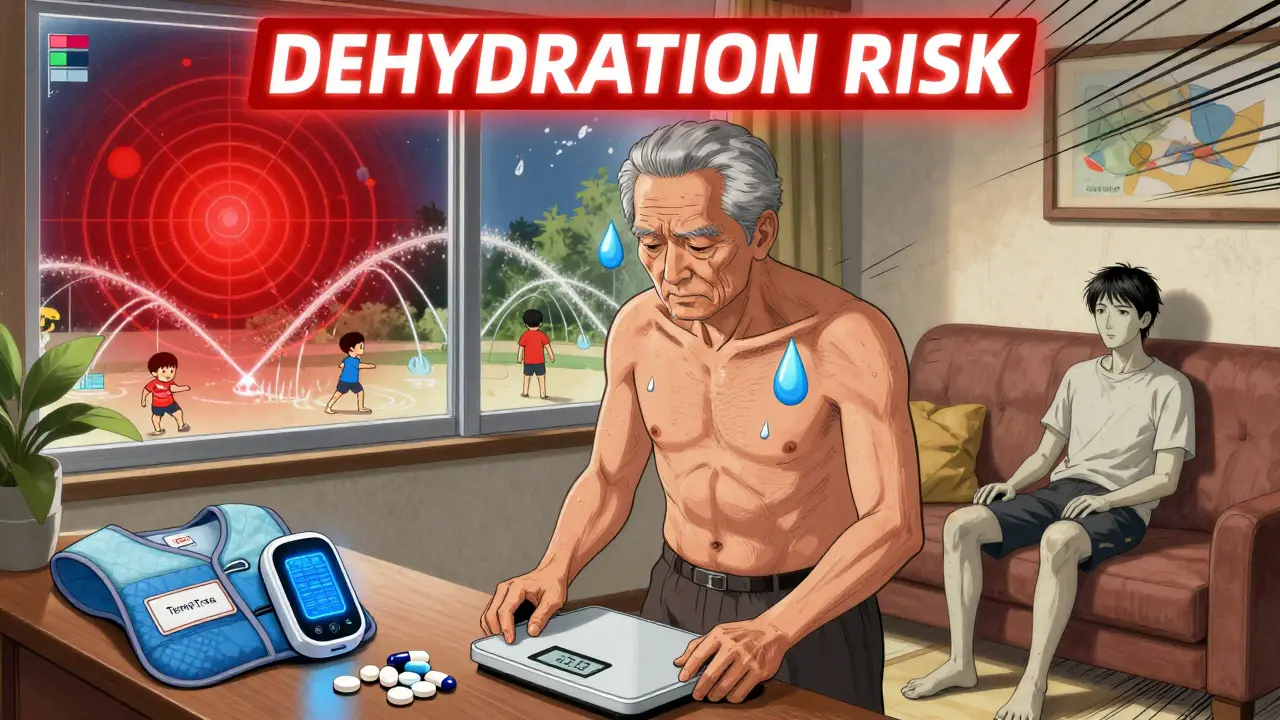
Signs You’re Overheating
If you’re on any of these meds, learn the warning signs. They don’t always look like classic heat illness.- Cramps (65% of cases)
- Dizziness or lightheadedness (55%)
- Headache (70%)
- Flushed, dry skin - or no sweating at all (85%)
- Nausea or vomiting (35%)
- Weakness or fatigue
- Rapid heartbeat
What You Can Do
You can’t always stop your meds. But you can manage the risk.- Drink more water. Add 500 to 1000 mL extra per day during hot weather. Don’t wait until you’re thirsty.
- Avoid the sun between 10 a.m. and 4 p.m. That’s when UV radiation peaks and temperatures are highest.
- Use air conditioning. If your home doesn’t have it, go to a mall, library, or cooling center. Even a few hours of cool air helps.
- Check your weight daily. Losing more than 2% of your body weight in a day means you’re dehydrated. Weigh yourself in the morning before eating or drinking.
- Wear cooling gear. Cooling vests can drop your core temperature by 0.5°C to 1°C. They’re especially helpful for people on antipsychotics or anticholinergics.
- Use SPF 30+ sunscreen. Some meds - like calcium channel blockers and ACE inhibitors - make your skin more sensitive to sunburn. Protect yourself.
- Ask your doctor. If you’re on multiple meds, ask if any of them affect heat tolerance. Ask if there’s a safer alternative.
What’s New in 2026
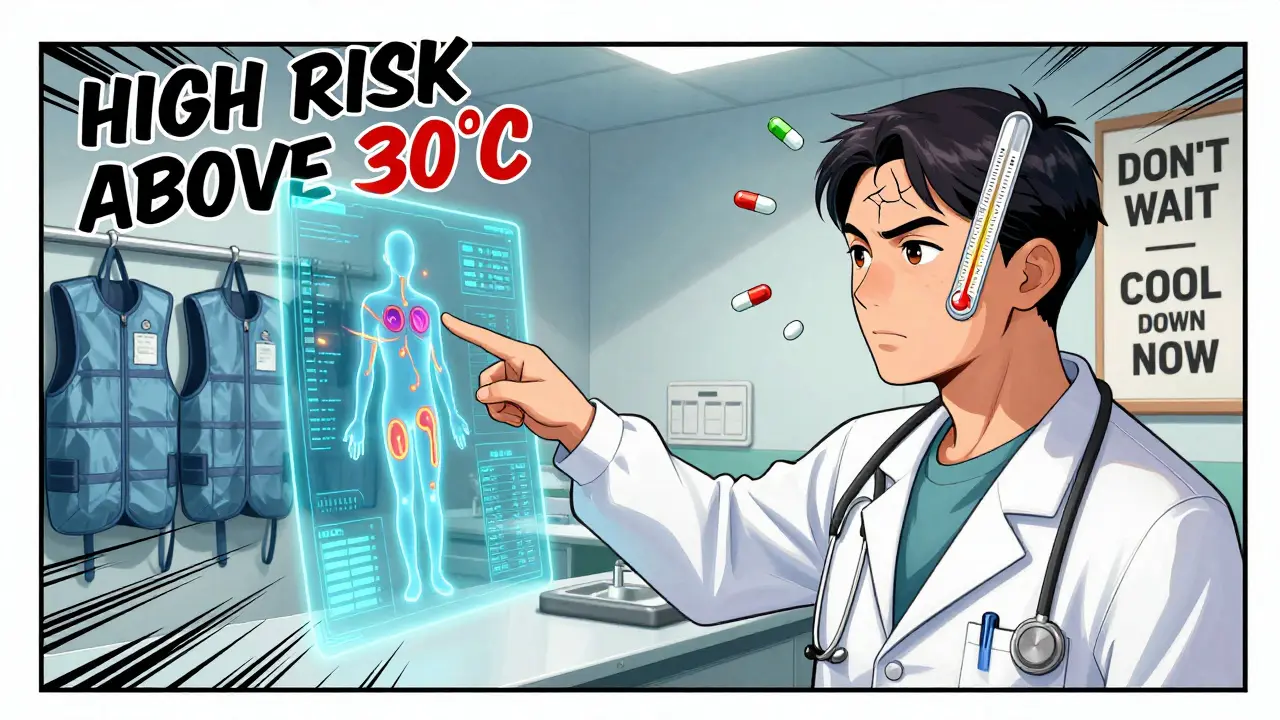
Health systems are starting to catch up. In 2023, Epic Systems added automatic alerts in electronic health records for 14 high-risk medications during summer months. If your doctor prescribes one of them, your chart now flags you as heat-sensitive. The FDA approved the first wearable core temperature monitor, TempTraq, in late 2023. It’s designed for people on heat-affecting drugs. It tracks real-time body temperature and sends alerts if you’re rising into danger zone. Researchers are now testing AI tools that analyze your medication list and predict your personal heat risk. A $2.5 million NIH study launched in September 2024 aims to build a tool that tells you: “Based on your drugs, you’re at high risk above 30°C.” That could change how we manage this problem.Final Thought
Heat intolerance from meds isn’t a myth. It’s a measurable, life-threatening side effect. It doesn’t happen to everyone - but it can happen to you. And if you’re on multiple drugs, especially if you’re over 65, you’re already in a high-risk group. Don’t assume you’re fine because you’ve never had a problem before. Heat is getting worse. Medications are getting more common. And your body’s ability to cool down? That’s fragile. Talk to your doctor. Know your meds. Stay cool. Your life might depend on it.Can drinking more water prevent heat stroke if I’m on diuretics?
Drinking more water helps, but it doesn’t fully fix the problem. Diuretics like hydrochlorothiazide force your kidneys to flush out fluid - even if you drink extra. You’re still losing more than you can replace. The key is to reduce heat exposure, not just increase fluids. Your body needs to sweat to cool down, and diuretics cut that ability by 30-50%. So while hydration is important, it’s not enough on its own.
Are over-the-counter meds like Benadryl really dangerous in the heat?
Yes. Diphenhydramine (Benadryl) is an anticholinergic, which blocks sweat glands. Studies show it can reduce sweating by up to 80%. Even a single dose can make you unable to cool down. Many people take it for allergies or sleep, not realizing it’s a major heat risk. The CDC warns that OTC antihistamines are among the top causes of medication-related heat illness in older adults.
Do all antidepressants cause heat intolerance?
No. Tricyclic antidepressants (TCAs) like amitriptyline reduce sweating by 65-75%. But SSRIs like fluoxetine and sertraline actually increase sweating by 20-30%. That sounds helpful, but it can lead to dehydration if you don’t drink enough. So both types carry risk - just in different ways. TCAs stop you from sweating; SSRIs make you sweat too much and lose fluids.
Why is lithium so risky during heat waves?
Lithium is toxic if your blood levels get too high. Dehydration from heat causes your kidneys to hold onto lithium instead of flushing it out. This can spike lithium levels by 25-35%. Even a small increase can cause tremors, confusion, seizures, or kidney damage. The CDC recommends checking lithium levels during heat waves and avoiding outdoor activity when temperatures exceed 29°C (85°F).
Can I switch to a different medication to avoid heat intolerance?
Sometimes, yes. For example, if you’re on a thiazide diuretic, your doctor might switch you to a potassium-sparing diuretic like spironolactone, which causes less fluid loss. If you’re on an anticholinergic for bladder control, mirabegron is an alternative that doesn’t affect sweating. But not all meds have safe alternatives. Never change your meds without talking to your doctor - the risks of stopping could be worse than heat intolerance.
Do cooling vests really work for people on antipsychotics?
Yes. Cooling vests use phase-change materials or circulating coolants to lower core body temperature by 0.5°C to 1.0°C. For people on antipsychotics, who can’t sweat and have impaired brain temperature control, even a small drop can prevent heat stroke. Catholic Health System in the U.S. now recommends them for high-risk patients during heat advisories. They’re not a cure, but they’re a critical safety tool.





Jack Havard
February 12, 2026 AT 07:46Let me get this straight - you’re telling me that sweating is somehow a biological obligation now? Since when did our bodies become a government-regulated cooling system? I’ve taken hydrochlorothiazide for 12 years and never once felt ‘heat intolerant.’ I just don’t go outside. Problem solved. Also, who authorized this article to be a CDC pamphlet? No one asked for this.
Gloria Ricky
February 13, 2026 AT 18:35Thank you for writing this. I’m a nurse and I see this all the time - older folks on 5+ meds, no AC, just sweating it out in a fan. My grandma was on Benadryl for sleep and didn’t realize she couldn’t cool down. She passed out in the yard last summer. This info could save lives. Please share it with your elderly neighbors.
Stacie Willhite
February 15, 2026 AT 18:14I’ve been on oxybutynin for overactive bladder for years. I never connected the dots until I got dizzy at a BBQ last month. I thought I was just dehydrated. Now I carry a water bottle everywhere, avoid the sun, and wear a hat like it’s my job. This article made me feel less alone. Thank you for the clarity.
Jason Pascoe
February 16, 2026 AT 14:55As someone from Australia who’s lived through three consecutive record-breaking summers, I can confirm this is real. We’ve had hospital admissions spike in pensioner suburbs where people are on beta blockers and diuretics. The local council now sends out heat alerts with medication warnings. It’s small, but it’s something. We need more of this awareness.
Sonja Stoces
February 17, 2026 AT 08:11Oh wow, so now the government wants to monitor our sweat? 🤡 Next they’ll be tracking our urine output and charging us for ‘excessive dehydration.’ This is just step one. They’re gonna start requiring ‘heat tolerance licenses’ for seniors. I’m already seeing the ads: ‘Your lithium levels are out of compliance. Please report to the Cooling Center.’
Annie Joyce
February 18, 2026 AT 07:39Y’all are underestimating how sneaky this is. I used to think ‘dry skin’ meant I needed lotion. Turns out, it meant my body was screaming for help. I’m on a TCA and didn’t know I was cooking myself from the inside. Now I’ve got a smartwatch that buzzes when my core hits 37.5°C. It’s wild. Also - cooling vests? They’re not for ‘weirdos.’ They’re for people who don’t want to die in a Target parking lot. Wear the vest. Be cool. Be alive.
Rob Turner
February 19, 2026 AT 19:00It’s funny, isn’t it? We’ve built cities with AC, but we still treat our bodies like they’re 18th-century machines. Medications are supposed to help us live longer - but if they make us vulnerable to the very environment we’ve engineered to survive in… maybe we’ve got the wrong priorities. I wonder what the philosophers of antiquity would say about a man who can’t sweat because his pills say so.
Luke Trouten
February 20, 2026 AT 04:15There’s a deeper truth here: modern medicine optimizes for one system at a time - blood pressure, bladder control, mood - without considering the body as a whole. We treat symptoms, not systems. And heat intolerance isn’t a side effect. It’s a system failure. Maybe we need pharmacology that doesn’t just fix one broken part, but respects the whole organism. This isn’t just about pills. It’s about how we think about health.
Gabriella Adams
February 22, 2026 AT 03:46As a geriatric pharmacist, I’ve reviewed over 300 medication regimens for heat risk. The most common mistake? Patients think ‘if I feel fine, I’m fine.’ But heat illness doesn’t announce itself with a siren. It creeps in. I’ve seen people on four heat-affecting drugs die in 48 hours. This isn’t fearmongering. It’s clinical reality. If you’re on multiple meds - especially over 65 - talk to your pharmacist. Not your doctor. Your pharmacist. They know the interactions.
Brad Ralph
February 24, 2026 AT 01:06lmao. they’re gonna make us wear vests. next they’ll be installing sweat sensors in our socks. 🤡
christian jon
February 25, 2026 AT 04:17THIS IS A TRAP. The pharmaceutical industry is pushing this narrative to sell more cooling vests, smartwatches, and ‘heat-safe’ meds. Why do you think the FDA approved TempTraq right after Ozempic sales exploded? It’s not about safety - it’s about profit. They want you scared. They want you dependent. They want you buying $200 vests because you’re ‘at risk.’ Wake up. The real danger is trusting the system that made you sick in the first place.
Sophia Nelson
February 25, 2026 AT 09:11So you’re saying I should stop my meds because I might get warm? What’s next? Tell me to stop taking insulin because I might get hot? This is just another fear tactic. I’m not a lab rat. I’m not wearing a vest. I’m not changing my life because of some article.
steve sunio
February 25, 2026 AT 19:19u gys are so dumb. if u cant sweat u just stay inside. no need for vests or watch or nothin. just dont go out. its that simple. u dont need no doctor. u need common sense.
Robert Petersen
February 26, 2026 AT 15:33I just want to say - thank you. Not just for the article, but for the fact that someone cared enough to write it. My dad’s on lithium and antipsychotics. He didn’t know he was at risk. We’ve got his meds reviewed now. We got him a cooling vest. He’s alive today because of this. You made a difference.