

Otitis externa, commonly called swimmer’s ear, isn’t just an annoyance after a swim-it’s a real infection that can turn a relaxing day at the pool into days of pain and discomfort. Unlike middle ear infections, which happen behind the eardrum, swimmer’s ear affects the skin lining your outer ear canal-the tube that runs from your eardrum to the outside of your head. When this skin gets irritated, wet, or scratched, bacteria or fungi move in and cause trouble. It’s not rare: about 1 in 10 Americans get it every year, according to the CDC. And if you swim often, live in a humid climate, or have diabetes, your risk goes up.
What Causes Swimmer’s Ear?
The outer ear canal is designed to protect itself. It’s slightly acidic-between pH 5.0 and 5.7-which keeps most germs from growing. Earwax, or cerumen, helps by trapping dirt and repelling water. But when that balance breaks down, infection follows.
Swimming is the classic trigger. Water trapped in the ear canal creates a moist environment where bacteria thrive. But you don’t need to swim to get it. Showering, sweating, or even cleaning your ears with cotton swabs can do the same damage. Swabbing pushes wax deeper, scrapes the delicate skin, and removes the natural barrier. That’s why people who clean their ears frequently are more likely to get swimmer’s ear.
There are two main culprits: bacteria and fungi. Pseudomonas aeruginosa is the most common bacterial offender, causing 35-54% of cases. Staphylococcus aureus comes second, responsible for 20-30%. Fungal infections, known as otomycosis, are less common but still make up about 10% of cases-mostly from Aspergillus or Candida species. These fungi love warm, damp places and often show up after antibiotic drops fail to clear a bacterial infection.
People with diabetes or weakened immune systems are at higher risk for severe cases. In rare instances, the infection can spread to the bone around the ear-a condition called malignant otitis externa. It affects only 0.03% of cases but can be life-threatening if not caught early.
How Bad Is It? Symptoms by Severity
Not all cases are the same. Symptoms range from mild irritation to unbearable pain. Doctors classify it in three levels:
- Mild (45% of cases): Itching, slight redness, and a feeling of fullness in the ear. Pain is minimal and gets worse when you tug on the earlobe or press on the bump in front of the ear.
- Moderate (35%): The ear canal starts swelling shut. You might hear muffled sounds. Pain increases, especially when chewing or moving your jaw. Drainage may appear clear or cloudy.
- Severe (20%): The canal is completely blocked by swelling. Pain is intense, sometimes radiating to your neck or face. Fever above 101°F (38.3°C), swollen lymph nodes, and pus are common. This is when you need to see a doctor immediately.
One thing to remember: if you have a perforated eardrum, some ear drops can damage your hearing. Always check with a professional before using anything in your ear if you’ve had ear surgery or tubes.
The Drops That Work: What’s Actually Effective?
Treatment depends on whether it’s bacterial or fungal, and how bad it is. The goal is simple: kill the infection, reduce swelling, and restore the ear’s natural acidity.
For mild cases: Over-the-counter 2% acetic acid with hydrocortisone (sold as VoSoL HC Otic or Swim-Ear) is the first-line choice. It’s cheap-around $15-and works in 85% of cases. Acetic acid restores the ear’s pH, making it hard for bacteria to survive. Hydrocortisone reduces itching and swelling. Many people use it after swimming as a preventive. Studies show it cuts recurrence by 65%.
For moderate to severe cases: Prescription drops like Ciprodex (ciprofloxacin and dexamethasone) are the gold standard. This combo kills bacteria and reduces inflammation in one bottle. Clinical trials show 92% of patients recover within 7 days. It’s more expensive-$147.50 without insurance-but it works faster and more reliably than single-ingredient drops.
Generic alternatives like ofloxacin (OtiRx, approved in March 2023) are also effective. The new extended-release version lasts 24 hours, so you only need one dose a day instead of two. It costs about $45 and has a 94% success rate.
For fungal infections, clotrimazole 1% is the go-to. It works in 93% of cases-far better than acetic acid, which only helps about 78% of fungal cases. If your ear itches like crazy and you see white or black patches inside, it’s likely fungal. Don’t waste time with antibiotic drops-they won’t help.
Stay away from old-school drops like neomycin-polymyxin. They’re cheaper but carry a 5-7% risk of causing allergic skin reactions. Worse, if you have a hole in your eardrum, they can damage your hearing. The FDA warns against them for this reason.

How to Use Ear Drops Correctly (Most People Get It Wrong)
Even the best drops won’t work if you use them wrong. A 2021 study found that 40% of people reduce their own treatment success by applying drops incorrectly.
Here’s how to do it right:
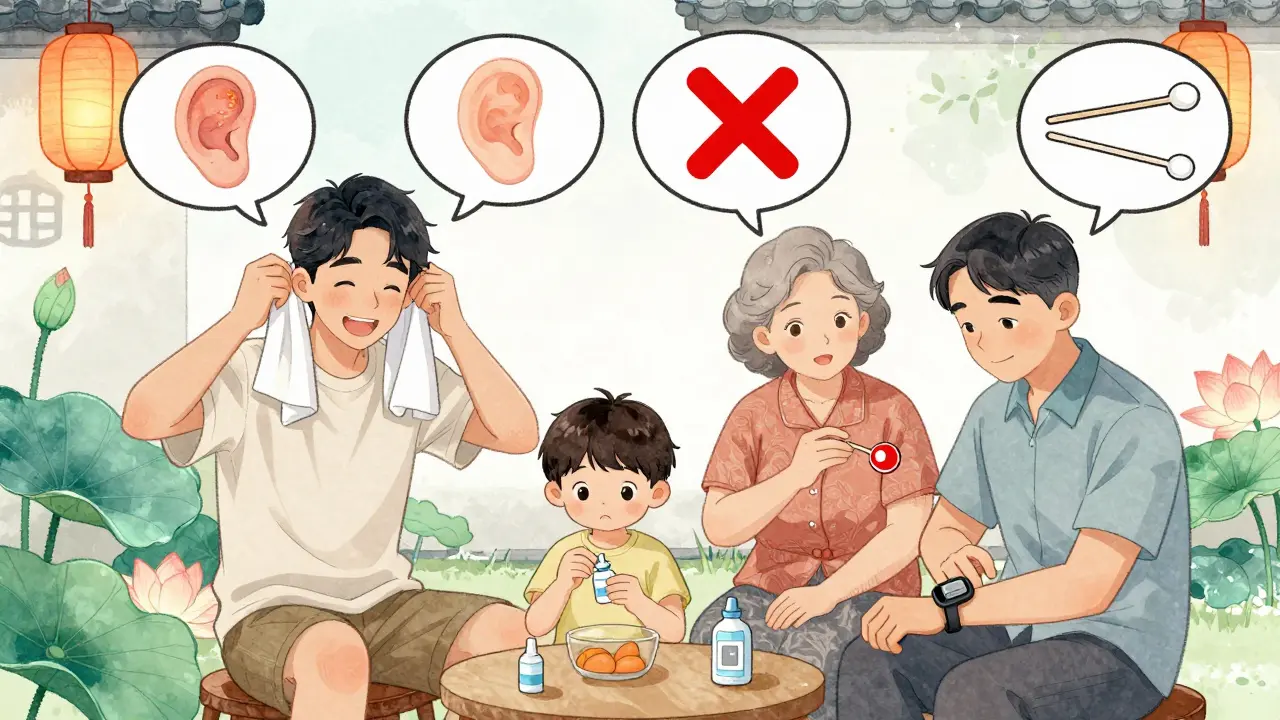
- Warm the bottle in your hands for 1-2 minutes. Cold drops can make you dizzy.
- Wipe the outer ear with a dry cloth. Don’t stick anything inside the canal.
- Lie on your side with the infected ear facing up.
- Instill the exact number of drops prescribed.
- Stay in that position for 5 full minutes. This lets the medicine reach deep into the canal.
- Gently tug on your earlobe to help the drops move deeper.
- Don’t plug your ear with cotton. It absorbs the medicine.
Many people skip the 5-minute wait. Others use cotton swabs afterward-big mistake. You’re wiping out the medicine you just paid for.
If your ear canal is swollen shut, drops can’t reach the infection. In those cases, a doctor may insert a tiny sponge called an ear wick. It expands with moisture and lets the drops soak in. It’s uncomfortable, but it’s necessary. About 65% of patients say it’s worth it.
What Doesn’t Work (And Why You Should Avoid It)
There’s a lot of misinformation out there.
Don’t use hydrogen peroxide. It dries out the skin and can make inflammation worse.
Don’t use vinegar alone. While acetic acid works, plain vinegar is too strong and can burn sensitive skin.
Don’t take oral antibiotics. The American Academy of Otolaryngology says they offer less than 7% extra benefit over topical drops-and they increase side effects like nausea and diarrhea by 15%. For most cases, pills are unnecessary.
Don’t self-diagnose fungal infections. If your symptoms don’t improve in 3 days with antibiotic drops, it might be fungal. But guessing wrong can delay treatment by a week or more.
One study found that 15% of people who tried to treat their own ear infection with OTC drops ended up in the ER because they used the wrong medicine.
Cost, Access, and New Options
Ciprodex is effective but pricey. If cost is an issue, ask your doctor about generic ofloxacin. It’s just as good for most cases and costs a third of the brand name. Some pharmacies offer discount programs-GoodRx can save you $100 or more.
OTC acetic acid drops are great for prevention. Use them after swimming or showering. Just a few drops can keep your ear canal dry and acidic.
New treatments are on the horizon. Stanford University is testing microbiome-based drops that restore healthy ear bacteria instead of killing everything. Early results look promising. But for now, the proven options are still the best.
When to See a Doctor
You don’t need to rush to the clinic for mild itching. But call your doctor if:
- Pain gets worse after 2 days of treatment
- You have a fever or swollen lymph nodes
- Your hearing feels muffled
- You have diabetes and symptoms don’t improve in 48 hours
- You’ve had ear surgery or tubes
Telemedicine is now reliable for diagnosing swimmer’s ear. Mayo Clinic’s 2022 pilot study showed 88% accuracy using video calls. If you’re in a rural area or can’t get an appointment, a virtual visit might be your best first step.
Prevention: How to Avoid It Next Time
The best treatment is no treatment at all. Here’s how to prevent swimmer’s ear:
- Use acetic acid drops after swimming or showering.
- Don’t insert cotton swabs, bobby pins, or fingers into your ear.
- Dry your ears with a towel after water exposure-tilt your head and gently pull the earlobe to help water drain.
- Wear a swim cap or earplugs if you swim often.
- If you have diabetes, keep your blood sugar under control. It’s one of the biggest risk factors.
Swimmer’s ear is common, but it’s not inevitable. With the right knowledge and care, you can enjoy the water without fear.
Can swimmer’s ear go away on its own?
Mild cases can sometimes clear up in a few days without treatment, especially if you keep the ear dry. But waiting is risky. The infection can worsen quickly, leading to severe pain, hearing loss, or spread to surrounding tissue. It’s safer to start treatment early with acetic acid drops or see a doctor if symptoms last more than 48 hours.
Are ear drops safe for children?
Yes, most ear drops are safe for kids, but always check the label or ask a doctor. Ciprodex is approved for children over 6 months. Acetic acid drops are safe for all ages. Never use neomycin-based drops in children unless a doctor specifically recommends them, due to ototoxicity risks. Make sure your child lies still for the full 5 minutes after applying drops-this is key for effectiveness.
Why does my ear hurt more after putting in drops?
It’s common to feel a brief sting, especially if the skin is raw or inflamed. This usually lasts only a few seconds. But if the pain lasts longer, gets worse, or you feel dizzy, stop using the drops and call your doctor. You might have a perforated eardrum, or the drop could be too harsh for your skin. Some people react to the preservatives or alcohol in certain formulations.
Can I use olive oil or home remedies for swimmer’s ear?
No. Olive oil, garlic oil, or tea tree oil are not proven treatments and can trap moisture, making the infection worse. Some home remedies even introduce new bacteria into the ear. Stick to FDA-approved drops or those recommended by a healthcare provider. There’s no substitute for evidence-based medicine here.
How long should I use ear drops?
Always finish the full course-even if you feel better. For Ciprodex, that’s 7 days. For acetic acid, it’s usually 7 days for treatment or daily for prevention. Stopping early can leave behind resistant bacteria, leading to a recurrence. Studies show patients who complete their full course have 50% fewer repeat infections.



Rachel Liew
February 1, 2026 AT 23:33i got swimmer's ear last summer and tried vinegar and olive oil bc i thought it was natural lol
big mistake. my ear felt like it was on fire for hours. never again.
Aditya Gupta
February 3, 2026 AT 22:50acetic acid drops after swimming? yes. i do it every time. cheap, easy, works. no more ear pain.
life changer.
Ed Di Cristofaro
February 4, 2026 AT 14:24people still use neomycin drops? bruh. the FDA warned about this like 5 years ago. you’re lucky you didn’t lose your hearing.
if you’re still using old-school drops you’re one step away from a medical meme.
Donna Macaranas
February 4, 2026 AT 15:36my sister had this last year and used ciprodex. she said the drops felt cold at first but then it just… worked. no drama.
glad there’s actual science behind this.
Melissa Melville
February 5, 2026 AT 18:09oh so that’s why my ear started itching after i used hydrogen peroxide like a genius 😅
thanks for saving me from myself.
franklin hillary
February 6, 2026 AT 00:40listen. the ear is not a vacuum. it’s a living system. you don’t scrub it clean like your sink.
the wax? the acid? the curve? it’s all engineered. stop poking it. stop pouring crap in it.
let it heal. let it balance. let it be.
modern medicine is just catching up to what our bodies already knew.
we’ve been fighting nature with Q-tips for a century. time to stop.
you don’t need to fix what isn’t broken.
but when it breaks? use the drops. not the vinegar. not the garlic. not the faith.
use the science.
and for god’s sake - wait five minutes.
five minutes. that’s all it takes to turn a disaster into a footnote.
stop rushing. stop panicking. just lie there.
your ear will thank you.
and if you’re diabetic? manage your sugar.
it’s not magic. it’s biology.
Ishmael brown
February 6, 2026 AT 14:55they say acetic acid works but i tried it and my ear felt like i poured lemon juice in it 😤
also i think this whole post is overhyped. 🤷♂️
just let it dry out bro. 🌊👂
vivian papadatu
February 6, 2026 AT 15:31the ear wick thing? i had one last winter. it’s uncomfortable but honestly? worth it.
you feel like a robot for a day but then - silence. no pain. no pressure.
just peace.
and yes, i cried. but not because of the pain.
because i finally could sleep.
Deep Rank
February 8, 2026 AT 07:57okay but why are we even talking about drops when the real issue is that people don’t know how to dry their ears after swimming? like… do you even towel off? or do you just shake your head like a dog and hope for the best? 🤦♀️
and then you wonder why your ear gets infected? it’s not the water. it’s your laziness.
also i saw someone use a hairdryer on low heat - that’s actually genius. why isn’t this in the article?
and why is everyone so obsessed with buying expensive drops when the solution is literally 5 seconds of drying?
we’ve turned a simple hygiene issue into a pharmaceutical industry cash grab.
and now you’re all buying ciprodex like it’s designer perfume.
just dry your ears. please.
Naomi Walsh
February 9, 2026 AT 12:32the fact that you’re even considering over-the-counter acetic acid for anything beyond prevention is alarming.
if you’re symptomatic, you need a prescription. period.
anyone who self-treats with OTC drops after 48 hours is playing Russian roulette with their auditory nerve.
and don’t get me started on ‘home remedies’ - that’s not wellness, that’s negligence.
you wouldn’t put tea tree oil on a surgical wound, so why treat your ear like a DIY spa?
Bryan Coleman
February 10, 2026 AT 16:39used ofloxacin last month. worked great. $45? yes. i saved $100 with goodrx.
just remember to warm it up. cold drops = instant vertigo.
and don’t forget the 5-minute rule. i skipped it once. regretted it for days.
Jamie Allan Brown
February 11, 2026 AT 05:28i used to think swimmer’s ear was just a ‘bad swim’ thing.
then i got it after a shower.
turned out i was cleaning my ears with a toothbrush. 🤦♂️
no more. just water. then dry. then walk away.
my ear thanked me.
Lisa Rodriguez
February 11, 2026 AT 08:04my kid got swimmer’s ear at age 4 and we used ciprodex - doctor said it’s safe for over 6 months
he cried during the drops but stayed still for 5 minutes like they said
next day he was back to running around like nothing happened
so yeah. drops work. just follow the steps
and stop letting them use q-tips. seriously. stop.
Lilliana Lowe
February 12, 2026 AT 09:48the article mentions ‘microbiome-based drops’ as if they’re some revolutionary breakthrough - yet cites zero peer-reviewed data.
Stanford? That’s a press release, not a clinical trial.
Meanwhile, the efficacy of ciprofloxacin-dexamethasone is documented in over 17 RCTs with pooled sample sizes exceeding 3,200 patients.
Let’s not confuse anecdotal optimism with evidence-based medicine.
And while we’re at it - ‘acetic acid cuts recurrence by 65%’? Source? Citation? Or is this just a marketing bullet point?
Jaden Green
February 12, 2026 AT 09:54why are we even discussing this? it’s just ear pain.
people used to live without ear drops. they’d just suffer for a week.
now we’ve turned a minor annoyance into a pharmaceutical emergency.
and the real tragedy? nobody teaches kids how to dry their ears.
we’re creating a generation of people who think their ears need constant chemical intervention.
we’ve forgotten how to let nature fix things.
and now we’re paying $150 for a bottle of drops because we don’t know how to tilt our heads.
pathetic.