
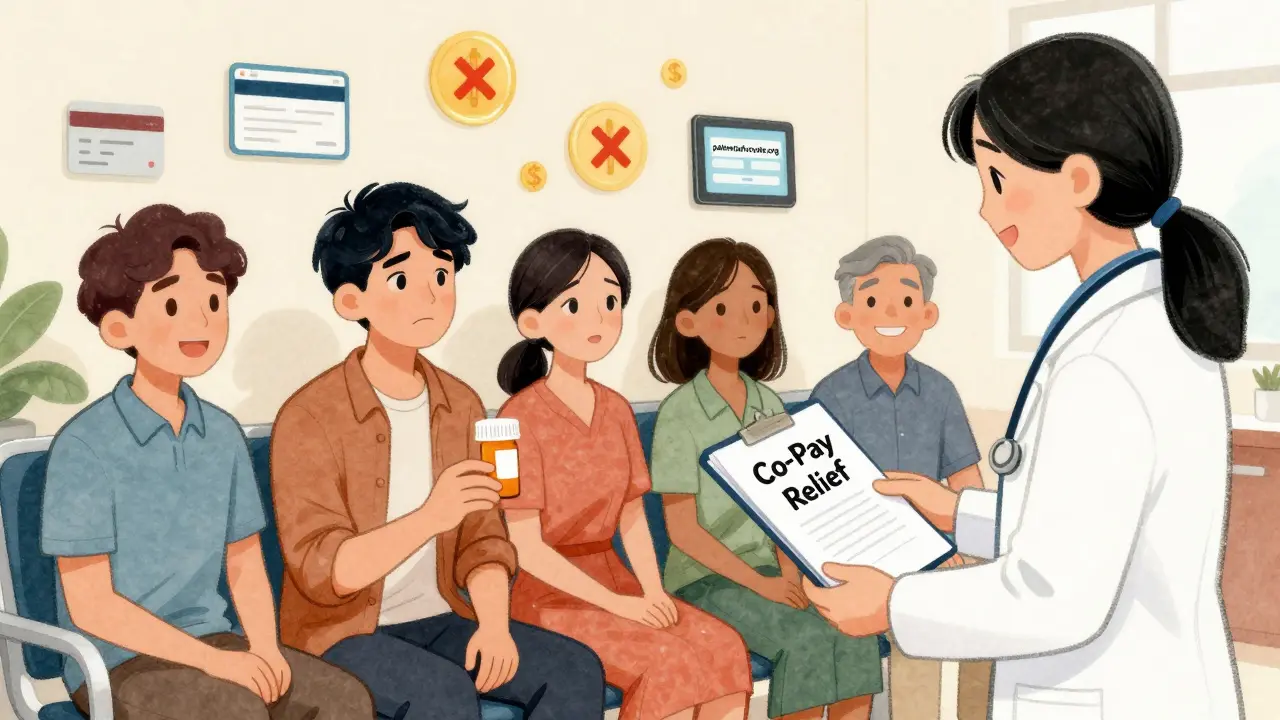
Getting the medicine you need shouldn’t mean choosing between rent and refills. Thousands of Americans face this choice every month because of high drug prices - even if they have insurance. That’s where patient advocacy foundations come in. These nonprofits don’t just offer hope; they give real money to help cover the cost of prescriptions. But how do you actually get that help? It’s not as complicated as it sounds, but there are rules, deadlines, and steps you can’t afford to miss.
What Patient Advocacy Foundations Actually Do
Patient advocacy foundations like the Patient Advocate Foundation (PAF) are nonprofit groups that connect people with financial help for medications. They’re not drug companies. They’re not government programs. They’re independent organizations funded by donations, grants, and partnerships - and they focus on filling the gaps that insurance doesn’t cover. For example, if you have a commercial insurance plan with a $2,000 deductible and your monthly cancer drug costs $800 after insurance, you’re still paying out of pocket. That’s where PAF’s Co-Pay Relief Program steps in. It doesn’t pay for the whole drug - it pays your co-pay, co-insurance, or deductible costs. For people with rare diseases like thyroid eye disease or sepsis, these grants can be the difference between staying on treatment and stopping it. Unlike pharmaceutical company programs that only help with their own drugs, patient advocacy foundations often cover multiple medications from different makers. That’s huge if you’re taking five different prescriptions for one condition.Who Qualifies for These Grants
You don’t need to be broke to qualify. You just need to be struggling. Here’s what most foundations require:- A confirmed diagnosis of a serious health condition - like cancer, kidney disease, or autoimmune disorders
- Proof you’re actively getting treatment - or starting within the next 60 days
- U.S. citizenship or permanent residency
- Treatment happening in the U.S. or a U.S. territory
- Income below a certain threshold (usually 400-500% of the federal poverty level)
How to Find the Right Foundation and Program
Not all foundations help with every drug. PAF runs dozens of condition-specific funds. Here’s how to find yours:- Go to www.patientadvocate.org
- Click on “Financial Aid Funds” or “Co-Pay Relief”
- Search by your condition - type in “lupus,” “multiple sclerosis,” or “HIV”
- Check if your medication is listed under “eligible drugs”
- Read the fine print on income limits and application deadlines
The Application Process - Step by Step
Applying takes time, but it’s doable. Here’s what you’ll need:- Your diagnosis letter from your doctor - must be signed and dated
- Proof of income - last two pay stubs, tax return, or a letter from your employer
- Proof of residency - utility bill, lease, or driver’s license
- Insurance card - front and back
- Prescription details - drug name, dosage, frequency
- A completed provider form - your doctor or pharmacy must fill this out

What Happens After You Apply
Once you submit everything, you’re in a queue. Funding is first-come, first-served. That means timing matters.- If a fund is full, your application will be held until the next month
- Some funds reopen on the first business day of the month - apply right then
- If approved, the grant goes directly to your pharmacy or insurer - not to you
- Grants usually cover 1-3 months of co-pays at a time
- You’ll need to reapply every few months if you still need help
How This Compares to Other Help Options
There are other ways to get drug help - but they work differently:| Option | Best For | Eligibility | How Long It Lasts | Funding Source |
|---|---|---|---|---|
| Patient Advocacy Foundations (like PAF) | Insured patients with high co-pays | U.S. citizens, income limits, active treatment | 1-3 months at a time; reapply monthly | Donor-funded |
| Pharmaceutical Company PAPs | Uninsured patients needing one specific drug | No insurance, income under 400% FPL | Usually 1 year; renewable | Drug manufacturer |
| Medicaid/Medicare | Low-income seniors or disabled | State or federal eligibility rules | Ongoing if eligible | Government |
| State Prescription Assistance Programs | Residents of specific states | Varies by state | Varies | State government |
Pro Tips to Increase Your Chances
- Apply early in the month - funds refill on the first business day. Don’t wait until the 25th. - Keep copies of everything - even if you apply online, print or save your submission confirmation. - Call your pharmacy - they know which programs work with them and can help fill out forms. - Don’t give up if you’re denied - 30% of initial applications are incomplete, not ineligible. - Ask your doctor to write a letter - explaining why the medication is medically necessary can strengthen your case. - Check for new funds - PAF added Thyroid Eye Disease and Sepsis funds in 2024. Your condition might be newly covered.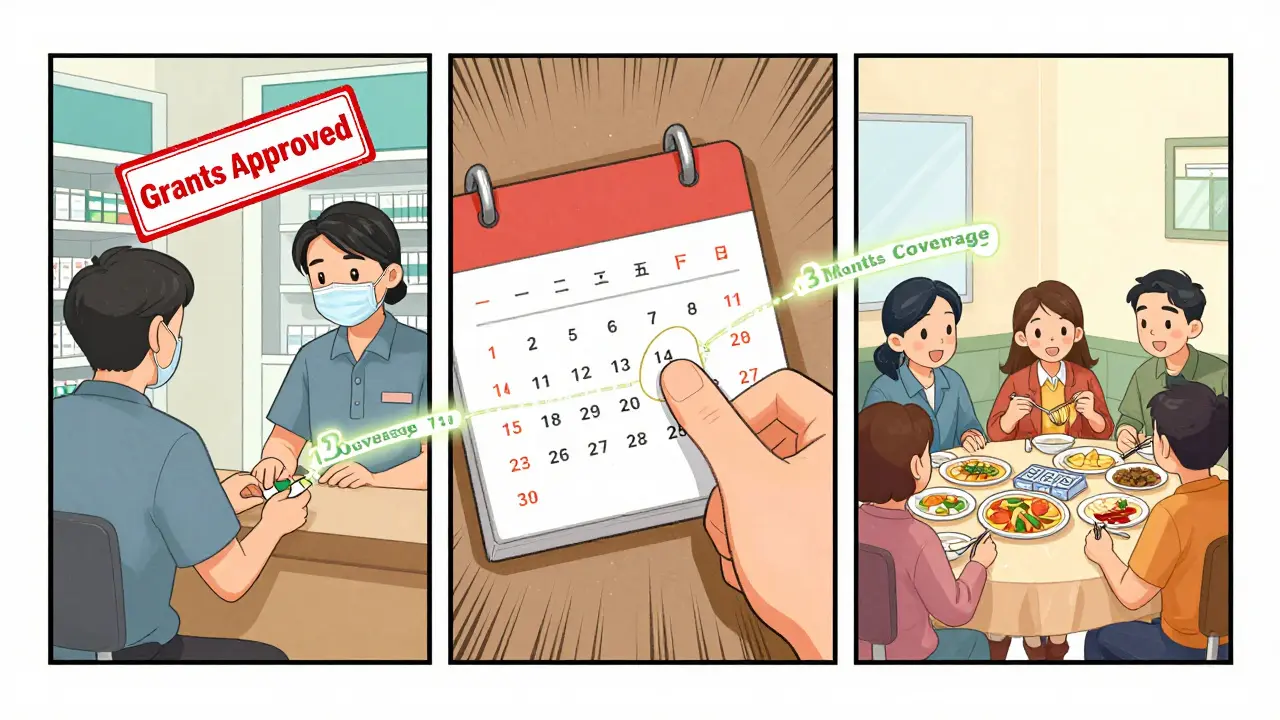
What If You Don’t Qualify?
If you’re turned down, it’s not the end. Look at other options:- Ask your doctor for samples
- Use GoodRx or SingleCare coupons - they often beat co-pays
- Apply for Medicaid if your income dropped
- Check if your employer offers a health savings account (HSA) or flexible spending account (FSA)
- Reach out to local charities - food banks and religious groups sometimes help with medical bills
Why This Matters Right Now
Prescription drug prices rose 55% between 2014 and 2022. In 2026, nearly 30 million Americans still don’t have health insurance. Millions more are underinsured - meaning their plans don’t cover what they need. Patient advocacy foundations aren’t a perfect fix. They’re underfunded. They close when money runs out. But they’re one of the few systems still working to keep people alive when the system fails them. This isn’t charity. It’s survival.Can I get a medication grant if I have Medicare?
Most patient advocacy foundations, including PAF’s Co-Pay Relief Program, do not help people with Medicare. Medicare has its own cost protections, and these programs are designed to fill gaps for those with private insurance. However, some broader financial aid funds may assist Medicare beneficiaries with non-medication costs like transportation or lab fees. Always check the specific program’s rules.
How long does it take to get approved for a medication grant?
Approval usually takes 2-4 weeks after submitting a complete application. If your doctor’s form is delayed, it can take longer. Once approved, the payment is sent directly to your pharmacy or insurer within 1-2 weeks. Apply early - funds can fill up fast.
Do I have to reapply every month?
Yes - most grants cover only 1 to 3 months of co-pays. You’ll need to reapply each time your funding runs out. Some programs allow you to submit renewal forms early, so you don’t lose coverage. Set calendar reminders to avoid gaps in your treatment.
Can I apply to multiple foundations at once?
Absolutely. You can apply to PAF, pharmaceutical company programs, and state assistance programs all at the same time. Don’t wait to see if one works - apply everywhere you qualify. Many patients get help from two or more sources.
What if my medication isn’t on the eligible drug list?
If your drug isn’t listed, check if there’s a similar alternative your doctor can prescribe. Sometimes a generic version is covered. If not, contact the foundation directly - they occasionally add new drugs. You can also ask the drug manufacturer for a patient assistance program, even if you have insurance.
Is there a limit to how much help I can get?
Yes. Most programs cap assistance at $5,000-$10,000 per year per patient. Some limit it to a certain number of prescriptions per month. The goal is to help you stay on treatment - not cover every drug you ever need. But even $200 a month can make a life-changing difference.
Next Steps: What to Do Today
If you’re struggling to afford your meds, don’t wait. Here’s your action plan:- Write down your diagnosis and all medications you’re taking
- Go to www.patientadvocate.org and search for your condition
- Call their helpline at 1-800-532-5274 if you’re confused
- Gather your income documents and insurance card
- Ask your doctor to complete the provider form - today
- Submit your application by the 3rd of the month to beat the rush

Ryan W
January 25, 2026 AT 22:37This whole system is a band-aid on a gunshot wound. We're outsourcing healthcare survival to nonprofit charity because the system collapsed. Patient Advocate Foundation? Cute name. But if you're not a U.S. citizen with commercial insurance and a clean credit score, you're SOL. And don't get me started on the 'provider form'-doctors are overworked, not volunteer clerks. This isn't advocacy. It's bureaucratic triage dressed up in feel-good marketing.
Also, why is everyone acting like this is new? This has been the reality since 2010. We just finally have a hashtag for it.
Karen Droege
January 27, 2026 AT 13:50OH MY HEART. I just cried reading this. 🥹 I’m a nurse in Vancouver, and I’ve seen patients cry in the parking lot because they had to choose between insulin and their kid’s school supplies. This guide? It’s a lifeline. But please-don’t just read it. PRINT IT. Give it to your doctor. Hand it to your neighbor who’s quiet at the grocery store. This isn’t just paperwork-it’s dignity.
And if you’re reading this and thinking, 'I don’t qualify,'-you probably do. The income limits are higher than you think. Call the helpline. Even if you’re scared. Even if you’ve been turned down before. I’ve seen people get approved on the third try. Don’t give up. You’re worth the fight.
Also-thank you for listing the exact website. So many posts just say 'look it up.' You gave us the map. That’s rare.
Napoleon Huere
January 27, 2026 AT 18:26There’s a deeper philosophical layer here we’re ignoring. This isn’t about medication grants. It’s about the commodification of life. We’ve turned healthcare into a transactional experience where survival is contingent on paperwork, income brackets, and bureaucratic luck. The foundation isn’t helping you-it’s mediating between your body and a broken market.
When the state outsources care to nonprofits, it’s not generosity-it’s abdication. We’re not 'grateful' for this system. We’re surviving it. And the fact that we’ve normalized this as 'smart advocacy' is the real tragedy. We’re not fixing the disease-we’re just getting better at treating the symptoms of systemic collapse.
So yes, apply. But also protest. Because no one should need a nonprofit to stay alive.
Shawn Raja
January 29, 2026 AT 17:39Let me get this straight-you’re telling me a 65-year-old with stage 4 pancreatic cancer has to submit six forms, wait 3 weeks, and hope a fund reopens on the first business day of the month… just to get her co-pay covered? And we call this 'advocacy'? 😂
Meanwhile, Big Pharma is raking in $12 billion in profits off one drug. But hey, at least we have a nonprofit that’ll pay $200/month so she doesn’t die in her garage. Classic American logic.
Apply? Yes. But also burn the system down. This isn’t help. It’s a public relations stunt with a donor list.
Henry Jenkins
January 31, 2026 AT 01:16I’ve been through this process twice-once for my wife’s autoimmune meds, again for my dad’s diabetes. The system is a maze, but it’s not impossible. One thing no one talks about: the pharmacy. Most pharmacists know these programs better than doctors. They’ve seen the same names come through for years. Ask them to call the foundation on your behalf. They have direct lines.
Also, the 'provider form' is the real bottleneck. I had my doctor’s office refuse to fill it out until I printed the entire application page, highlighted the instructions in yellow, and left it on their desk with a Starbucks gift card. Yes, I bribed them. Would I do it again? In a heartbeat.
And yes, you can apply to multiple foundations. I got help from PAF, a state program, AND the drug manufacturer. It’s not cheating-it’s strategy. Treat it like a game of chess. Move early. Move often.
And don’t let anyone tell you you’re 'deserving' or 'not deserving.' You need the meds. That’s the only metric that matters.
TONY ADAMS
January 31, 2026 AT 02:21bro i just got denied for my insulin and now i’m crying in my car. can someone send me the link again? i missed it. also does this work for marijuana? i need it for my anxiety. my doctor said it’s better than pills. pls help. i’m so tired.
Uche Okoro
February 1, 2026 AT 03:47This is a textbook example of neoliberal healthcare privatization masquerading as compassion. The Patient Advocate Foundation operates as a structural buffer-absorbing the social costs of unregulated pharmaceutical pricing while absolving the state and corporations of accountability. Their funding model is predicated on donor fatigue and public apathy.
Moreover, the exclusion of Medicare beneficiaries is not an oversight-it’s a deliberate policy choice to preserve the illusion that public insurance is 'sufficient.' The fact that this is presented as a 'solution' rather than a symptom of systemic failure is the most insidious part.
Do not mistake charity for justice.
shivam utkresth
February 1, 2026 AT 13:24As someone from India who moved to the U.S. for treatment, I was shocked at how fragmented this system is. Back home, I’d just walk into a hospital and get the drug. Here, you need a degree in bureaucracy just to breathe.
But I’m grateful for this guide. I applied to PAF last month-got approved in 17 days. The hardest part? Getting my doctor to fill out the form. I had to explain the program to him three times. He said, 'I didn’t know this existed.'
So if you’re reading this and you’re a healthcare provider? Please, learn this. Your patient might be one form away from giving up.
And if you’re a patient? Don’t apologize for asking for help. You’re not begging. You’re claiming what’s yours.
Joanna Domżalska
February 3, 2026 AT 10:25Wait. So we’re celebrating a nonprofit that helps people afford drugs… but only if they have private insurance? That’s not advocacy. That’s gatekeeping with a heart emoji.
And why is everyone acting like this is groundbreaking? This has been happening since the 90s. The only difference now is that we’ve branded it as 'empowerment.'
Also-'don’t give up if denied'? What kind of toxic positivity is this? If you’re denied, it’s because the system doesn’t care. Not because you didn’t try hard enough.
Stop romanticizing broken systems. Fix them. Or shut up.
Faisal Mohamed
February 3, 2026 AT 16:32Okay, I just cried reading this. 🥺💔 I’ve been applying to PAF for my daughter’s rare disease meds for 8 months. We got approved on the 3rd try. The first time? Missing one signature. Second time? Insurance card expired. Third time? I printed the whole guide and taped it to the fridge. I made my husband read it out loud every night.
And guess what? We got it. Not because we’re special. Because we didn’t quit.
Also-thank you for listing the exact phone number. I called at 7 a.m. and got a real person. Not a bot. Not a voicemail. A HUMAN. That’s rare. 🙏
PS: I used GoodRx to cover the gap while waiting. It saved us $150/month. Link in comments if you need it.
Sally Dalton
February 3, 2026 AT 18:46i just wanna say thank you for writing this. i’ve been too scared to apply for my meds for a year. i thought i was too rich because i have a job… but my deductible is $6k and my co-pay is $400 a month. i’m not broke, but i’m not okay. this made me feel like i’m not crazy for needing help.
also i’m gonna call the helpline tomorrow. i’m so nervous but i’m doing it. thank you for making me feel like i’m not alone. 💛
Mohammed Rizvi
February 4, 2026 AT 23:32Let’s be real: this guide is great. But it’s also a symptom of a society that lets people die because they can’t afford a pill.
I’ve seen friends get approved. I’ve seen friends die waiting. The difference? Timing. Luck. A doctor who actually cared.
So yes-apply. Do everything in this post. But don’t call it 'advocacy.' Call it what it is: survival hacking. And if you’re one of the lucky ones who gets through? Use your voice. Don’t just say 'thank you.' Say 'this is wrong.'
Because next time, it might be your kid.
Napoleon Huere
February 6, 2026 AT 09:43Interesting how everyone’s focused on the mechanics of the grant-when the real issue is why we’re even here. We’ve normalized the idea that human survival should be contingent on a form, a signature, a fund that runs out on the 15th of the month.
What if we stopped asking 'how do I get this grant?' and started asking 'why does this grant exist at all?'
Because the answer isn’t charity. It’s accountability.