
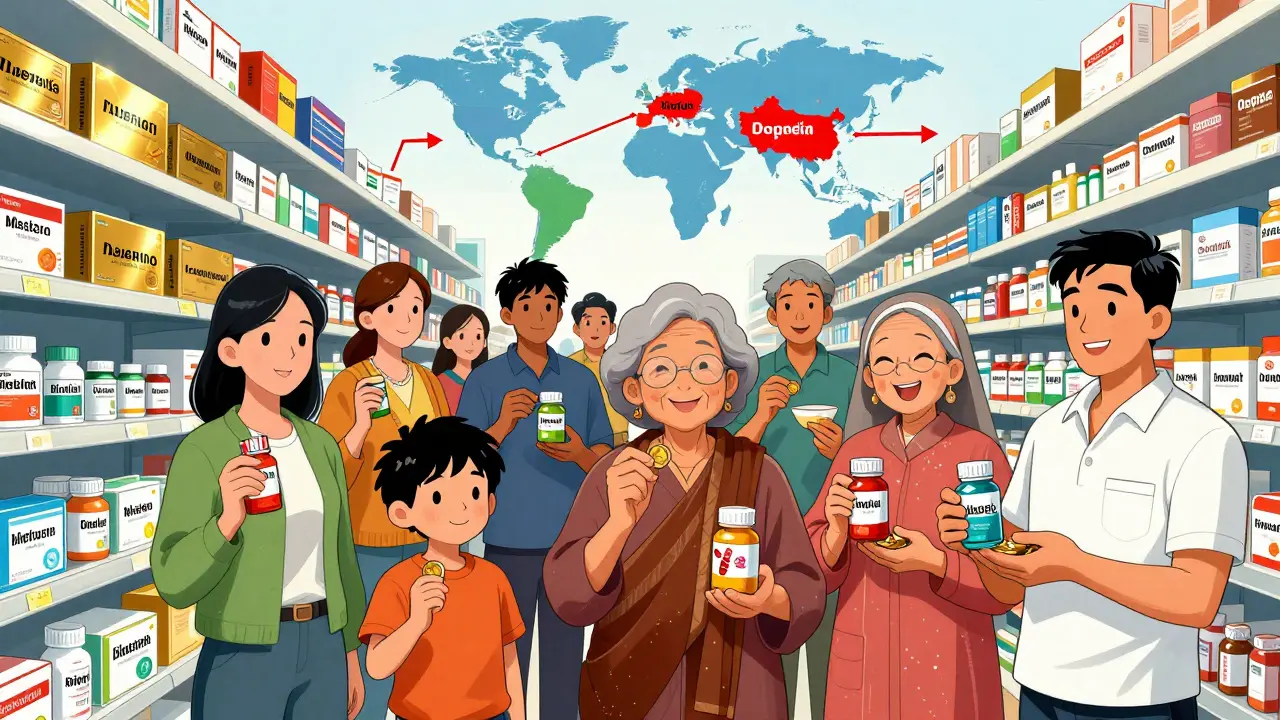
Every year, people around the world spend trillions on healthcare. In 2025, global health spending is expected to hit $10.5 trillion. But here’s the thing: most of that money doesn’t go to doctors or hospitals. It goes to medicines. And not just the new, flashy ones. A huge chunk - often more than half - is spent on generics. These are the cheaper, no-name versions of brand-name drugs. They’re not copies. They’re the same medicine, just without the marketing. And they’re the reason millions of people can still afford to take their blood pressure pills, insulin, or antibiotics.
Why Generics Are the Silent Stabilizers of Global Health
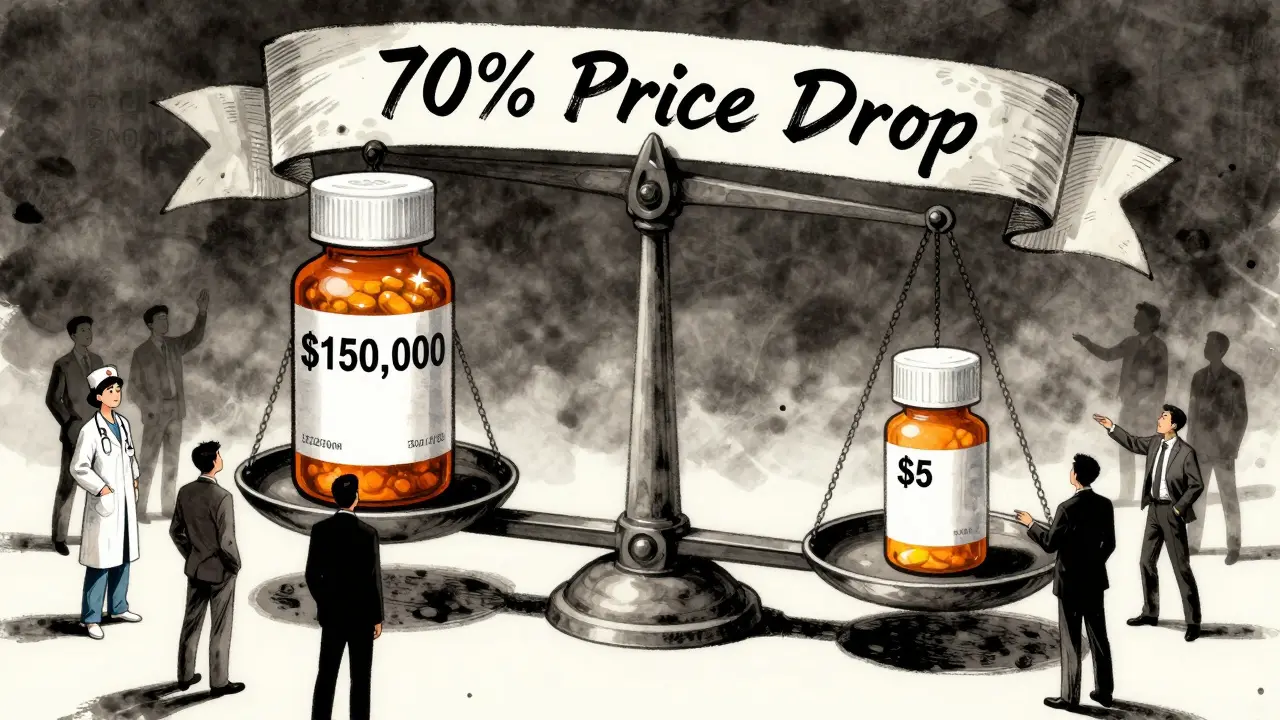
Imagine a world without generics. You’d pay $300 for a month’s supply of metformin for diabetes. Or $2,000 for a generic version of a cancer drug that used to cost $10,000. That’s not hypothetical. In the U.S., brand-name drugs like Humira cost over $7,000 per month before biosimilars arrived. Now, with generics and biosimilars, the price has dropped by 70% in some markets. That’s the power of competition.
Generics aren’t just cheaper. They’re essential. In high-income countries, 80-90% of all prescriptions are filled with generics. In the U.S., generics made up 90% of prescriptions in 2024 but accounted for only 15% of total drug spending. That’s because brand-name drugs, especially new ones in oncology, immunology, and obesity, are priced at astronomical levels. The average new cancer drug costs over $150,000 a year. Generics keep the system from collapsing under its own weight.
The Real Cost of Healthcare: Who Pays and Who Can’t
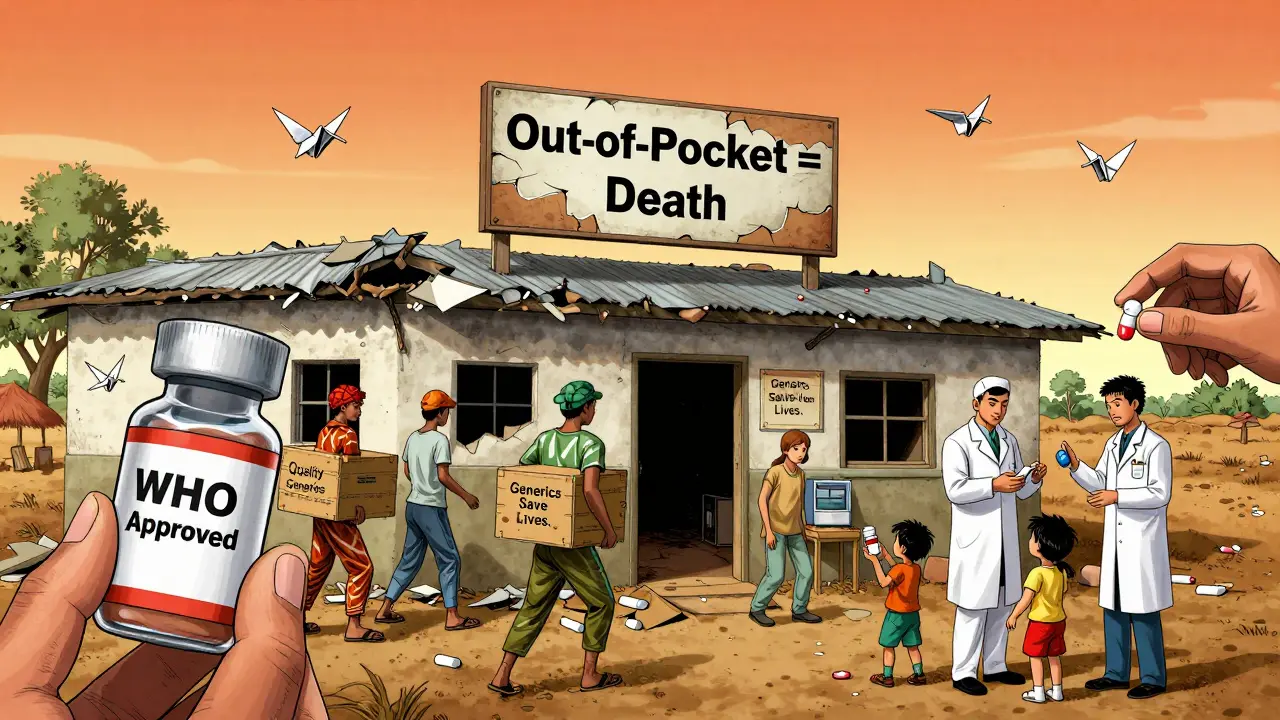
But here’s where it gets ugly. In 55 countries, people pay for healthcare out of their own pockets. That means if you’re in Nigeria, Afghanistan, or Turkmenistan, and you need a generic antibiotic, you buy it with cash - no insurance, no government help. In those places, out-of-pocket spending makes up more than 75% of total health costs. That’s not a choice. That’s survival.
Compare that to the U.S., where even with insurance, out-of-pocket drug costs are rising. In 2025, the average American will pay $177 per person on prescriptions. By 2033, that number is projected to jump to $231. That’s a 30% increase. Meanwhile, in low-income countries, the average person spends less than $1 a year on healthcare. That’s not a budget. That’s a joke. And yet, even there, generics are the only thing keeping people alive.
According to Human Rights Watch, only high-income countries hit the WHO-recommended 5% of GDP spent on health. The rest? Upper-middle income countries average 4%. Lower-middle? 2.4%. Low-income? Just 1.2%. No low-income country meets the benchmark. Generics aren’t a luxury here. They’re the only reason any care exists at all.
Generics vs. Innovation: The Economic Tightrope
There’s a myth that generics kill innovation. They don’t. They balance it. The global pharmaceutical market is growing at 3-6% a year and will hit $1.6 trillion by 2025. But that growth is fueled by new, expensive drugs - not generics. Generics don’t drive that growth. They contain it.
Think of it like this: pharmaceutical companies spend billions developing a new drug. They get 10-12 years of patent protection. During that time, they charge what the market will bear. Then the patent expires. Suddenly, 20 companies can make the same pill. Prices drop by 80-95%. That’s not a failure. That’s the system working.
In the U.S., drug spending jumped $50 billion in 2024 alone - from $437 billion to $487 billion. Most of that was in specialty drugs: cancer, diabetes, autoimmune diseases. These are areas where generics are scarce. Why? Because they’re hard to make. Biologics - drugs made from living cells - are complex. Copying them isn’t like copying a pill. That’s where biosimilars come in. They’re the next wave of generics for complex drugs. But adoption is slow. Doctors don’t always trust them. Insurers don’t always cover them. Patients don’t always know they exist.
Where Generics Work - and Where They Don’t
Generics aren’t the same everywhere. In Europe, they’re standard. In India and China, they’re the backbone of the system. India produces 20% of the world’s generic medicines. China is catching up fast. But in Africa, Latin America, and parts of Asia, access is patchy. Why?
It’s not about demand. It’s about supply chains, regulation, and trust. In many low-income countries, the problem isn’t that generics don’t exist. It’s that they’re not available in rural clinics. Or the quality is unreliable. Or the government doesn’t prioritize procurement. The WHO Global Health Expenditure Database shows that 37 countries saw real cuts in public health spending after the pandemic. Lebanon’s spending dropped 71%. Malawi’s fell 41%. When governments can’t buy medicines, people die.
Meanwhile, in the U.S., generics are everywhere - but they’re not always affordable. A 30-day supply of lisinopril, a generic blood pressure drug, can cost $4 at Walmart. But if you’re uninsured or underinsured, even $4 is too much. Some states have programs to help. Most don’t. And with Medicare Part D’s coverage gap - the so-called “donut hole” - many seniors pay full price for drugs until they hit a spending cap. Generics help, but they don’t fix the system.
The Future of Generics: Biosimilars, Policy, and Global Equity
The next big shift isn’t just about more generics. It’s about biosimilars. These are the next generation - cheaper versions of biologic drugs like Humira, Enbrel, and insulin. They’re complex, expensive to develop, and hard to approve. But they’re coming. In 2025, the first biosimilar to Humira hit the U.S. market. Prices dropped 35% in the first year. That’s huge.
But policy matters. In countries with strong generic procurement systems - like the UK, Canada, or Thailand - prices stay low. In countries with weak regulation - like many in Africa - counterfeit drugs flood the market. Fake insulin. Fake antibiotics. People die. The World Health Organization estimates that 1 in 10 medical products in low- and middle-income countries is substandard or falsified. That’s not a market failure. It’s a crime.
Meanwhile, global health aid is shrinking. Development assistance for health is projected to drop to $39.1 billion in 2025 - the lowest since 2009. That means countries can’t rely on outside help anymore. They have to build systems that work with what they have. Generics are the answer. But only if governments invest in supply chains, quality control, and training for pharmacists and doctors.
What This Means for You
Whether you live in Melbourne, Mumbai, or Milwaukee, the economics of generics affect you. If you take a daily pill, you’re probably on a generic. If you’re worried about drug costs, ask your doctor: “Is there a generic version?” If you’re in a country with public health coverage, demand that generics be prioritized in formularies. If you’re in a country without it, support organizations that bring affordable medicines to clinics.
Generics aren’t glamorous. They don’t make headlines. But they keep the world running. They’re the reason a child in Kenya can get antibiotics for pneumonia. The reason a diabetic in Brazil can afford insulin. The reason a retiree in Ohio doesn’t have to choose between food and medication.
Healthcare spending is rising. Innovation is expensive. But if we want a world where no one dies because they can’t afford a pill, we need to protect and expand access to generics. Not as a last resort. Not as a compromise. But as the foundation of global health equity.
Ayodeji Williams
January 7, 2026 AT 18:35Sai Ganesh
January 8, 2026 AT 08:37Aparna karwande
January 9, 2026 AT 03:32Katrina Morris
January 9, 2026 AT 09:17Rachel Steward
January 9, 2026 AT 21:30Alex Danner
January 11, 2026 AT 06:56Jessie Ann Lambrecht
January 12, 2026 AT 15:46Vince Nairn
January 14, 2026 AT 02:55Paul Mason
January 15, 2026 AT 02:23LALITA KUDIYA
January 15, 2026 AT 07:21Kyle King
January 16, 2026 AT 03:32Jonathan Larson
January 17, 2026 AT 09:29Anthony Capunong
January 18, 2026 AT 12:25