The Hidden Sugar Spike When Taking Steroids
If you've been prescribed a course of steroids for asthma, arthritis, or a severe allergic reaction, you know they are powerful tools. They calm inflammation and help your body heal. However, there is a catch that often catches patients off guard. Corticosteroids is a class of medication that mimics natural hormones produced by the adrenal glands. While essential for treating many inflammatory conditions, these drugs carry a significant metabolic cost. Your blood sugar can skyrocket within days of starting treatment, even if you have never had diabetes before.
Medical literature indicates that between 20% and 50% of patients on high-dose steroid therapy will experience hyperglycemia. This isn't just a minor fluctuation; for some, it becomes a dangerous clinical condition requiring immediate insulin therapy. Understanding why this happens and how to manage it is crucial for your safety. You cannot rely on standard diabetes advice alone because the biology behind steroid-induced spikes is unique.
How Steroids Disrupt Your Metabolism
To understand why your blood glucose rises, we need to look at what Prednisone is a common synthetic glucocorticoid used to suppress the immune system. Glucocorticoids interact with four major areas of your body simultaneously to drive up sugar levels. It's not just one thing going wrong; it's a cascade effect.
First, your liver goes into overdrive. Normally, your liver stores glucose. On steroids, it starts producing new glucose at a rate 35% to 40% higher than usual through a process called gluconeogenesis. Think of the liver as a factory that suddenly gets orders to produce excess product regardless of demand.
Secondly, your muscles become resistant to insulin. Insulin acts like a key that unlocks muscle cells to let glucose in for energy. Steroids interfere with the signaling pathways, specifically targeting the GLUT4 transporter. Research shows this reduces glucose uptake by approximately 30%. Essentially, the key doesn't turn properly anymore, leaving sugar trapped in the bloodstream.
Thirdly, fat tissue releases free fatty acids. Steroids increase lipolysis by up to 30%, flooding your system with fats. These fats create toxic environments for the pancreatic beta-cells that make insulin, further hampering production. Finally, the pancreas itself gets suppressed. The very cells responsible for secreting insulin see a drop in activity of 20% to 35% due to direct interference with their receptors.
| Body System | Mechanism of Action | Net Effect on Glucose |
|---|---|---|
| Liver | Induces gluconeogenesis enzymes | Increases endogenous glucose production by 35-40% |
| Skeletal Muscle | Inhibits GLUT4 transporters | Reduces glucose uptake by ~30% |
| Adipose Tissue | Increases lipolysis and free fatty acids | Exacerbates insulin resistance |
| Pancreatic Beta-cells | Suppresses insulin synthesis genes | Decreases insulin secretion by 20-35% |

Risk Factors That Determine Severity
Not everyone reacts the same way. Some people take high doses without major spikes, while others crash quickly. Medical guidelines from institutions like the Royal Shrewsbury Hospital outline clear risk markers. If you fall into certain categories, you are much more vulnerable.
The dose is the biggest factor. A daily dose of prednisolone equivalent to 7.5 mg or higher increases your risk significantly-by about 3.2 times compared to lower doses. Every additional 5 mg of prednisone you take raises the probability of hyperglycemia by another 18%. Duration matters too. The longer you stay on the drug past two weeks, the more likely your metabolism struggles to adapt.
Your health history plays a role as well. Being over 50 years old triples your risk. If you are overweight (BMI of 25 or higher), you already have some baseline insulin resistance, making you twice as likely to develop issues. Perhaps most importantly, a family history of diabetes or a history of gestational diabetes during pregnancy increases the odds four-fold.
The potency of the steroid also varies. Dexamethasone is roughly six to eight times more potent in causing blood sugar spikes than prednisone at equivalent anti-inflammatory doses. If your doctor switches your regimen, watch your numbers closely.
Monitoring Protocols and Warning Signs
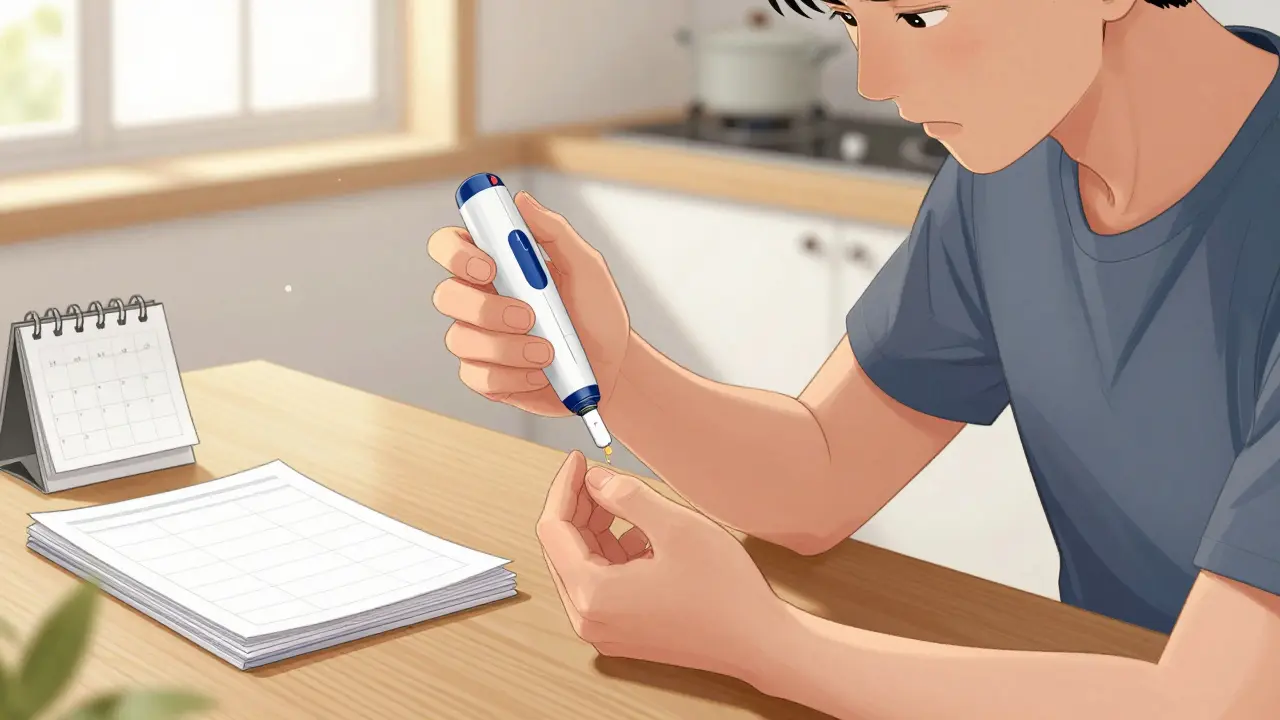
You might wonder if you should be checking your blood sugar. For patients on short courses, routine checks might not happen, which is why many cases go undetected until complications arise. Symptoms include increased thirst, frequent urination, and persistent fatigue. However, about 40% of cases show no obvious symptoms and are found only by blood tests.
Current protocols recommend monitoring blood glucose at least twice daily for anyone taking prednisone above 20 mg per day. You are looking for specific thresholds. If your fasting glucose exceeds 140 mg/dL (7.8 mmol/L) or random glucose is over 180 mg/dL (10.0 mmol/L), pharmacological intervention is usually warranted.
Timing is critical. The hyperglycemic peak typically occurs 4 to 8 hours after your morning dose of steroids. This is known as the "steroid curve." Testing immediately upon waking won't capture the peak; you need to check later in the afternoon to see the true impact. Without catching this window, you might falsely assume the medication is working well.
Treatment Strategies and Medication Adjustments
If your levels do spike, what do you do? Simply taking the medication for your existing diabetes isn't always enough. If you were managing Type 2 diabetes before the steroid prescription, expect your insulin requirements to jump by 50% to 100% during the high-dose phase. Clinical protocols from universities like UCSF suggest increasing basal insulin by 20% for every 10 mg of prednisone added above the 20 mg threshold.
Oral medications like sulfonylureas are sometimes used, but they come with a specific danger. Because steroids affect your liver and metabolism differently than standard food intake, relying solely on pills that stimulate insulin release can lead to hypoglycemia (low blood sugar) once you start tapering the steroids. As the steroid dose drops, your insulin sensitivity returns rapidly, but the oral meds remain active. About 37% of adverse events in this setting involve inappropriate use of sulfonylureas during the taper.
A safer approach often involves rapid-acting insulin to cover meals, calculated at a ratio of 1 unit per 5 to 10 grams of carbohydrate, alongside the adjusted basal dose. In hospitals, continuous intravenous insulin drips are sometimes used for unstable patients to maintain tight control until the steroid load decreases.
Recovery and Life After Steroids
One of the most comforting aspects of steroid-induced diabetes is that it is often reversible. Once the corticosteroid therapy ends, your insulin sensitivity usually returns to normal. Blood glucose levels typically normalize within 3 to 5 days of stopping the drug. This is where patient confusion often sets in. Many people continue taking their increased doses of diabetes medication after the steroids stop, leading to dangerous lows.
New digital tools are helping bridge this gap. The European Association for the Study of Diabetes launched a mobile application called STEROID-Glucose, which provides real-time adjustment recommendations. Early pilots showed a 32% reduction in hyperglycemic events using such apps. It highlights how precise management needs to be matched precisely to the steroid schedule.
Looking forward, researchers are developing tissue-selective modulators that aim to keep the anti-inflammatory benefits while blocking the metabolic disruption. Compound XG-201 is currently in trials showing promising results in reducing hyperglycemia incidence by 65% compared to traditional treatments. Until those are widely available, vigilance remains your best defense.
Can steroids cause diabetes in someone who has never had it before?
Yes. This condition is known as steroid-induced diabetes. Approximately 10% to 30% of patients on high-dose therapy may develop high blood sugar levels that meet the criteria for diabetes, even without prior diagnosis. However, levels often return to normal once the steroid is discontinued.
How do I know when to start insulin while on steroids?
Generally, doctors recommend starting insulin if your fasting blood glucose stays above 140 mg/dL or if random checks exceed 180 mg/dL despite diet changes. Since individual responses vary, strict monitoring is required to determine the exact timing for initiation.
Will my blood sugar go back to normal after I stop taking prednisone?
For most people, yes. Once the corticosteroid is tapered off, insulin sensitivity usually recovers within 3 to 5 days. It is vital to reduce insulin doses during the taper to avoid hypoglycemia.
Is Dexamethasone worse for blood sugar than Prednisone?
Yes. Dexamethasone carries a significantly higher risk of causing hyperglycemia-roughly six to eight times higher risk than prednisone at equivalent anti-inflammatory doses. It has a longer duration of action and stronger metabolic impact.
Do I need to test my blood sugar at home if I'm prescribed steroids?
If your dose is high (e.g., prednisone >20mg/day), yes. You should test at least twice daily. Ideally, check 4 to 8 hours after your morning dose to catch the peak glucose level caused by the medication.