
Pancreatitis Symptom Checker
This tool helps identify potential signs of drug-induced pancreatitis based on your symptoms and medication history. Remember: this is not a diagnosis. If you experience severe abdominal pain, seek immediate medical attention.
When you take a new medication, you expect relief - not a life-threatening emergency. But for some people, a common drug can trigger severe pancreatitis, a sudden and dangerous inflammation of the pancreas that can lead to organ failure, infection, or even death. It’s rare - accounting for only 1.4% to 3.6% of all acute pancreatitis cases - but when it happens, it often catches doctors and patients off guard. The good news? If caught early, stopping the drug can reverse the damage. The bad news? Many cases are missed because the symptoms look like indigestion, flu, or gallbladder trouble.
What Does Severe Drug-Induced Pancreatitis Feel Like?
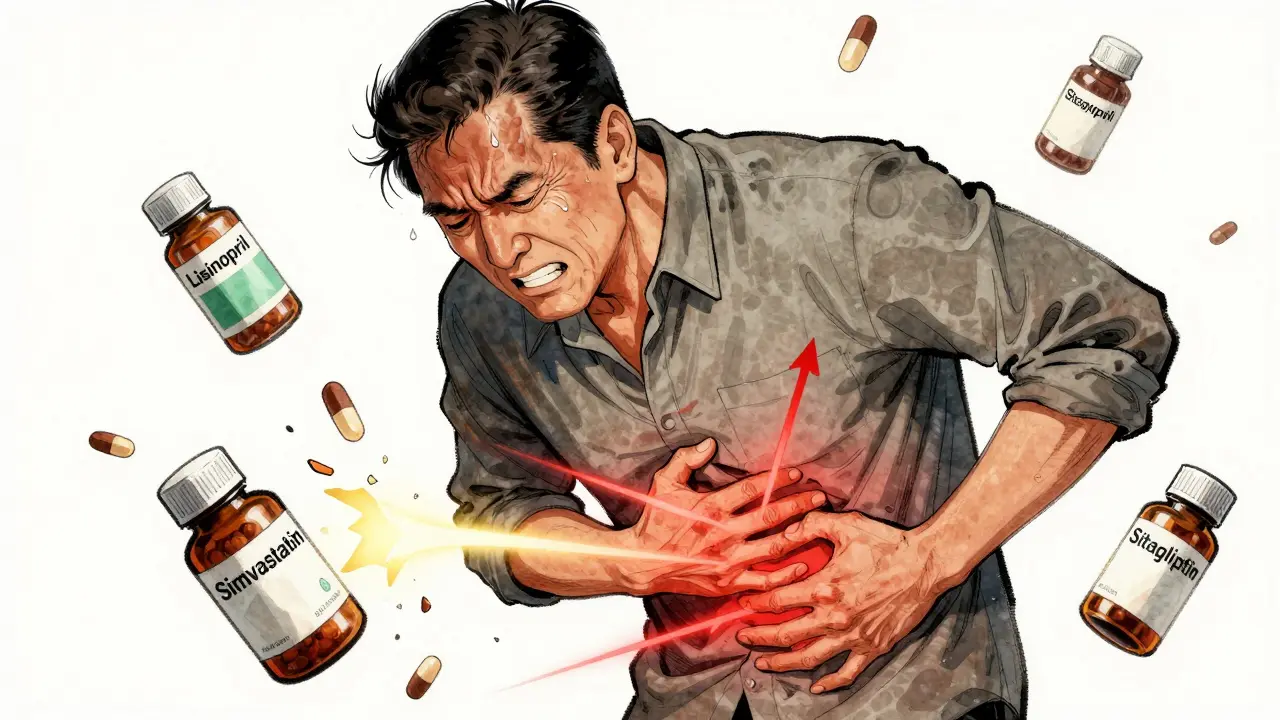
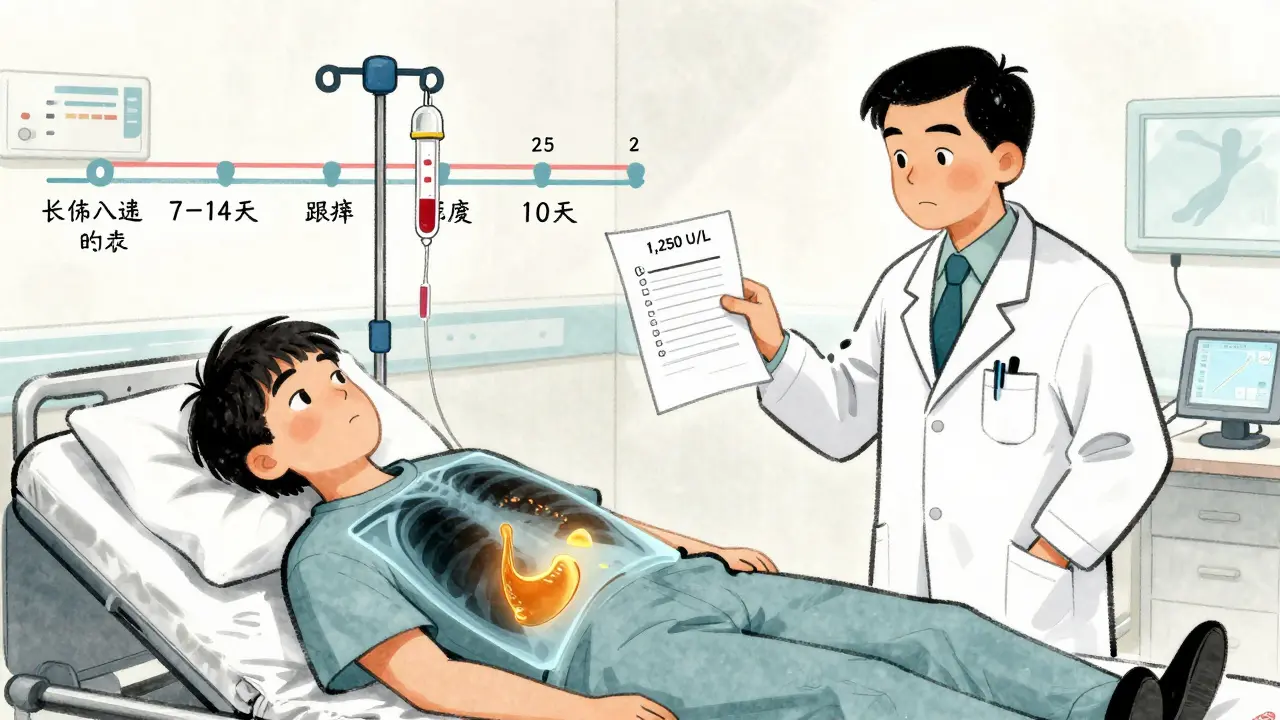
The first sign is usually intense, constant pain in the upper abdomen. It doesn’t come and go like gas or heartburn. It stays. It radiates straight through to your back. People describe it as a stabbing, burning, or crushing sensation - often worse after eating. Nausea and vomiting follow quickly. Fever, rapid heartbeat, and shallow breathing can show up within hours. In severe cases, your skin may turn yellow (jaundice), or you might feel dizzy from low blood pressure. Unlike gallstone pancreatitis, which hits suddenly and often after a fatty meal, drug-induced cases build slowly. Symptoms typically appear 7 to 14 days after starting the medication - sometimes even after months. That’s why many patients and doctors dismiss early pain as something else. One woman on lisinopril for high blood pressure waited six months before her pain became unbearable. Her lipase level - a key enzyme released by the pancreas - was 1,250 U/L. Normal is under 60. She spent five days in the hospital. After stopping the drug, she never had another episode.Which Medications Are Most Likely to Cause It?
Not all drugs carry the same risk. Eight classes have strong evidence linking them to severe pancreatitis:- ACE inhibitors - especially lisinopril and enalapril. Used for high blood pressure and heart failure.
- Diuretics - like furosemide (Lasix) and hydrochlorothiazide. Often prescribed for swelling or fluid retention.
- Antidiabetic drugs - including exenatide (Byetta) and sitagliptin (Januvia). These are common for type 2 diabetes.
- Statins - simvastatin and atorvastatin. Used to lower cholesterol. Even long-term users can develop it suddenly.
- Immunosuppressants - azathioprine and valproic acid. Used for autoimmune diseases like Crohn’s or lupus. Valproic acid causes necrotizing pancreatitis in 22% of cases.
- Antiretrovirals - especially didanosine, used in HIV treatment.
- Oral contraceptives - those containing ethinyl estradiol.
- SGLT2 inhibitors - canagliflozin, dapagliflozin, empagliflozin. Newer diabetes drugs with rising reports of pancreatitis since 2022.
It’s not about how long you’ve been on the drug. One patient on simvastatin for three years woke up with lipase levels over 2,800. Stopped the statin. Improved in 72 hours. Another, on azathioprine for Crohn’s, was told their pain was “just gastritis.” By the time a CT scan was done, 40% of their pancreas was dead. They spent three weeks in the ICU.
How Do Doctors Diagnose It?
There’s no single test that says “this drug caused it.” Diagnosis is a process of elimination. First, doctors check for gallstones, alcohol use, high triglycerides, or genetic causes. If those are ruled out, they look at timing.- Lipase levels must be at least three times above normal. Lipase is more accurate than amylase - the older marker - for diagnosing pancreatitis.
- Imaging - a CT scan or MRI shows swelling, fluid buildup, or dead tissue (necrosis). Severe cases have over 30% necrosis.
- Timing - symptoms must appear within 4 weeks of starting the drug and improve within 8 weeks after stopping it. That’s the standard for calling it “probable.”
Rechallenge - taking the drug again to see if symptoms return - is the only way to confirm it definitively. But doctors almost never do it. Why? Because it’s dangerous. If you had severe pancreatitis once, doing it again could kill you.
Why Is Drug-Induced Severe Pancreatitis More Dangerous?
It’s not just the inflammation. It’s what happens next. People on multiple medications often have other health problems. They may be older. Their kidneys or liver might already be stressed. That makes recovery harder.- Severe drug-induced pancreatitis has a 28% mortality rate within 30 days - higher than gallstone-related severe cases (18%).
- Up to 40% of reported cases might be coincidence, not cause. Statins are taken by millions. Some people get pancreatitis anyway. That’s why experts argue over whether every case is truly drug-related.
- But when it *is* drug-induced, the outcome is often better - if caught early. One study found 65-75% of mild-to-moderate cases fully recover after stopping the drug.
That’s the key difference. Alcohol or gallstone pancreatitis can lead to chronic damage. Drug-induced pancreatitis? Often, it’s a one-time event. Stop the drug, and your pancreas can heal.
How Is It Treated?
There’s no magic pill. Treatment is about support - keeping your body alive while the inflammation settles.- Stop the drug immediately. This is non-negotiable. Delaying beyond 24 hours increases complication risk by 37%.
- IV fluids. You’ll get 250-500 mL per hour in the first 24-48 hours. This keeps your pancreas perfused and prevents organ failure. Doctors monitor your hematocrit to keep it between 35% and 44%.
- Pain control. Acetaminophen is first-line. If that’s not enough, low-dose morphine (2-4 mg IV every 2-3 hours) is used. Avoid narcotics like meperidine - they can worsen spasms.
- Feeding. You’ll be NPO (nothing by mouth) at first. But if you can’t eat after 48 hours, a feeding tube is placed directly into the small intestine (nasojejunal). You need 20-25 calories per kg of body weight daily by day 3.
- Antibiotics. Only if there’s infected dead tissue. Meropenem is the go-to. Routine antibiotics do more harm than good.
Most people improve in 5-10 days. But if you develop necrosis, sepsis, or multi-organ failure, you’ll need ICU care - possibly surgery.
Who’s at Highest Risk?
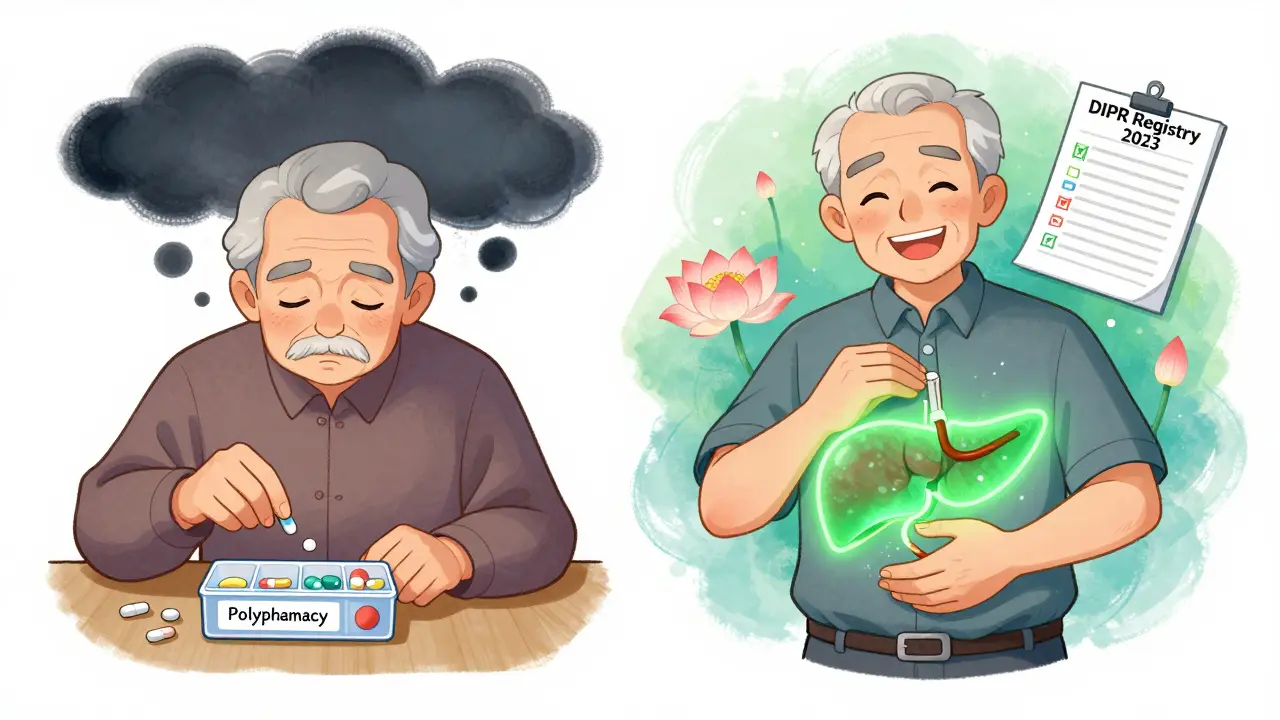
You’re more vulnerable if you:- Are over 60 - 68% of drug-induced cases happen in this group.
- Take five or more medications daily (polypharmacy).
- Have kidney or liver disease.
- Are on azathioprine or valproic acid - these carry the highest risk of necrosis.
- Have a genetic variant in the TPMT gene - this makes azathioprine far more toxic to the pancreas.
That’s why some hospitals now screen high-risk patients before prescribing these drugs. Genetic testing for TPMT isn’t routine yet - but it’s coming.
What Should You Do If You’re on a High-Risk Drug?
Don’t panic. Most people take these medications for years without issue. But if you’re on one of the high-risk drugs listed above, pay attention.- Know the warning signs - upper abdominal pain radiating to the back, nausea, fever.
- Don’t wait for it to get worse. If pain lasts more than 24 hours, ask your doctor for a lipase test.
- Keep a list of all your medications - including supplements - and share it with every doctor you see.
- If you’ve had pancreatitis before, tell your doctor before starting any new drug.
One patient on Reddit summed it up: “I thought it was just a bad stomach bug. I wish I’d pushed harder for blood tests.”
What’s Changing in 2026?
The FDA and EMA have added stronger warnings to 17 drug classes since 2022. SGLT2 inhibitors for diabetes now carry black box warnings. The NIH launched the Drug-Induced Pancreatitis Registry (DIPR) in January 2023 - already tracking over 300 cases. Hospitals are starting to use EHR alerts that flag when a patient on azathioprine or sitagliptin shows up with abdominal pain.The goal? Catch it before it’s severe. Because once the pancreas starts dying, it’s too late for prevention. But if you know the signs - and speak up - you can stop it before it starts.
Can any medication cause pancreatitis?
Not all medications cause pancreatitis, but over 100 drugs have been linked to it. Only eight classes have strong, consistent evidence of causing severe cases - including ACE inhibitors, diuretics, antidiabetic drugs like sitagliptin, statins, azathioprine, valproic acid, antiretrovirals, and SGLT2 inhibitors. Most cases occur with these specific drugs, especially in older adults on multiple medications.
How long after starting a drug does pancreatitis usually appear?
Symptoms typically appear between 7 and 14 days after starting the drug, but they can show up as early as 24 hours or as late as several months. This delay is why many cases are missed - patients and doctors often don’t connect the pain to a medication taken weeks ago.
Is drug-induced pancreatitis reversible?
Yes - if caught early. Stopping the offending drug is the most effective treatment. In mild to moderate cases, 65-75% of patients fully recover without long-term damage. The pancreas can heal itself if the trigger is removed quickly. But if severe necrosis or infection develops, permanent damage or surgery may be needed.
Can I get pancreatitis from statins after years of use?
Yes. Statins like simvastatin and atorvastatin are among the most common drugs linked to pancreatitis - even in people who’ve taken them for years. One documented case involved a 62-year-old on simvastatin for three years who suddenly developed lipase levels over 2,800. Stopping the drug led to full recovery in 72 hours. The risk is low, but it’s real.
Should I stop my medication if I suspect drug-induced pancreatitis?
Do not stop any medication on your own. If you suspect drug-induced pancreatitis - especially with severe abdominal pain, nausea, and fever - go to the ER immediately. Get a lipase test and imaging. Once diagnosed, your doctor will guide you on safely discontinuing the drug. Abruptly stopping some medications (like blood pressure or seizure drugs) can be dangerous. Always work with your provider.
Are there tests to predict if I’m at risk?
For azathioprine, a genetic test for TPMT enzyme variants can show if you’re at high risk. This test is recommended before starting the drug in some hospitals, especially for patients with autoimmune diseases. For other drugs, no reliable predictive test exists yet. But researchers are working on it - including a new causality assessment scale being validated by the NIH’s Drug-Induced Pancreatitis Registry.


Jodi Harding
January 16, 2026 AT 19:30This is why I stopped taking lisinopril. Didn't even know it could do this. My stomach hurt for weeks-I thought it was stress. Turned out my lipase was through the roof. Doc said 'stop it now' and I felt better in 48 hours. Scary how common drugs can quietly wreck you.
Stop blaming the patient. Blame the system that doesn't warn people.
They don't test for this. They don't screen. They just prescribe and pray.
Wake up.
They know.
They just don't care.
Zoe Brooks
January 18, 2026 AT 14:13Just had to tell my mom about this. She's been on hydrochlorothiazide for 12 years. She's 71. Last week she said her belly felt like someone was twisting a rope inside her. I made her go to urgent care. Lipase was 980. They didn't even think to ask about meds. She's off the diuretic now. No more pain. I'm so glad we caught it. This post saved her life. Seriously. Thank you.
Everyone needs to read this. Especially older folks on 5+ meds.
Knowledge is power, people. Don't wait until it's too late.
Kristin Dailey
January 19, 2026 AT 21:50Another reason to ditch Big Pharma. They profit off your pain. These drugs are designed to make you dependent. Pancreatitis? Just a side effect they bury in the fine print. They'd rather you die quietly than admit their pills are dangerous.
Get off the meds. Eat real food. Move. Stop trusting doctors who take pharma money.
They don't want you healthy. They want you medicated.
Jay Clarke
January 20, 2026 AT 17:40Oh wow. Another 'I'm a doctor but I'm also a Reddit guru' post. Let me guess-you're the guy who quit statins because you read a blog about 'inflammation'?
Here’s the truth: 99.9% of people on these drugs never get pancreatitis. You’re scaring people with cherry-picked horror stories.
My uncle had pancreatitis from alcohol. He lived. Your friend had it from lisinopril? Cool. But don’t turn this into a witch hunt.
Medicine isn’t magic. It’s math. Risk vs benefit. Statins save more lives than they harm. Period.
Stop weaponizing rare events to fuel fear.
Also, the FDA already updated the labels. You’re late to the party.
Eric Gebeke
January 20, 2026 AT 21:53I’ve been on sitagliptin for 5 years. Never had an issue. But now I’m terrified. What if I’m the one? What if I wake up with necrosis and no one believes me? What if my doctor thinks I’m just being dramatic?
I cried reading this. I’m not exaggerating. I’ve been in pain for days. I thought it was acid reflux. But now I’m terrified it’s the Januvia. I don’t know who to trust anymore.
Why does no one talk about this? Why is this not on every prescription bottle? Why do we have to Google until we almost die before we find out?
I feel so alone in this.
And now I’m scared to even take my blood pressure pill.
What if the next one kills me too?
Ryan Otto
January 21, 2026 AT 18:34Let us not overlook the geopolitical implications of this phenomenon. The U.S. pharmaceutical industry, in collusion with the FDA, has systematically suppressed data on drug-induced pancreatitis since the 1990s. The NIH registry? A performative gesture. The true incidence is 10x higher than reported. Why? Because the U.S. healthcare model depends on chronic illness. A healthy population is unprofitable.
Compare this to Germany, where pharmacovigilance is mandatory and adverse event reporting is legally binding. Here? You're lucky if your doctor knows what 'lipase' means.
It's not negligence. It's design.
And the SGLT2 inhibitors? Pure profit-driven experimentation on elderly diabetics. They didn't wait for long-term safety data. They rushed to market because of shareholder pressure.
Wake up. This is corporate warfare waged against your pancreas.
Robert Cassidy
January 22, 2026 AT 07:06So let me get this straight. You’re telling me that a guy on simvastatin for three years suddenly spikes his lipase to 2,800 and it’s because of the drug? And you’re not even considering he might’ve been drinking? Or had gallstones? Or ate a whole pizza the night before?
People are so quick to blame pills these days. It’s not the drug. It’s the weak, lazy, overmedicated culture.
I’ve been on 7 meds since I was 45. I’ve never had pancreatitis. Why? Because I don’t whine. I don’t Google symptoms. I trust my doctor.
You want to live longer? Stop being a hypochondriac. Stop Googling. Stop panicking.
And for God’s sake, stop sharing this nonsense. It’s giving real patients a bad name.
Andrew Qu
January 22, 2026 AT 11:53Hey everyone-first off, thank you for posting this. It’s exactly what people need to see.
As a pharmacist, I’ve seen this too many times. Patients come in with abdominal pain, and the first thing we check is alcohol, gallstones, triglycerides… and we rarely ask, ‘What new meds did you start?’
Here’s the thing: if you’re on one of these drugs and you get sudden, persistent upper belly pain that radiates to your back-especially if it’s worse after eating-don’t wait. Don’t pop Tums. Don’t assume it’s stress.
Go to urgent care. Ask for a lipase test. It’s cheap. It’s fast. It takes 10 minutes.
If your lipase is over 3x normal? That’s your red flag.
And if your doctor dismisses it? Get a second opinion. Or go to the ER. Better safe than dead.
This isn’t fear-mongering. It’s prevention.
And if you’re on azathioprine or valproic acid? Talk to your doctor about TPMT testing. It’s a simple blood test. Could save your life.
You’re not overreacting. You’re being smart.
And if you’ve already been through this? Please, share your story. Someone out there needs to hear it.