
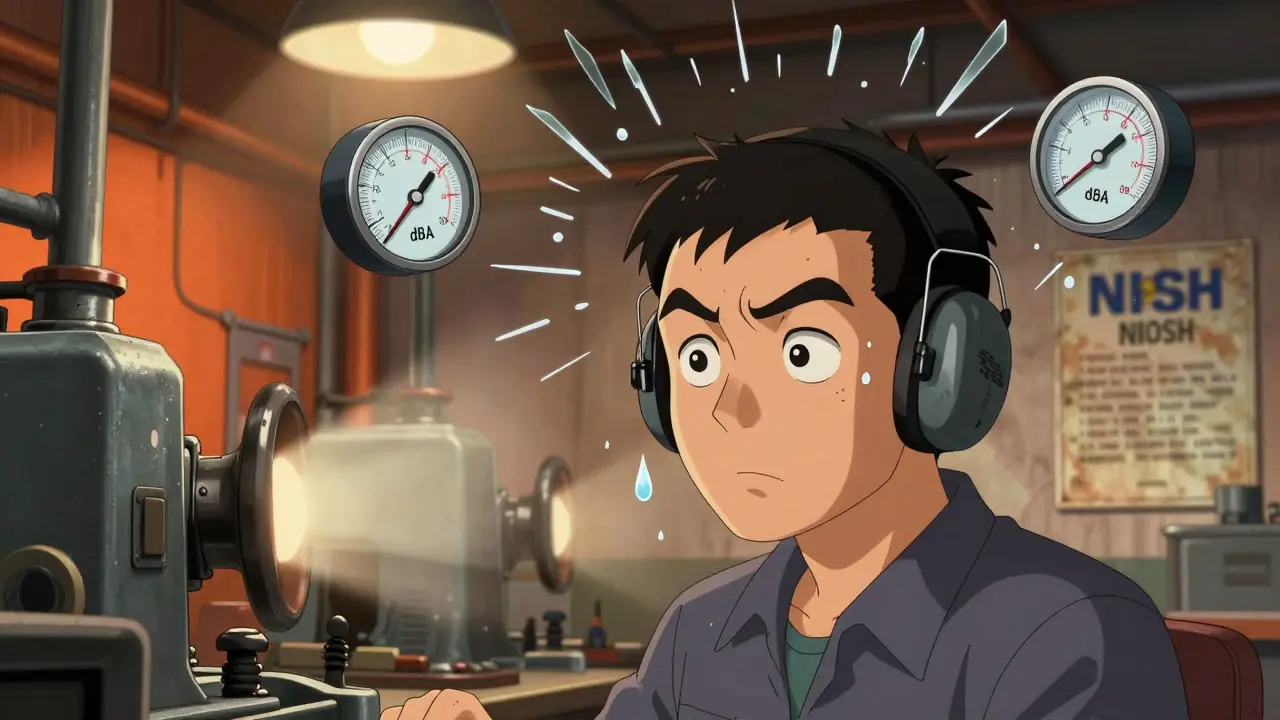
Every day, millions of people are exposed to sounds that can quietly damage their hearing-without them even realizing it. At work, the roar of machinery, the clatter of tools, or the hum of generators might seem normal. At concerts, the bass thumps so hard you feel it in your chest. But these aren’t just loud noises. They’re noise exposure limits that, if crossed, can lead to permanent hearing loss. And the scary part? It’s 100% preventable.
What Counts as Dangerous Noise?
Noise isn’t just about how loud something sounds. It’s about how long you’re exposed to it, and how much energy it carries. The science is clear: continuous exposure to 85 decibels (dBA) over eight hours can start to harm your hearing. That’s about the level of city traffic or a lawnmower. But here’s the catch: every 3-decibel increase doubles the noise energy. So at 88 dBA, your safe exposure drops to just four hours. At 91 dBA? Two hours. At 100 dBA-like a chainsaw or a motorcycle-you’ve got only 15 minutes before damage becomes likely. Different countries and agencies set different rules. In the U.S., OSHA says 90 dBA over eight hours is the legal limit. But NIOSH, the federal health agency that studies workplace safety, says 85 dBA is the real threshold for danger. That’s not a small difference. It’s a 50% reduction in safe noise energy. And NIOSH’s standard is backed by decades of research showing workers exposed to 85-90 dBA over 20 years develop measurable hearing loss. OSHA’s rule allows for a 25% risk of hearing damage over a career. NIOSH’s goal? Less than 8%.Why the Rules Vary-and What It Means for You
Why does OSHA allow 90 dBA while NIOSH says 85 is safer? It’s not about science. It’s about enforcement and economics. OSHA’s 5-decibel exchange rate means that when noise goes up by 5 dB, exposure time is halved. NIOSH uses a 3-dB rate, which is far more protective. For example, at 100 dBA, OSHA says you can work for 2.5 hours. NIOSH says 15 minutes. The difference? A 700% underestimation of risk, according to the American College of Occupational and Environmental Medicine. Australia follows NIOSH’s lead: 85 dBA over eight hours, with peak noise capped at 140 dBC. The European Union sets its upper limit at 87 dBA-even when you’re wearing ear protection. The UK uses 80 dBA as the action level and 85 dBA as the limit. China’s standards mirror NIOSH. California already uses NIOSH’s stricter rules in its workplace laws. And more states are following. The bottom line? Don’t assume your workplace is safe just because it’s legal. Legal doesn’t mean safe. If you’re working around loud machinery, ask: Is the noise level above 85 dBA? If yes, you’re at risk-even if your employer says it’s fine.How Noise Damages Your Ears
Your inner ear has tiny hair cells that turn sound waves into electrical signals your brain understands. These cells don’t grow back. Every time you’re exposed to loud noise, some of them die. At first, you might notice ringing in your ears after a concert-that’s a temporary threshold shift. It feels like your hearing is muffled. But if this keeps happening, the damage becomes permanent. You won’t hear high-pitched sounds anymore-birds singing, children’s voices, alarms, or even the word "th" in speech. The CDC says 24% of hearing loss in the U.S. is caused by noise exposure. That’s over 30 million people. And it’s not just factory workers. Musicians, construction crews, warehouse staff, airport ground crews, and even baristas near espresso machines are at risk. A 2022 survey found 63% of professional musicians have some degree of hearing loss. Orchestral musicians? They’re often exposed to 89-94 dBA during performances. That’s louder than a jackhammer.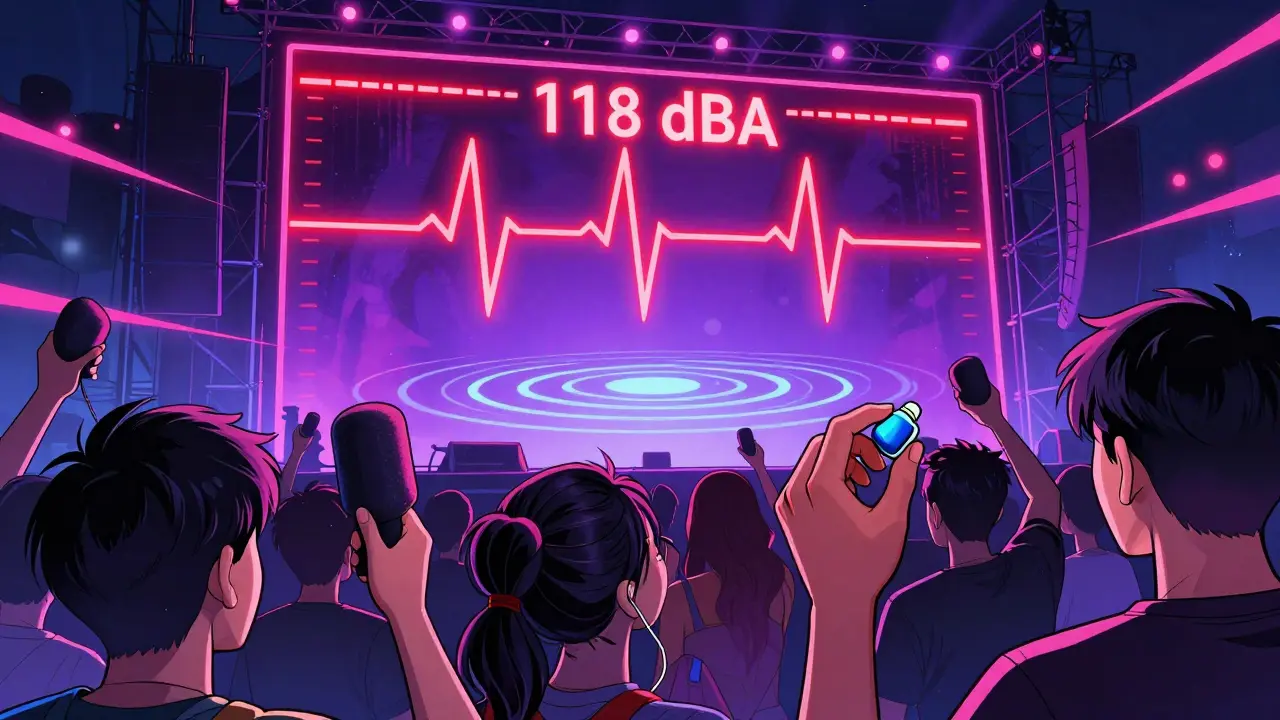
What Employers Should Do
If you’re an employer, you’re not just protecting your workers-you’re protecting your bottom line. The Bureau of Labor Statistics recorded 15,500 cases of hearing loss in 2022. Workers’ compensation claims for hearing damage cost over $1 billion a year in the U.S. The solution isn’t just handing out earplugs. It’s a hierarchy of controls:- Eliminate or substitute noisy equipment. Buy quieter tools. NIOSH’s "Buy Quiet" program lists decibel ratings for 150 common tools-like drills, saws, and compressors.
- Engineering controls-install sound barriers, enclosures, or vibration dampeners. A simple acoustic panel can cut noise by 10-15 dB.
- Administrative controls-rotate workers to limit time in noisy areas. Schedule loud tasks for low-traffic hours.
- PPE-earplugs and earmuffs. But only if they’re fitted right. NIOSH found that without hands-on training, only 40% of workers use hearing protection correctly. With training? That jumps to 85%.
Concerts, Clubs, and Personal Audio-The Hidden Threat
You don’t have to work in a factory to lose your hearing. A three-hour rock concert can hit 110-120 dBA. That’s louder than a jet engine taking off. The World Health Organization recommends limiting personal audio devices to 40 hours per week at 80 dBA. But most people crank their earbuds to 90-100 dBA-and listen for hours. Apple and Spotify now warn users when their volume exceeds safe levels. That’s progress. Many festivals now offer free earplugs. Lifehouse Festival reports 75% of attendees use them. Some venues have "quiet zones"-areas with ambient noise around 70-75 dBA where you can rest your ears. Real-time sound level displays are popping up at shows, letting people know when they’re in danger. The European Commission is even considering extending occupational noise rules to concert staff and venues where exposure exceeds 80 dBA.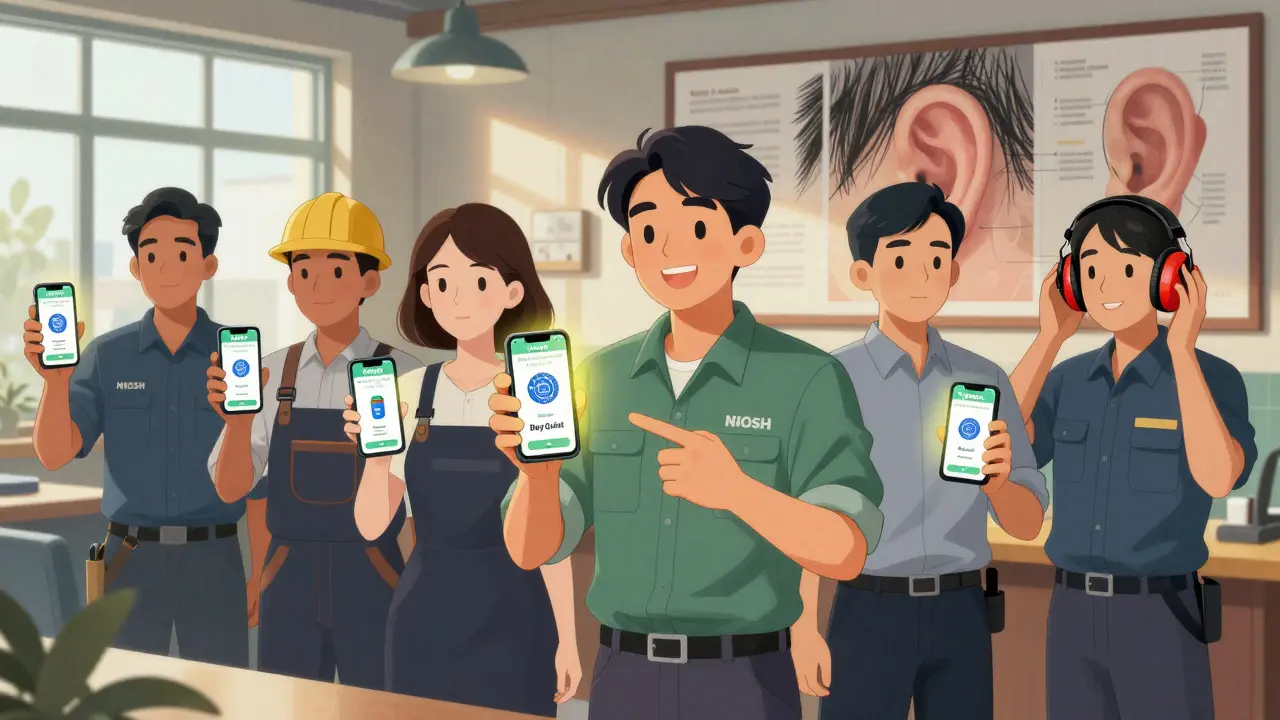
What You Can Do Right Now
You don’t need to wait for a law to protect your hearing. Here’s what works:- Use earplugs at concerts. Musician-grade filters (like Etymotic or Loop) reduce volume without distorting sound.
- Take listening breaks. Every hour, give your ears 10 minutes of quiet.
- Check your phone’s sound meter. Apps like NIOSH’s Sound Level Meter can measure noise around you with 92% accuracy.
- At work, ask for a noise assessment. If it’s over 85 dBA, you’re entitled to hearing protection and training.
- Get your hearing tested annually. Don’t wait until you can’t hear your grandkids.
The Future of Hearing Protection
By 2040, if every workplace and venue adopts the 85 dBA standard, the National Institute on Deafness and Other Communication Disorders estimates we could prevent 240,000 cases of hearing loss each year in the U.S. alone. That’s not just a number. That’s 240,000 people who can still hear their children laugh, their favorite songs, and the quiet moments that make life rich. The science is settled. The tools are available. The cost of inaction? Far higher than the cost of prevention.Is 85 decibels really that loud?
Yes. 85 dBA is about the sound of heavy city traffic or a lawnmower. It’s not ear-splitting, but if you’re exposed to it for eight hours straight-like a full workday-it can start damaging your hearing. The danger isn’t in how loud it sounds in the moment. It’s in the cumulative effect over years.
Can I just use foam earplugs at concerts?
You can, but they’re not ideal. Foam plugs muffle high frequencies, making music sound dull. Musician-grade filtered earplugs reduce volume evenly across all frequencies, so you still hear the music clearly-but safely. They cost $20-$50 and last years with care.
Does wearing hearing protection mean I’m safe?
Not if you’re not wearing them right. NIOSH found that 60% of workers use hearing protection incorrectly-either not inserting earplugs fully, wearing earmuffs over long hair, or removing them too often. Proper fit matters more than the brand. Get trained. Ask your employer for a fitting session.
My job is loud, but my employer doesn’t provide earplugs. What now?
Under OSHA rules, if noise exceeds 85 dBA over eight hours, your employer must provide hearing protection at no cost. If they don’t, you can file a complaint with OSHA anonymously. You have the right to a safe workplace-even if they haven’t made it easy.
Are smartphone sound meter apps accurate?
Yes. A 2023 study in JAMA Otolaryngology found that smartphone apps like NIOSH’s Sound Level Meter measure noise within 92% accuracy compared to professional meters. You can use them to check your commute, your gym, or your kid’s music player. It’s free, easy, and could save your hearing.
Can hearing loss from noise be reversed?
No. Once the hair cells in your inner ear are damaged, they don’t regenerate. That’s why prevention is everything. If you’re already noticing ringing or muffled hearing, see an audiologist. You may need hearing aids, but you can still stop further damage with better habits and protection.


Joe Bartlett
December 17, 2025 AT 09:26Been working on construction sites for 15 years. Heard this stuff before. Earplugs work fine. No need to overcomplicate it.
Naomi Lopez
December 19, 2025 AT 03:38It’s fascinating how regulatory bodies prioritize economic feasibility over neurophysiological integrity. OSHA’s 90 dBA threshold isn’t a scientific benchmark-it’s a corporate concession dressed in bureaucratic language. NIOSH’s 85 dBA standard reflects actual auditory pathology data, not political expediency.
Evelyn Vélez Mejía
December 20, 2025 AT 01:58What we’re really discussing here isn’t decibels-it’s the erosion of human sensitivity in the name of productivity. We’ve normalized sensory deprivation as a cost of modern labor. The hair cells in our cochleae aren’t replaceable parts; they’re the last fragile bridge between us and the symphony of existence. When we silence them, we don’t just lose sound-we lose intimacy. The laughter of a child, the whisper of wind through leaves, the tremolo of a violin-these aren’t luxuries. They’re the quiet poetry of being alive. And we’re trading them for overtime.
Victoria Rogers
December 20, 2025 AT 14:51lol osha is fine. niosh is just woke science. my uncle worked in a steel mill for 40 years and he still hears just fine. you guys are all hyping this up because you’re scared of loud noises. also why are we even talking about concerts? no one cares.
Jonathan Morris
December 20, 2025 AT 21:51Did you know the WHO and CDC are pushing this to justify mandatory earbud tracking via smartphone OS? They’re already embedding decibel logging in iOS and Android. This isn’t about hearing-it’s about behavioral control. Next they’ll tax you for listening to music above 80 dBA. Don’t be fooled. This is surveillance dressed as safety.
BETH VON KAUFFMANN
December 21, 2025 AT 18:19Per the ANSI S3.44 standard and ISO 1999:2013, the dose-response curve for NIHL is nonlinear and frequency-dependent, particularly in the 3–6 kHz range. Employers relying on OSHA’s 5-dB exchange rate are operating under a deprecated model that underestimates risk by 40–60% compared to the 3-dB criterion. Also, PPE effectiveness is contingent on attenuation real-world variability, which is rarely accounted for in compliance audits.
Virginia Seitz
December 23, 2025 AT 10:46My brother’s a drummer. He uses these cute little music earplugs 🎵❤️ and says he hears better than ever. Everyone should just try them! 😊
Peter Ronai
December 23, 2025 AT 16:42YOU’RE ALL MISSING THE POINT. This isn’t about noise. It’s about control. They want you to wear earplugs so you can’t hear your coworkers talking about the real issues-wages, union busting, corporate greed. They’re distracting you with decibels while they gut your benefits. Wake up. This is psychological warfare disguised as public health.
Steven Lavoie
December 24, 2025 AT 10:23I work in a warehouse where the forklifts hit 92 dBA. We got fitted earplugs last year after a safety training. Honestly, it changed everything. I don’t get headaches anymore, and I can actually hear my coworkers when they call out. It’s not about being told what to do-it’s about being given the tools to stay healthy. Simple stuff, really.
Michael Whitaker
December 24, 2025 AT 19:14While I acknowledge the empirical validity of NIOSH’s 85 dBA threshold, I must respectfully challenge the epistemological framing of this discourse. The imposition of auditory conservation protocols as a moral imperative inadvertently infantilizes the autonomous adult. One might argue that personal agency-rather than regulatory coercion-should govern exposure decisions. After all, is it not the essence of liberty to choose one’s own sensory risks?
Salome Perez
December 24, 2025 AT 21:42When I was a music therapist in a rehab center, I saw firsthand how hearing loss isolates people-not just from sound, but from connection. A grandmother who couldn’t hear her grandchild say ‘I love you’ stopped smiling. A veteran who lost his hearing after service stopped attending family gatherings. Hearing isn’t just about volume-it’s about belonging. That’s why these standards matter. Not because they’re strict. But because they’re kind.
Pawan Chaudhary
December 26, 2025 AT 20:11Great post! I work in a call center in India, and our AC units are noisy. I never thought about it until now. I ordered some earplugs online today. Small step, but I feel better already. 🙏
Chris Van Horn
December 27, 2025 AT 14:42Let me be clear: this is a psyop. The entire hearing loss narrative is manufactured by the hearing aid industry to sell $3000 devices. The real cause? Glyphosate in your water. The CDC? Controlled by Big Pharma. The 85 dBA standard? A lie. I’ve measured my chainsaw at 98 dBA and used no protection for 10 years. My hearing? Perfect. They don’t want you to know this.
amanda s
December 29, 2025 AT 06:38They’re coming for your earbuds next. First it’s concerts, then it’s your Spotify playlist, then it’s your phone’s volume slider. This is the slippery slope. You think they care about your hearing? They care about controlling you. I’m turning my music up to 110 dBA just to prove a point. #FreeHearing