
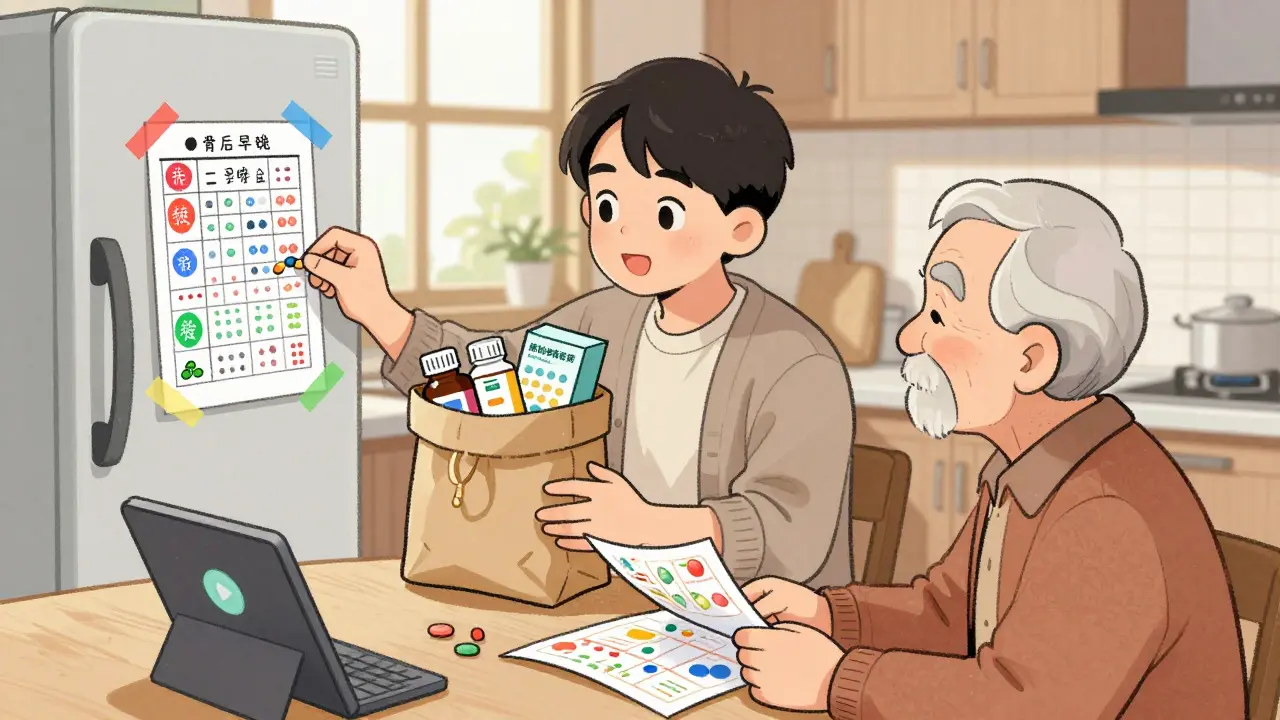
Managing medications for an aging loved one isn’t just about handing out pills. It’s about preventing hospital visits, avoiding deadly drug interactions, and keeping someone safe at home. If you’re caring for a parent, grandparent, or other relative taking five or more medications, you’re not alone-over 68% of adults 65 and older in the U.S. are on multiple prescriptions. And without a clear, updated list, mistakes happen. A single missed dose or wrong timing can lead to confusion, falls, or worse. The good news? A simple, well-organized medication list cuts those risks in half.
Why a Medication List Matters More Than You Think
Think of your loved one’s medication list like a car’s owner’s manual. If you don’t know what’s under the hood, you can’t fix it when something breaks. In senior care, that ‘something’ is often a dangerous drug interaction. The FDA reports that nearly 90% of medication errors in older adults happen because someone didn’t know what was being taken, when, or why. One study found that people taking five or more medications are 88% more likely to suffer an adverse reaction. And it’s not just prescriptions-over-the-counter painkillers, vitamins, and herbal supplements add up fast. A common mistake? Giving someone acetaminophen (Tylenol) on top of a prescription that already contains it. That’s how liver damage starts.
Doctors don’t always have the full picture. A 2023 study showed that 58% of caregivers noticed a mismatch between what the hospital said was prescribed and what was actually in the medicine cabinet. That’s why your list isn’t just helpful-it’s lifesaving. It’s the one document every pharmacist, ER doctor, and home nurse needs to see before they touch a pill bottle.
What to Include on the List (The 12-Point Checklist)
A good medication list isn’t just a scribble on a napkin. It needs detail. The FDA’s 2023 guide recommends these 12 essential elements for every medication:
- Brand name and generic name (e.g., Lisinopril 10mg - brand: Zestril)
- Dosage (e.g., 1 tablet, 5 mL, 10 mg)
- Frequency (e.g., once daily, twice a day, every 6 hours)
- Time of day (e.g., 8 AM, 8 PM, or with breakfast)
- Purpose (e.g., ‘for blood pressure,’ ‘for arthritis pain’)
- Special instructions (e.g., ‘take with food,’ ‘do not crush,’ ‘avoid alcohol’)
- Start date (when they began taking it)
- Prescribing doctor (name and phone number)
- Pharmacy name and number
- Expiration date
- Known side effects to watch for (e.g., dizziness, swelling, nausea)
- Allergies and reactions (e.g., ‘penicillin - rash and swelling’)
Don’t forget over-the-counter meds and supplements. Many caregivers leave these out because they think they’re ‘harmless.’ But fish oil can thin the blood. Calcium supplements interfere with thyroid meds. Turmeric can lower blood sugar too much. Treat every pill the same way.
Choose the Right Format: Paper, Digital, or Both
There’s no one-size-fits-all format. But here’s what works best in real life:
- Paper list (for emergencies): Keep a printed copy in a waterproof sleeve in the wallet, purse, or emergency kit. It doesn’t need Wi-Fi. Paramedics and ER staff look for this first. Use a clear plastic sleeve so you can write over it with a dry-erase marker.
- Digital list (for daily use): Apps like Medisafe, MyMeds, or even a simple Google Doc work. Digital tools can send reminders, track refills, and sync with pharmacies. If your loved one uses a smart speaker, you can even set up voice commands like, ‘Alexa, what meds did Mom take today?’
- The brown bag method: Once a month, gather every pill bottle, box, and supplement container into a brown paper bag. Bring it to every doctor’s visit. This is the most reliable way to catch duplicates, expired meds, or pills no one remembers taking. AARP found 89% of caregivers said this method prevented errors.
Most successful caregivers use both. Paper for emergencies. Digital for daily tracking. That way, if the power goes out or the phone dies, you’re covered.

How to Build the List (Step-by-Step)
Don’t try to do this in one sitting. Break it into manageable steps:
- Collect everything. Go through every drawer, cabinet, nightstand, and purse. Look in the fridge too-some insulin and liquid meds need refrigeration. Don’t miss the ‘as needed’ pills in the bathroom cabinet.
- Read every label. Write down exactly what’s printed: name, strength, instructions. If a label is faded, call the pharmacy. Don’t guess.
- Group by time of day. Make a chart: Morning, Afternoon, Evening, Bedtime. This helps avoid confusion. For example: ‘8 AM: Lisinopril, Aspirin - 12 PM: Glipizide - 8 PM: Gabapentin, Melatonin.’
- Mark what’s ‘as needed’. Create a separate section for PRN meds (like painkillers or anti-anxiety pills). Note the max daily dose and how often they can be taken.
- Make two copies. One stays at home in a visible spot (fridge or bedside table). One goes in your wallet or phone.
- Share it. Give a copy to every doctor, pharmacist, and home health aide. Ask them to initial the list when they update it.
It takes 2-3 hours the first time. After that, it’s 15 minutes a week.
Keep It Updated-Or It’s Useless
A list that’s three months old is worse than no list at all. Medications change all the time: a new prescription, a dose adjustment, a discontinued drug. The biggest danger? Hospital discharge. A 2023 study found that 78% of senior readmissions were linked to outdated medication lists after a hospital stay.
Set a rule: Update the list within 24 hours of any change. That means after a doctor’s visit, a pharmacy refill, or even a phone call from the nurse. Use a highlighter to mark changes. If you’re using a digital app, turn on notifications for refill reminders and doctor updates.
Also, review the list with a pharmacist every three months. They’re trained to spot duplicates, dangerous combinations, and unnecessary meds. The American Pharmacists Association says this reduces errors by 29%.
Common Pitfalls and How to Avoid Them
Here’s what trips up most caregivers-and how to fix it:
- ‘I don’t know why they’re taking this’: Call the pharmacy. Ask for the purpose of each drug. Write it down. If the doctor didn’t explain it, the pharmacist will.
- Too many doctors, too many lists: Designate one person as the ‘medication coordinator.’ That’s you. Collect all prescriptions and make sure everyone’s on the same page.
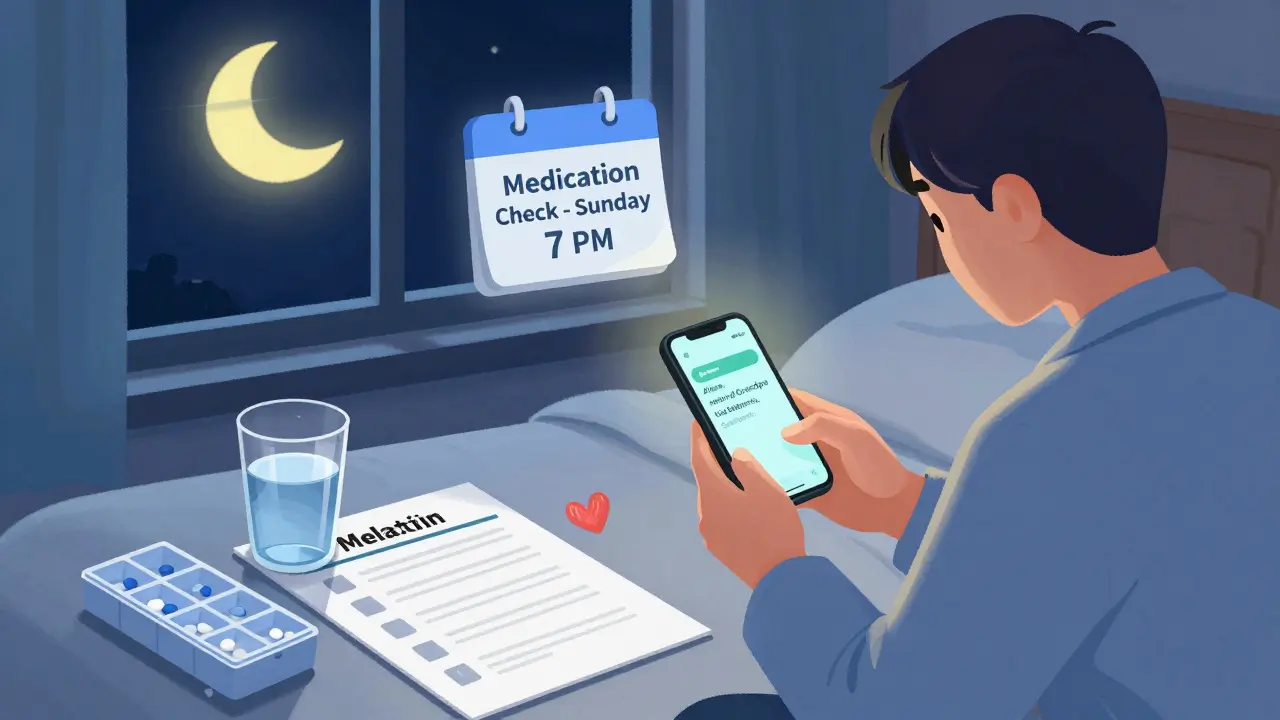
- ‘I forgot to update it’: Set a weekly reminder on your phone: ‘Sunday 7 PM - Medication Check.’
- ‘They won’t let me help’: Frame it as safety, not control. Say: ‘I just want to make sure you don’t get sick from a mix-up.’
- Color-coding helps: Use colored stickers or pens: red for heart meds, blue for pain, green for vitamins. One caregiver on Reddit said this cut her errors by 65%.
What to Do When Things Go Wrong
Even with the best system, mistakes happen. If you suspect a bad reaction-dizziness, confusion, rash, swelling-stop the suspected med and call the doctor immediately. Keep a log: date, time, symptom, what was taken. Take the brown bag to the ER. Don’t rely on memory.
If you’re overwhelmed, ask for help. Many pharmacies offer free medication therapy management (MTM) for Medicare patients on five or more drugs. CVS, Walgreens, and Rite Aid will review your list, flag risks, and even sync refills automatically. Some local Area Agencies on Aging offer free caregiver support with medication organization.
Final Thought: It’s Not About Perfection
You don’t need to be a nurse to keep a medication list. You just need to be consistent. A simple, accurate list done 80% of the time is better than a perfect one that’s never updated. The goal isn’t to control every pill-it’s to prevent a disaster. Every time you check a date, write down a new prescription, or bring the brown bag to an appointment, you’re not just organizing meds. You’re protecting someone’s life.
What if my loved one refuses to let me organize their meds?
Start by focusing on safety, not control. Say, ‘I’m worried about you having a bad reaction or mixing up pills. I just want to make sure we’re both on the same page so you stay healthy.’ Offer to help them make the list themselves-you’re just the scribe. Many seniors feel more in control when they’re the ones writing it down. Also, show them how easy it is to use a digital app with big buttons and voice reminders. Some apps even let them record their own voice saying, ‘Take this pill now.’
Should I include vitamins and supplements?
Yes. Always. Supplements aren’t regulated like prescription drugs, so they can interact badly. For example, vitamin K can make blood thinners like warfarin less effective. St. John’s Wort can cancel out antidepressants. Even common ones like calcium, magnesium, or iron can interfere with thyroid or antibiotic meds. Treat every pill, capsule, or gummy the same way you treat a prescription. Write down the name, dose, and why they’re taking it.
How often should I review the list with a pharmacist?
At least every three months if your loved one is on five or more medications. Many pharmacies offer free Medication Therapy Management (MTM) services for Medicare patients. The pharmacist will check for duplicates, dangerous combinations, and unnecessary drugs. They can also help simplify the schedule-like switching from four pills a day to two combined pills. This alone can reduce missed doses by 40%.
What’s the best way to store the medication list?
Keep the paper copy in a visible, easy-to-reach spot-like taped to the fridge or in a binder next to the medicine cabinet. Also, keep a laminated version in your wallet or purse. For digital copies, save it in your phone’s Notes app and share it with trusted family members. Set up cloud backup so it’s accessible from any device. If your loved one has a smart speaker, you can even ask, ‘Alexa, read my mom’s medication list.’
Can I use a template?
Yes. The FDA’s ‘My Medicines’ template is free and available online. It includes all 12 required fields and even has space for photos of pills. Many pharmacies also offer printable versions. You can also use a simple table in Google Docs or Excel. The key isn’t the template-it’s consistency. Use the same format every time so anyone who reads it knows where to look.
What if my loved one is in the hospital?
Bring the brown bag-every single time. Hand it to the nurse or pharmacist on admission. Ask them to compare it to what’s on their chart. After discharge, get a written list of all changes and update your list within 24 hours. If they don’t give you one, ask for it. You have the right to know what was added, changed, or stopped. Don’t assume they’ll call your doctor. Follow up yourself.





Bradly Draper
December 28, 2025 AT 01:06I’ve been doing this for my mom for two years now. Just writing down her pills on a piece of paper saved her from a bad mix-up last Christmas. She was taking two different things that both had acetaminophen. Didn’t know until I checked. Now we keep it taped to the fridge. Simple, but it works.
Don’t overthink it. Just start. Even one list is better than none.
Julius Hader
December 29, 2025 AT 01:34Wow. Finally someone who gets it. 😊
So many people think ‘oh, Grandpa’s fine, he’s been taking these forever.’ NOPE. That’s how people end up in the ER with liver failure because they didn’t realize their ‘natural’ supplement had the same active ingredient as their blood pressure med.
Stop being lazy. Write it down. It’s not hard. And if you don’t, you’re not a caregiver-you’re a liability.
Mimi Bos
December 29, 2025 AT 07:05so i tried the brown bag thing last month and wow. like… i found 3 bottles i forgot about. one was expired from 2020. another was for my aunt who passed. and one? i had no idea what it was. just a little blue pill. 😅
also i spelled ‘pharmacy’ wrong on my list. whoops. but the pharmacist laughed and said he’s seen worse. like someone wrote ‘for headaches’ on a blood thinner. oof.
Payton Daily
December 30, 2025 AT 12:30Let me tell you something profound: medication is not just chemistry-it’s control. Society tells us to trust doctors, but who really holds the power? The person who holds the list.
Think about it. Every pill is a decision. Every dose, a surrender to systems we don’t understand. Your grandma isn’t just taking pills-she’s participating in a silent contract with Big Pharma, the FDA, and the American healthcare machine.
By organizing her meds, you’re not just preventing errors-you’re reclaiming autonomy. You’re saying: ‘I see you. I remember you. I won’t let you be erased by bureaucracy.’
That’s not organizing. That’s resistance.
Kelsey Youmans
December 31, 2025 AT 15:16Thank you for this comprehensive and thoughtful guide. The emphasis on consistency over perfection is particularly valuable. I have found that maintaining a dual system-digital for convenience and printed for emergencies-has been instrumental in ensuring continuity of care.
Additionally, the inclusion of pharmacist involvement every three months is a best practice that should be more widely promoted. Pharmacists are underutilized resources in chronic care management.
Sydney Lee
December 31, 2025 AT 17:56Of course you’re supposed to write everything down. But let’s be honest-this is just Band-Aid medicine for a broken system.
Why should a 78-year-old widow with dementia have to remember to update a list every 24 hours? Why isn’t there a centralized, federally mandated electronic record that syncs across all pharmacies and providers? Why are we putting this burden on families?
I’m not blaming you. I’m blaming the system that lets this happen. And if you think a Google Doc fixes healthcare inequity, you’re deluding yourself.
But… yes. Do the list. Because if you don’t, someone might die. And that’s on all of us.
oluwarotimi w alaka
January 1, 2026 AT 11:45USA always make things complicated. In Nigeria, we just ask the man who sell the medicine, he tell us what to take and when. No list. No app. No paper.
But you people? You need 12 points, color codes, smart speakers, and brown bags. Maybe you overthink too much. Maybe your pills are not the problem. Maybe your mind is.
Also, I heard the FDA is controlled by pharma. So… your list? Maybe it’s part of the plan.
Debra Cagwin
January 2, 2026 AT 16:00This is such an important topic, and you’ve laid it out so clearly. I’ve coached dozens of caregivers through this process, and the biggest hurdle isn’t the list-it’s guilt. They feel like they’re taking away their loved one’s independence.
But here’s the truth: organizing meds isn’t about control. It’s about dignity. It’s about letting them stay safe in their own home.
Start small. One pill at a time. Celebrate the wins. You’re doing something beautiful-even if it feels boring. You’re holding someone’s life in your hands. And that matters.
Hakim Bachiri
January 3, 2026 AT 12:05Ugh. I just spent 45 mins organizing my dad’s meds. He’s on 17 things. 17! And the pharmacy gave him 3 new ones last week without telling us. AGAIN.
And now I have to go to his cardiologist tomorrow with a 3-page list, and I’m sure they’ll just say ‘oh, we’ll update the chart’-and then forget. AGAIN.
Why is this so hard?! Who designed this system?! Why does it take a PhD in pharmacology to keep your grandpa alive?!
Also, I used red for heart meds, blue for pain, green for vitamins… and then my cat knocked over the pen and smudged the whole thing. I cried. I’m not okay.
Celia McTighe
January 4, 2026 AT 13:40THIS. 🙌 I used to hate this stuff… until my grandma had a fall because she took her blood thinner twice by accident. We didn’t know she’d already taken it that morning.
Now we use Medisafe + a printed copy in her wallet. And I set a weekly reminder for us to sit together and check it. We even make tea while we do it. It’s become our thing.
It’s not perfect. But it’s ours. And that’s enough. 💙