
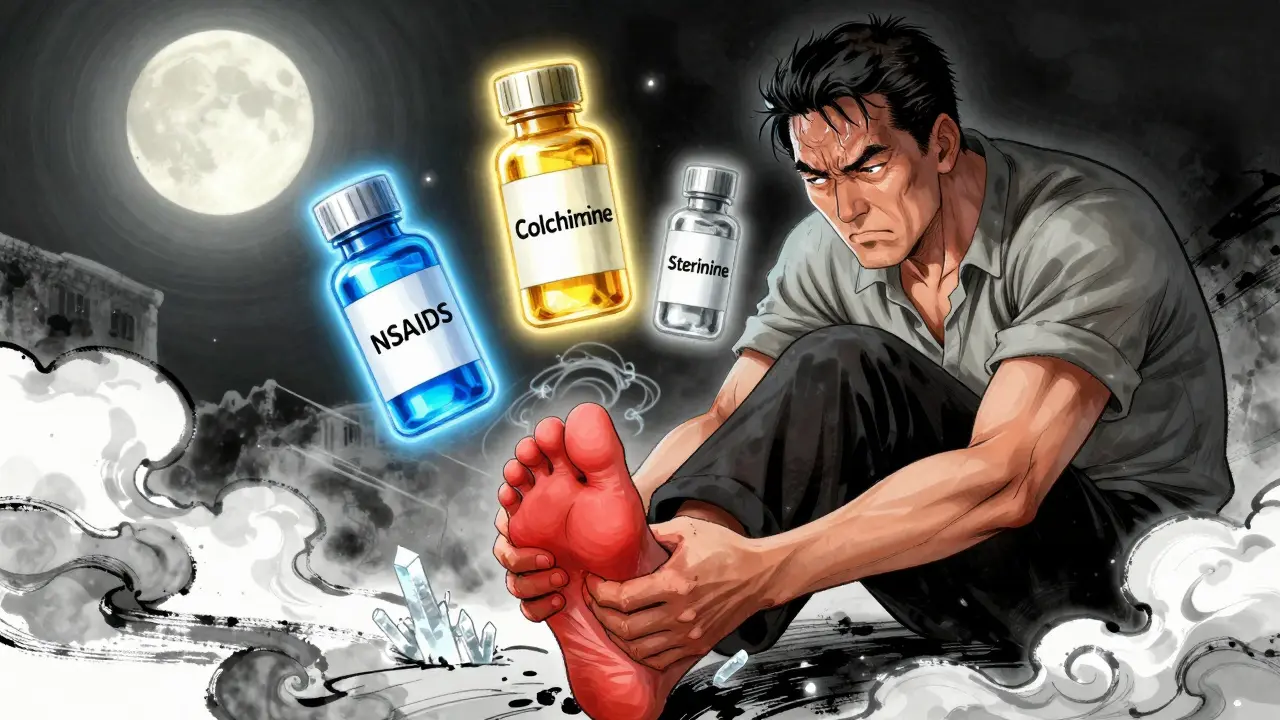
When a gout flare hits, it doesn’t ask for permission. One minute you’re fine, the next, your big toe feels like it’s been smashed with a hammer. The pain is sharp, the swelling intense, and the redness unmistakable. If you’ve been through this, you know waiting it out isn’t an option - you need relief, fast. And that’s where colchicine, NSAIDs, and steroids come in. These are the three main tools doctors reach for when a gout flare strikes. But which one’s right for you? It’s not about which is strongest. It’s about which fits your body, your health history, and your life.
What Happens During a Gout Flare?
Gout isn’t just bad joint pain. It’s inflammation caused by sharp uric acid crystals building up in your joints. When those crystals trigger your immune system, your body goes into overdrive - swelling, heat, and searing pain follow. These flares can come out of nowhere, often at night, and hit hardest in the big toe, ankle, or knee. Left untreated, they can last days or even weeks. But the good news? With the right treatment started early, most people feel better in 24 to 48 hours.
That’s why timing matters more than you think. Experts say if you start treatment within 24 hours of the first sign of pain, you’re far more likely to stop the flare in its tracks. Some doctors even joke: start it within 24 seconds. It’s not literal, but it drives home the point - don’t wait.
NSAIDs: The Go-To for Most People
NSAIDs - nonsteroidal anti-inflammatory drugs - are the most common first choice for gout flares. That’s because they work fast, they’re widely available, and they’re cheap. Common ones include naproxen, ibuprofen, and indomethacin. But here’s what most people don’t realize: you need to take them at full anti-inflammatory doses, not the low doses you’d use for a headache.
For example:
- Naproxen: 500 mg twice a day
- Ibuprofen: 800 mg three times a day
- Indomethacin: 50 mg three times a day
These aren’t casual doses. They’re targeted to shut down inflammation quickly. Only three NSAIDs - indomethacin, naproxen, and sulindac - have FDA approval specifically for gout, but in practice, any NSAID at the right dose can work.
But here’s the catch: NSAIDs aren’t safe for everyone. If you have kidney problems, high blood pressure, heart disease, or a history of stomach ulcers, these drugs can make things worse. Older adults are especially at risk. Studies show side effects like stomach bleeding, fluid retention, and worsening kidney function are common in this group. If you’re on blood thinners like warfarin, NSAIDs can be dangerous too.
Still, for healthy adults without major health issues, NSAIDs are reliable. One study found naproxen and low-dose colchicine gave similar pain relief over seven days - but naproxen caused fewer side effects. That makes it a solid pick if your body can handle it.
Colchicine: The Old Favorite With a New Dose
Colchicine has been used for gout for over a century. It’s not an anti-inflammatory like NSAIDs - it works by calming down the immune cells that go wild when uric acid crystals show up. That makes it unique.
But here’s the twist: the old way of taking it - 4.8 mg over six hours - was a nightmare. Diarrhea, vomiting, cramps - it was almost as bad as the gout itself. Now, we know better. Modern guidelines recommend a much lower dose: just 1.8 mg total, taken as 1.2 mg first, then 0.6 mg an hour later.
That low-dose approach works just as well for pain relief but cuts side effects by more than half. It’s a huge improvement. Still, colchicine has a narrow safety window. Too much, and you risk serious problems like muscle damage (rhabdomyolysis), nerve damage, or even life-threatening toxicity. That’s why it’s risky if you have kidney or liver problems. Many older patients can’t take it safely.
Another thing to watch: colchicine interacts with common meds like statins and some antibiotics. If you’re on multiple prescriptions, your pharmacist needs to check for clashes. It’s also not ideal if you’ve had a flare before - some people find it less effective the second time around.
Bottom line: colchicine is a good option if you’re young, healthy, and have no kidney issues. But if you’re over 65 or on other meds, it’s not always the safest bet.
Steroids: The Hidden Gem
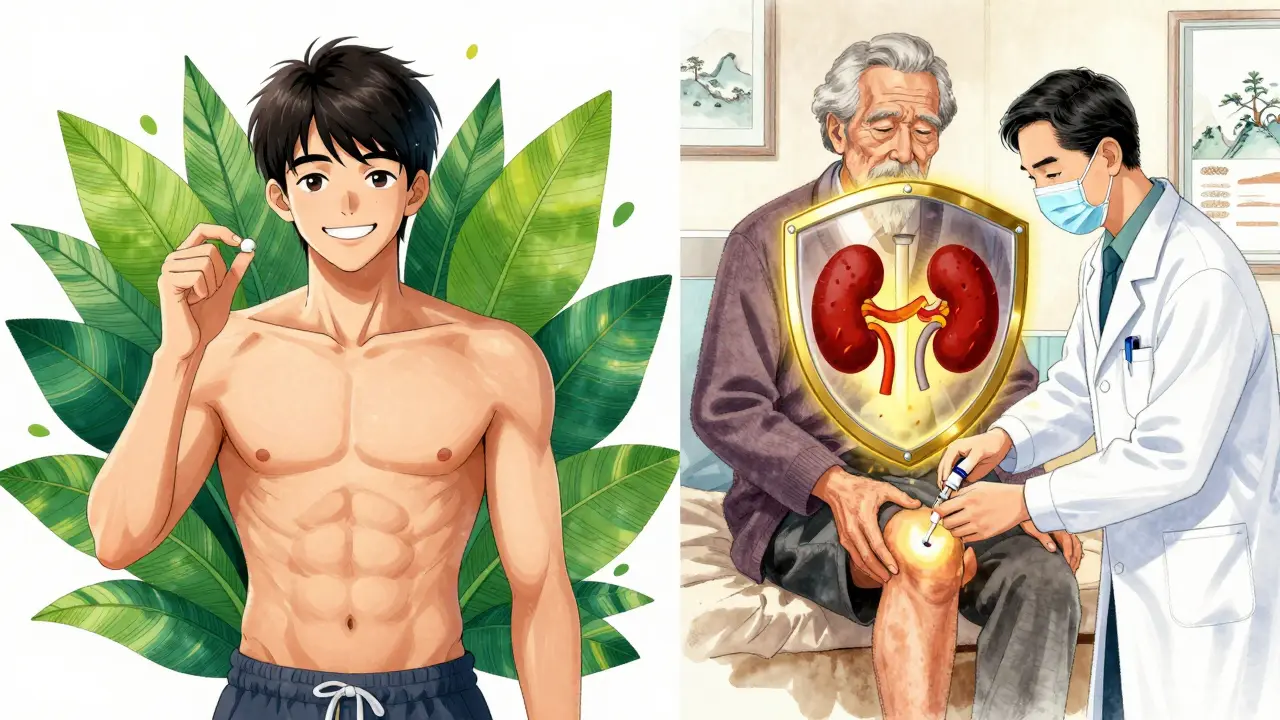
Here’s the thing most people don’t know: steroids might be the best choice for many gout patients - especially those with other health problems. Corticosteroids like prednisone work just as well as NSAIDs at reducing pain and swelling. In fact, a major review of six studies with over 800 patients found no real difference in pain relief between steroids and NSAIDs. But steroids had fewer serious side effects.
And they’re flexible. You can take them as pills, get a shot in your muscle, or - best of all - get a direct injection into the inflamed joint. If it’s just one joint (like your big toe), an injection can give you relief in hours with almost no side effects. No stomach upset. No kidney strain. No drug interactions.
Oral steroids usually start at 40-60 mg a day for a few days, then slowly taper down over 10-14 days. Tapering is critical. Stop too fast, and the flare can come back worse than before. That’s a common mistake.
Yes, steroids can raise blood sugar - so if you have diabetes, you’ll need to check your levels more often. But a short course (under two weeks) is generally safe for most diabetics if monitored. The real advantage? Steroids are safe for people who can’t take NSAIDs or colchicine. That includes people with kidney disease, heart failure, or stomach ulcers.
Doctors who treat gout regularly say steroids are underused. Why? Maybe because people think steroids are scary. But for acute gout? A short course is not the same as long-term steroid use. It’s a tool, not a trap.
Who Gets What? A Simple Guide
There’s no single best drug. The right choice depends on your health. Here’s how to think about it:
| Patient Profile | Best Option | Why |
|---|---|---|
| Healthy adult, no other conditions | NSAIDs (naproxen or ibuprofen) | Fast, effective, low cost |
| Over 65, kidney or heart issues | Oral or injected steroids | Lower risk of kidney or stomach damage |
| History of stomach ulcers or bleeding | Steroids or intra-articular injection | NSAIDs can cause dangerous bleeding |
| Taking statins or antibiotics | Steroids | Colchicine can interact dangerously |
| One joint affected (e.g., big toe) | Intra-articular steroid injection | Targeted relief, minimal side effects |
| Can’t take NSAIDs or steroids | Low-dose colchicine | Only option left - but monitor closely |
If you’re unsure, talk to your doctor. But don’t wait. Start treatment within 24 hours. The sooner you begin, the better the results.
What About Combining Treatments?
Some flares are stubborn. If one drug doesn’t cut it, doctors sometimes combine them. For example, a short course of steroids plus low-dose colchicine can be very effective. Or NSAIDs with colchicine - though that’s riskier because both can upset the stomach and kidneys.
Combination therapy isn’t for everyone. It’s usually reserved for severe flares or people who haven’t responded to single drugs. Your doctor will weigh the risks. But if you’ve had a flare that didn’t improve with one medicine, this might be your next step.
What Happens After the Flare?
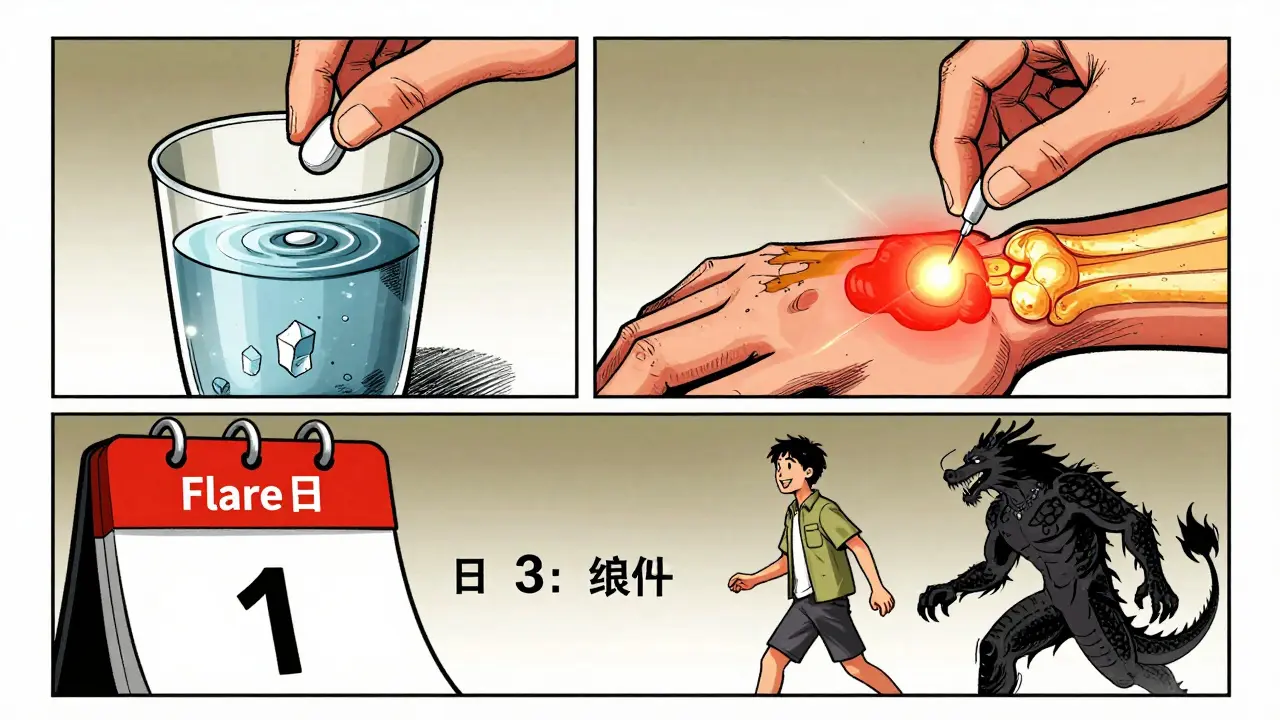
Relief from pain is just the beginning. Gout is a chronic condition. If you don’t address the root cause - high uric acid levels - you’ll have more flares. That’s why many doctors start urate-lowering therapy (like allopurinol) after the flare settles.
But here’s the catch: starting those meds during a flare can make it worse. So if you’re beginning urate-lowering treatment, you need to protect yourself. For at least three months (or six if you’ve had tophi), you’ll need to take a low-dose NSAID, colchicine, or steroid to prevent new flares. This isn’t optional. It’s part of the plan.
What You Can Do Today
Don’t wait for the next flare to figure this out. If you’ve had gout before:
- Know your risk factors - kidney disease? Heart problems? Diabetes?
- Ask your doctor which treatment is safest for YOU.
- Keep a small supply of your preferred medication on hand.
- Track your flares - what triggered them? What worked?
- Don’t ignore early signs. Redness, heat, tingling? Start treatment right away.
And if you’ve never had gout but have high uric acid? Talk to your doctor about prevention. Lifestyle changes - less alcohol, fewer sugary drinks, more water - can cut your risk by half.
Can I just take ibuprofen for gout like I do for a headache?
No. Regular headache doses of ibuprofen (200-400 mg) won’t stop a gout flare. You need the full anti-inflammatory dose: 800 mg three times a day. Even then, it’s not safe for everyone. If you have kidney disease, high blood pressure, or stomach issues, ibuprofen could make things worse. Always check with your doctor before using NSAIDs for gout.
Is colchicine dangerous?
Only if you take too much or if you have kidney or liver problems. The old high-dose regimens caused serious side effects. Today’s low-dose approach (1.8 mg total) is much safer and just as effective. But it still interacts with many common medications like statins and antibiotics. Always tell your doctor and pharmacist what else you’re taking.
Why do steroids work so well for gout?
Steroids don’t just reduce pain - they calm the immune system’s overreaction to uric acid crystals. That’s why they’re effective even when NSAIDs and colchicine don’t work. They’re especially useful for people who can’t take other drugs due to kidney, heart, or stomach issues. A short course (10-14 days) is safe and often more effective than other options for older adults.
Can I get a steroid shot for my gout flare?
Yes - and if it’s just one joint (like your big toe or knee), it’s often the best option. An injection delivers the drug exactly where it’s needed, with almost no side effects. It’s faster than pills and avoids stomach, kidney, or liver risks. Talk to your doctor or rheumatologist - many can give the shot right in the office.
What if my gout keeps coming back even after treatment?
Frequent flares mean your uric acid levels are still too high. Pain meds only treat the symptom. You need long-term treatment to lower uric acid - usually with allopurinol or febuxostat. But starting these drugs during a flare can make it worse. So once the flare settles, your doctor should start a low-dose urate-lowering drug - and keep you on a preventive medicine like colchicine or a low-dose steroid for 3-6 months to stop new flares.
Final Thought
Gout flares are brutal, but they’re not a life sentence. The right treatment, started early, can turn a week of agony into a day of relief. The key isn’t finding the “best” drug - it’s finding the right drug for you. Your age, your other health problems, your meds, your lifestyle - they all matter more than any guideline. Talk to your doctor. Ask questions. Don’t let fear of steroids or confusion about doses stop you from getting the care you need. Your joints will thank you.



Venkataramanan Viswanathan
January 5, 2026 AT 15:01While the article provides a thorough comparison, I must emphasize that in many South Asian populations, dietary triggers like refined carbohydrates and excessive red meat consumption are often overlooked in gout management. Colchicine remains widely used here due to cost and accessibility, but adherence to low-dose protocols is inconsistent. The real challenge lies in patient education-many still believe gout is a ‘punishment’ for overindulgence rather than a metabolic disorder. We need more culturally tailored counseling, not just pharmacological guidance.
Saylor Frye
January 7, 2026 AT 09:25NSAIDs are the lazy man’s solution. Steroids? Now that’s real medicine. The fact that you’re still debating ibuprofen doses in 2025 is almost embarrassing. If you’re not considering intra-articular corticosteroids as first-line for monoarticular flares, you’re practicing medicine like it’s 1998.
Kiran Plaha
January 7, 2026 AT 11:39I had gout last year and took colchicine. It made me sick. My doctor switched me to prednisone and I felt better in a day. I didn’t know steroid shots were an option until I asked. Maybe more people should ask.
Matt Beck
January 9, 2026 AT 02:14Think about it… uric acid crystals… they’re not just… *particles*… they’re *symbols*… of metabolic imbalance… of modern life… of our disconnect from ancestral diets… and when we inject steroids… we’re not just suppressing inflammation… we’re negotiating with the universe… 🌌⚡️🤯
Kelly Beck
January 10, 2026 AT 05:57Hey, I just want to say how amazing it is that you took the time to break this down so clearly! I’ve been living with gout for years and honestly, I didn’t realize how much the timing of treatment mattered-starting within 24 hours is such a game-changer! And the part about steroid injections? I had no idea they could be so targeted and safe. I’m going to talk to my rheumatologist this week and ask about it. You’ve given me so much hope and clarity, and I really appreciate that! 💪💖
Molly McLane
January 11, 2026 AT 01:44Thank you for including the table-it’s so helpful. I’ve been telling my patients for years that steroids are underused, but they’re scared because of the word ‘steroid.’ We need to reframe it: short-term, targeted, life-changing. Not ‘steroids for bodybuilders,’ but ‘medicine for your joint.’ Also, for those on statins? Colchicine is a minefield. Always check interactions. And if you’re over 65? Start with the injection. It’s easier, safer, and you’ll thank yourself later.
Katie Schoen
January 11, 2026 AT 08:17So let me get this straight… we’ve got a drug that’s been around since the 1800s, we lowered the dose to avoid turning people into human toilets, and now we’re acting like it’s a breakthrough? Meanwhile, steroids-cheap, effective, and literally injected into the joint-are treated like forbidden magic? 🤦♀️ Classic medical inertia. Also, ‘don’t wait’? Bro, I waited three days because I thought it was a sprain. Don’t be that person.
Beth Templeton
January 12, 2026 AT 06:37Colchicine doesn’t work after the second flare. Steroids do. NSAIDs kill kidneys. Injection wins. Done.
Tiffany Adjei - Opong
January 12, 2026 AT 08:26Actually, the article ignores the elephant in the room: most gout patients are on diuretics. Hydrochlorothiazide? That’s a gout trigger. And nobody talks about it. Also, ‘low-dose colchicine’? Sure, if you’re a 30-year-old gym bro. But if you’re on a statin, you’re playing Russian roulette with rhabdo. And don’t even get me started on how ‘steroids are safe’-have you seen the rebound flares when people stop prednisone cold turkey? This is oversimplified medicine for people who want easy answers. The real answer? Lose weight. Stop drinking. Stop eating shrimp. But nobody wants to hear that.