
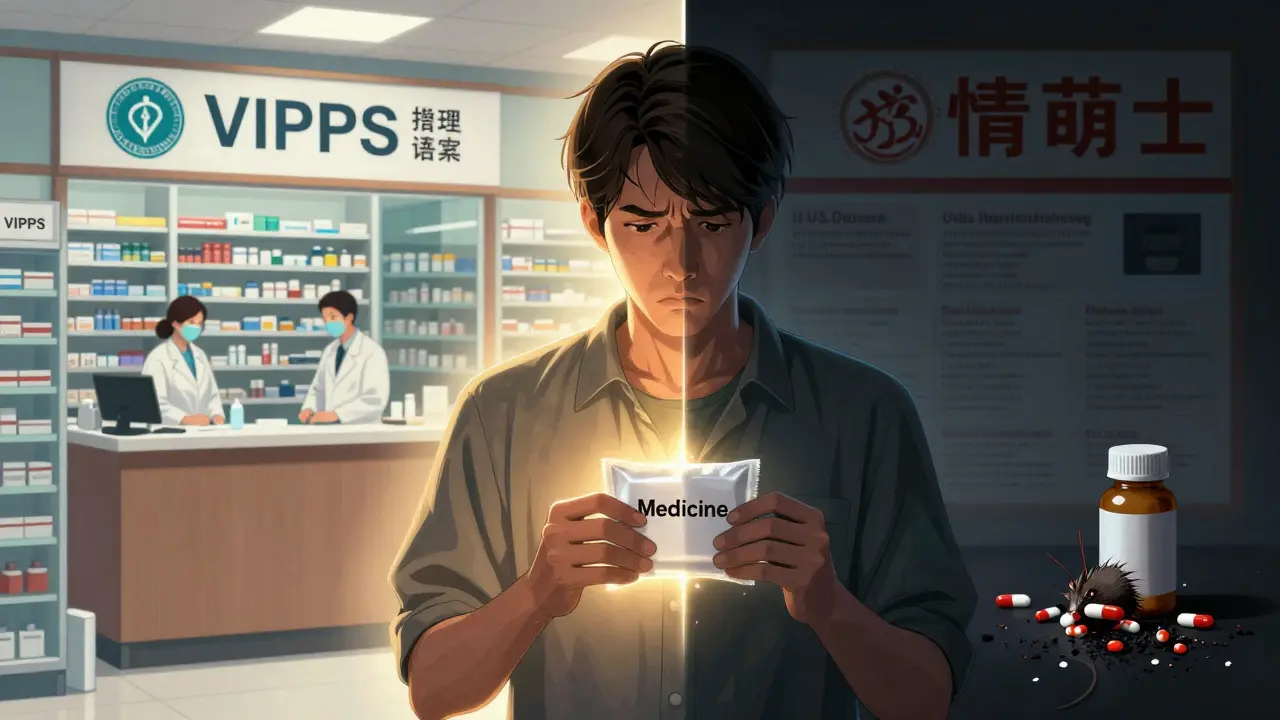
Buying medications online sounds simple: click, pay, and wait for pills to arrive at your door. For many, it’s a lifeline-especially if you live far from a pharmacy, have trouble getting time off work, or are paying out-of-pocket for expensive drugs. But here’s the hard truth: online pharmacies are a minefield. Out of every five sites you find, four could be selling you fake, expired, or dangerously mislabeled medicine. And the worst part? Most people have no idea how to tell the difference.
What Makes an Online Pharmacy Legitimate?
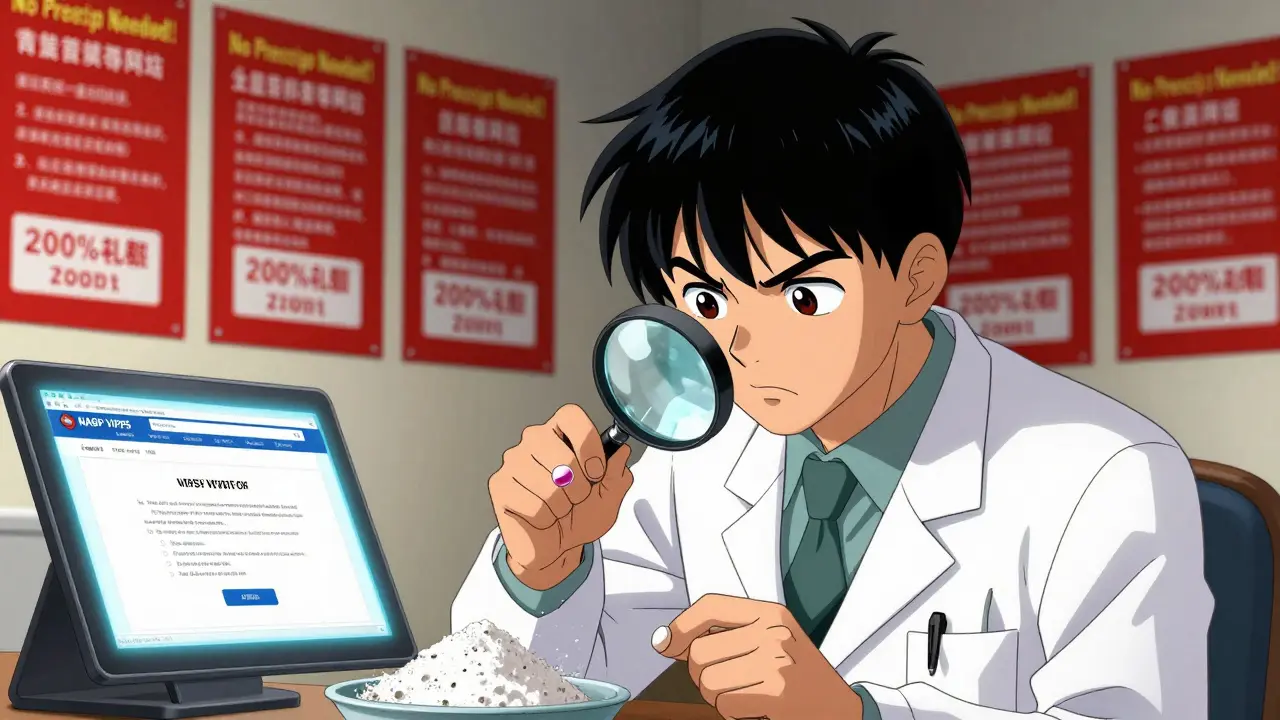
A real online pharmacy doesn’t just look professional-it follows strict rules. The gold standard is the VIPPS accreditation from the National Association of Boards of Pharmacy (NABP). This isn’t just a logo you can buy. To earn it, a pharmacy must meet 15 requirements: licensed in every state it ships to, staffed by licensed pharmacists available 24/7, and required to verify your prescription before shipping. They must also have a physical U.S. address you can visit, and they must protect your private health data under HIPAA.Legitimate pharmacies don’t offer Viagra or Xanax without a valid prescription. If a site says "no prescription needed," walk away. The FDA says 87% of illegal online pharmacies sell prescription drugs without one. That’s not convenience-it’s illegal and dangerous.
Also, look for a U.S. address and phone number. Legitimate pharmacies are registered with state boards. You can verify this yourself by visiting the NABP’s VIPPS website and searching for the pharmacy name. If it’s not listed, it’s not safe.
The Risks of Fake Online Pharmacies
In 2024, the FDA recorded 1,842 adverse events linked to illegal online pharmacies-up 27% from the year before. These aren’t minor side effects. People have ended up in the hospital because what they thought was insulin was actually sugar. Others took pills they believed were antidepressants, only to find out they contained unknown chemicals, sometimes at 200% of the labeled dose.One Reddit user, "MedSavvy2023," shared how they bought sertraline from an unverified site. Lab tests later showed their pills contained only 18% of the active ingredient. That’s not a placebo-it’s a medical emergency. For someone with depression, that kind of inconsistency can trigger relapse, panic attacks, or even suicidal thoughts.
Counterfeit generics are the biggest problem. Legitimate online pharmacies sell generics at 40-60% less than retail. Illegal ones promise 70-90% savings. Why? Because they’re not selling medication at all-they’re selling fillers. Talcum powder. Sawdust. Dyes. Even rat poison has been found in fake pills.
Temperature matters too. Many generics require stable temperatures during shipping. A 2025 study by the American Pharmacists Association found that 83% of shipments from unregulated pharmacies degraded after just 72 hours in heat. That means your blood pressure pill might be useless by the time it reaches you.
How to Verify a Pharmacy Before You Buy
You don’t need a pharmacy degree to stay safe. Just follow these four steps:- Check for a valid prescription requirement. If they don’t ask for one, it’s fake.
- Look for a U.S. physical address. Click on it. Does it lead to a real building? Google Maps it. Legitimate pharmacies have real locations.
- Confirm they have a licensed pharmacist on staff. Call the number. Ask to speak to one. If they hang up or can’t connect you, walk away.
- Verify VIPPS accreditation. Go to nabp.pharmacy and search for the pharmacy. If it’s not there, it’s not safe.
Massachusetts started enforcing stricter rules in January 2025. Now, even out-of-state pharmacies must get a special license to ship to residents there. That’s a sign of how seriously regulators are taking this. Missouri also passed new rules in December 2024 requiring pharmacies to notify customers about temperature risks and how they handle damaged shipments. These aren’t paperwork-they’re safety nets.
Cost vs. Risk: The Real Price of Cheap Medication
Yes, generics from legitimate online pharmacies can save you hundreds a year. A 30-day supply of metformin might cost $15 at a VIPPS-accredited site versus $75 at your local drugstore. But illegal sites? They lure you with prices like $2 for the same drug. That’s not a deal-it’s a trap.Here’s what you’re really paying for:
- Empty pill bottles (117 people reported this from MediSaveOnline.com)
- Mislabeled diabetes drugs causing dangerous low blood sugar (89 cases from QuickPharmaRX)
- Medication that doesn’t work because it’s degraded or fake
- Legal trouble if you’re caught with unapproved drugs
- Emergency room visits or long-term health damage
Trustpilot data shows legitimate pharmacies average 4.3 stars from over 127,000 reviews. Illegal ones? 1.8 stars. The most common complaints? "Received sugar pills." "No response after payment." "My condition got worse."
Tools to Stay Safe
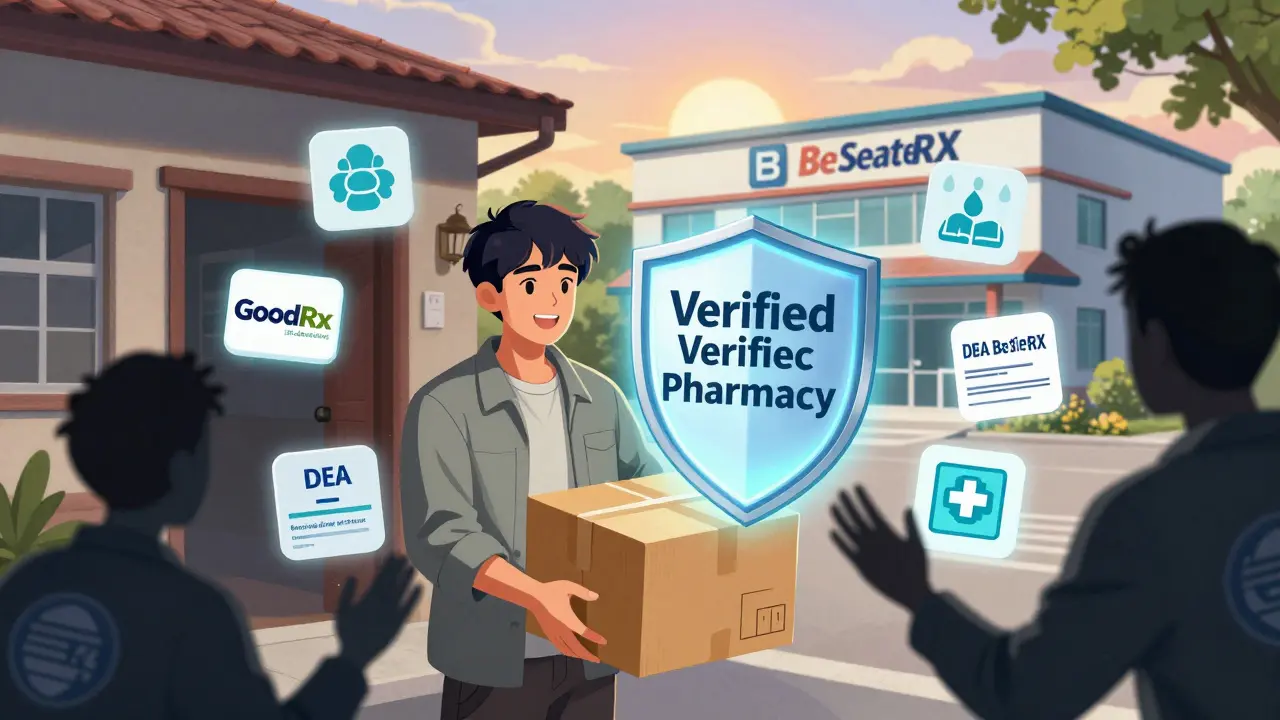
You don’t have to guess. Use these trusted tools:- GoodRx: Filters only VIPPS-accredited pharmacies. Used by 48 million Americans monthly.
- NABP VIPPS Search Tool: Free, official, and updated daily. Type in any pharmacy name and see if it’s verified.
- FDA BeSafeRX: The FDA’s campaign to help consumers spot red flags. Their website has a simple checklist.
- DEA Telemedicine Registration List: If a site connects you to a doctor online, that doctor’s platform must be DEA-registered. Check the DEA’s public list.
And if you spot a shady site? Report it. The FDA received over 14,800 reports in Q1 2025-up 33% from last year. Every report helps shut down a dangerous operation.
Who Uses Online Pharmacies-and Why?
About 38% of U.S. adults used an online pharmacy in the past year. The highest users? People with chronic conditions like diabetes, high blood pressure, or depression. Rural residents, too-52% of them rely on mail-order because the nearest pharmacy is 50 miles away.Legitimate online pharmacies aren’t going away. In fact, they’re growing. The U.S. market is now worth $74 billion, with 92% of sales coming from generics. Big players like CVS Caremark, Optum Rx, and Express Scripts dominate the verified side. They’re not trying to trick you-they’re trying to make access easier, safer, and cheaper.
But the unverified market? It’s a shadow economy. It makes up 82% of the market volume, but only 37% of the revenue. Why? Because people buy from them once, get sick, and never return. The real business is in repeat customers-and fake pharmacies don’t have them.
What’s Changing in 2025 and Beyond
New rules are rolling out fast. The DEA now requires all telemedicine platforms to register. That means if a site offers online consultations for prescriptions, the platform itself must be approved. By 2026, they’ll need to connect to state drug monitoring systems to prevent doctor shopping.By 2027, 78% of legitimate pharmacies plan to use blockchain to track every pill from manufacturer to your door. That’s not sci-fi-it’s the next step in safety. The FDA is also rolling out AI tools to scan websites and automatically flag illegal sellers. In 2025 alone, they issued warning letters to 217 sites.
But here’s the reality: technology won’t fix this alone. Consumers have to stay alert. No algorithm can replace your own vigilance.
Are all online pharmacies illegal?
No. Over 7,000 online pharmacies in the U.S. are verified as legitimate by the NABP’s VIPPS program. These include major players like CVS, Optum Rx, and HealthWarehouse.com. They follow federal and state laws, require prescriptions, employ licensed pharmacists, and ship safe, verified medications. The problem isn’t online pharmacies-it’s the thousands of unregulated sites pretending to be one.
Can I trust pharmacies based in other countries?
Generally, no. The FDA does not regulate foreign pharmacies. Even if a site claims to be "Canadian" or "British," it’s often a front. In 2024, 65% of all counterfeit drugs seized at U.S. borders came from overseas sources. The only exception is if the pharmacy is VIPPS-accredited and has a U.S. physical address, even if it sources drugs internationally. But even then, it’s rare. Stick to U.S.-based, verified pharmacies.
Why do fake pharmacies look so professional?
Because they copy real ones. They use similar logos, fake testimonials, and even cloned website layouts. Some even hire real-looking pharmacists to answer chatbots. But look deeper. Check their physical address on Google Maps. Call their phone number. Search their name on the NABP site. If it doesn’t show up in official records, it’s a scam. Legitimate pharmacies don’t need to hide-they’re proud of their credentials.
What should I do if I already bought from a fake pharmacy?
Stop taking the medication immediately. Contact your doctor or pharmacist to discuss potential risks. Report the site to the FDA through their online reporting system. If you experienced side effects, seek medical care. You can also file a complaint with the FTC. Don’t wait-harm can be delayed. A fake pill might not make you sick right away, but it could cause long-term damage or interact dangerously with other drugs you’re taking.
Is it safe to use online pharmacies for controlled substances like opioids or anxiety meds?
Only if the pharmacy is VIPPS-accredited and the prescribing telemedicine platform is DEA-registered. Since January 2025, all telemedicine providers must be registered with the DEA to prescribe controlled substances. Even then, you must have had at least one in-person evaluation with a doctor before the first online prescription. The Ryan Haight Act still applies. Never buy opioids, Xanax, or Adderall from a site that doesn’t ask for a prescription or doesn’t connect you to a registered provider.
Dean Jones
March 6, 2026 AT 00:52Let me tell you something real: the internet doesn’t care if you’re sick. It just wants your money. I’ve seen pharmacies that look like they’re run by NASA - sleek logos, professional fonts, testimonials that sound like they were written by Shakespeare. But when you dig? No physical address. No verified pharmacist on the line. Just a chatbot that says "We’re here for you!" while your blood pressure meds turn into chalk dust. I once ordered lisinopril from a site that claimed to be "Canadian." Turned out it was a server in Moldova. I took one pill. Felt like my head was going to explode. Went to the ER. They laughed. Said I got lucky. That’s not luck. That’s negligence dressed up as convenience.
And don’t even get me started on the "no prescription needed" crowd. You think you’re saving money? You’re buying a lottery ticket where the prize is a trip to the ICU. I’ve got a cousin on insulin. Bought from one of those sites. Her glucose spiked to 580. She was in a coma for three days. The pharmacy? Gone. No trace. No refund. Just a ghost site with a .xyz domain. This isn’t about trust. It’s about survival.
Legit pharmacies? They don’t need to scream. They don’t need to offer 90% off. They just show up. Verified. Licensed. Transparent. I check VIPPS every time. Even if it takes 5 minutes. Because that 5 minutes saved me from becoming a statistic. And yeah, I know - it’s a pain. But so is dying because you were too lazy to Google a pharmacy name.
Milad Jawabra
March 7, 2026 AT 11:48Bro. I just bought 30 days of metformin for $12 from a site I found on Reddit. VIPPS? Yeah, I checked. It’s legit. Saved me $200. My doctor doesn’t even care as long as the meds work. Stop scaring people. Not everyone’s dumb enough to click on some sketchy .ru site. There’s a difference between "too good to be true" and "actually good and cheap." And guess what? The system is rigged. Big pharma charges $80 for a pill that costs $2 to make. We’re not villains. We’re just trying not to go broke.
Also - I’m not taking my meds from a "pharmacist" I called on a landline. I’m taking them from a company that ships in sealed, climate-controlled packaging with a QR code that links to batch records. That’s not shady. That’s next-level. Stop using 2015 logic to judge 2025 solutions.
Richard Elric5111
March 9, 2026 AT 05:13It is not merely a question of regulatory compliance or even pharmacological integrity; rather, it is a metaphysical inquiry into the nature of trust in an era where the digital veil has rendered the tangible obsolete. When one procures pharmaceuticals through an unverified channel, one is not merely acquiring a substance - one is surrendering one’s corporeal autonomy to an algorithmic entity whose provenance is untraceable, whose accountability is non-existent, and whose moral framework is entirely absent. The body, in this context, becomes a site of negotiation between the commodification of health and the erosion of institutional safeguards. To purchase without verification is to consent to a silent, systemic violence - one that does not announce itself with sirens, but with the quiet hum of a server farm in a jurisdiction that does not recognize human life as sacred.
Thus, the question is not whether the pharmacy is accredited - but whether, in our collective acquiescence to convenience, we have ceased to value the sanctity of our own biology. The FDA’s statistics are not data points; they are elegies.
Betsy Silverman
March 11, 2026 AT 00:17I’m a nurse in rural Ohio. We have one pharmacy in town. It’s closed on Sundays. My patients? Diabetics. Heart patients. People who drive 45 minutes just to refill a script. Some of them can’t afford $75 for metformin. So they go online. And you know what? Most of them are smart. They check the NABP. They call the pharmacy. They ask for the pharmacist. They don’t just click "Buy Now."
But here’s the thing - nobody tells them how. The system doesn’t hand them a checklist. They Google "cheap diabetes meds" and hope. That’s why your post matters. Because you gave them a map. I’m printing this out for my clinic. Thank you.
Ivan Viktor
March 12, 2026 AT 01:45Zacharia Reda
March 13, 2026 AT 14:15People keep saying "just use GoodRx" like it’s magic. But here’s the kicker - GoodRx doesn’t verify pharmacies. It just lists prices. You still have to click through and check VIPPS yourself. I’ve seen listings where the pharmacy name is the same, but the URL is different. One’s legit. One’s a phishing site. GoodRx doesn’t tell you which. So yeah, the tool helps… but it’s not a shield. It’s a flashlight. And you’ve still gotta look.
Also - if you’re buying from a site that doesn’t ask for your prescription, you’re not saving money. You’re paying in risk. And trust me - ER bills don’t come with discounts.
Jeff Card
March 14, 2026 AT 17:08I used to think all online pharmacies were scams. Then my dad got sick. He couldn’t leave the house. We found a VIPPS site that shipped to our state. They called us to confirm the dose. They emailed us the batch number. They even sent a printed insert with a phone number for questions. It cost half what the local CVS charged.
He’s still here. Because we didn’t just trust. We verified.
That’s all. Just verify. It’s not hard.
Matt Alexander
March 16, 2026 AT 12:03Simple rules:
1. If they don’t ask for a script - run.
2. If the address is a PO Box or a warehouse - run.
3. If the phone number doesn’t connect to a person - run.
4. If the price is 80% off - it’s not a deal. It’s a trap.
That’s it. No PhD needed. Just don’t be dumb.
marjorie arsenault
March 17, 2026 AT 10:54I’m a single mom with three kids. I’m on insulin. I work two jobs. I don’t have time to call pharmacies or Google addresses. But I do have time to open GoodRx, pick the cheapest option that says "VIPPS Verified," and click "order."
That’s all I need. And if someone tells me I’m being reckless, I’ll remind them - I’m not risking my life. I’m fighting to keep it.
So thanks for giving me the tools. Not everyone gets a handbook. Some of us just need one clear signpost.
Deborah Dennis
March 18, 2026 AT 03:50Ethan Zeeb
March 20, 2026 AT 03:47I respect the intent here. But let’s be real - most people don’t care about VIPPS. They care about price and speed. And the fact is, the unregulated market exists because the regulated one is broken. If your insurance won’t cover your meds, and your pharmacy won’t ship, and your doctor won’t help… what are you supposed to do? Starve? Sit in a waiting room for 3 hours just to get a $15 pill?
I’m not saying buy from sketchy sites. I’m saying fix the system. Because until you do, people will keep risking their lives to survive.
Darren Torpey
March 21, 2026 AT 17:57Imagine your meds are a magic potion. The legit ones? They come in a crystal vial with a glowing seal, handwritten instructions, and a wizard who calls you to check in. The shady ones? They come in a greasy paper bag labeled "BENEFITS MAY INCLUDE: SURPRISE!"
I used to think I was a wizard. Turns out I was just a sucker. Now I only buy from sites that let me see the pharmacist’s LinkedIn. Yes, really. One did. She had a cat in the background. We talked about her cat. I trust her. That’s the real VIPPS - human connection.
Lebogang kekana
March 22, 2026 AT 21:02Let me tell you about my cousin in Johannesburg - he bought "antibiotics" from a site that looked like a WHO website. Turned out it was a mix of bleach and caffeine. He ended up in ICU. They pumped his stomach. He lost three months of work.
But here’s the twist - he didn’t report it. Why? Because he was ashamed. He thought he was dumb. He thought he was the only one.
So if you’re reading this - you’re not alone. And if you see a sketchy site? REPORT IT. Don’t wait. Don’t be quiet. One report can save a life. I’m not just talking. I’m shouting it from the rooftops.
Jessica Chaloux
March 23, 2026 AT 05:38I took fake Xanax once. I thought I was relaxing. Turns out I was having a panic attack because it was laced with fentanyl. I didn’t know. I thought I was just "having a bad day."
My mom found me crying in the shower. She called 911.
I’m alive because she knew to check the pharmacy. I didn’t.
So if you’re thinking of buying from a site that says "no questions asked" - please. Stop. Breathe. Google VIPPS. Call someone. I’m begging you. I don’t want anyone to feel what I felt.
Mariah Carle
March 23, 2026 AT 11:50Is it possible that the real villain isn’t the shady pharmacy… but the fact that we’ve been taught to see health as a commodity? We don’t ask "Is this safe?" We ask "Is this cheap?"
We treat our bodies like smartphones - upgrade when it’s on sale, ignore the warranty, hope the battery doesn’t explode.
Maybe the answer isn’t more verification tools.
Maybe it’s a cultural shift.
Maybe we need to stop treating medicine like Amazon Prime.
Just… a thought.